
For laboratory research use only. Not for human consumption.
Talk to our research support team: 512-998-2437
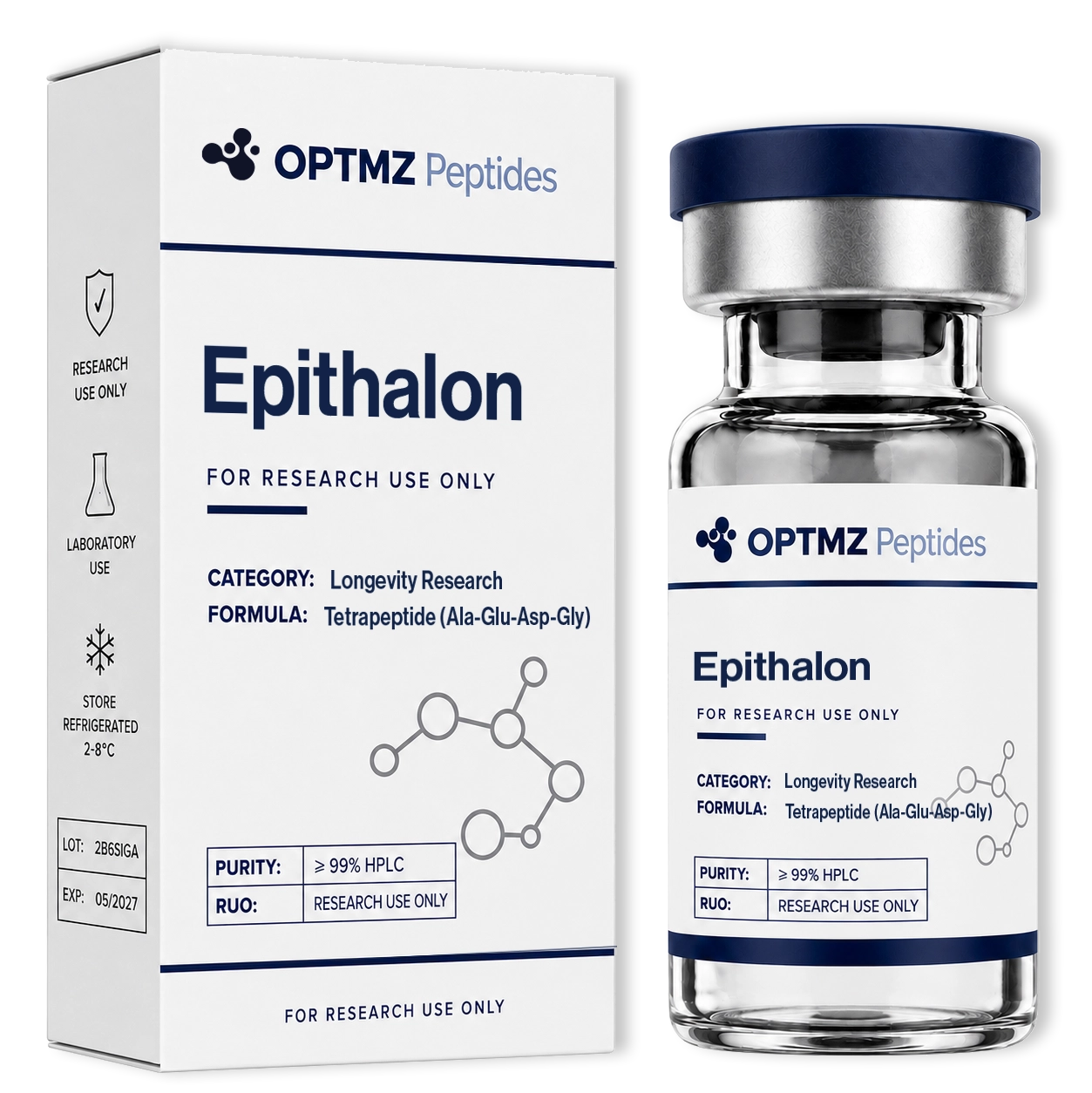

$43.00 – $1,200.00Price range: $43.00 through $1,200.00
These products are for laboratory research only and not intended for medical use. They are not FDA-approved to diagnose, treat, cure, or prevent any disease. By purchasing, you certify they will be used solely for research and not for human or animal consumption.
Research Use Only
All research peptides supplied by OPTMZ Peptides are intended strictly for laboratory research applications and are not designed for medical use. These materials are not approved by the U.S. Food and Drug Administration (FDA) to diagnose, treat, cure, or prevent any disease. By purchasing, the buyer confirms use strictly for scientific research purposes and not for human or animal consumption.
Product Overview
Epithalon (also known as Epitalon) is a synthetic tetrapeptide investigated in controlled laboratory environments for its potential interactions with cellular aging pathways, gene expression, telomere biology, oxidative processes, and cellular regulatory mechanisms.
Epithalon consists of four amino acids and has been studied primarily in experimental models related to cellular senescence, longevity biology, pineal-associated signaling, and mechanisms involved in cellular homeostasis.
The COA itself confirms CAS 64082-79-7, 99.1% chromatographic purity, 7.69 mg measured Epithalon content, and mass-spectral identity confirmation.
*I would resolve the content discrepancy before publishing this COA with a 10 mg product.
Each tested batch of Epithalon undergoes analytical evaluation to verify chromatographic purity, identity, peptide content, and analytical consistency. A corresponding Certificate of Analysis is maintained for the tested lot.
For the submitted OPTMZ Peptides sample, independent testing by Krause Analytical reported:
The laboratory specifies that reported values are on a per-vial basis unless otherwise noted.
The accompanying report also provides the underlying chromatogram on page 2 and mass-spectral data on page 3 for sample 205087.
Epithalon should be handled by qualified professionals in controlled laboratory environments. Appropriate storage conditions should be maintained to preserve peptide stability and structural integrity.
Avoid unnecessary exposure to heat, moisture, and repeated temperature fluctuations. Experimental preparation, storage, and handling should follow validated laboratory protocols appropriate to the intended research application.
Epithalon has been investigated in experimental and preclinical models involving cellular aging, molecular biology, and regulatory signaling.
Research areas include:
These areas describe experimental research contexts and do not establish therapeutic efficacy, longevity benefits, or safety in humans.
Epithalon continues to be investigated in experimental biology, particularly within studies involving cellular aging, telomere-associated mechanisms, gene regulation, oxidative processes, and short-peptide signaling.
Its compact four-amino-acid AEDG sequence makes Epithalon particularly relevant to laboratory investigations examining how short regulatory peptides interact with molecular and cellular pathways.
For laboratory research use only. Intended strictly for in vitro research applications.
All products currently listed on this site are for research purposes ONLY.
The COA itself confirms CAS 64082-79-7, 99.1% chromatographic purity, 7.69 mg measured Epithalon content, and mass-spectral identity confirmation.
*I would resolve the content discrepancy before publishing this COA with a 10 mg product.
Each tested batch of Epithalon undergoes analytical evaluation to verify chromatographic purity, identity, peptide content, and analytical consistency. A corresponding Certificate of Analysis is maintained for the tested lot.
For the submitted OPTMZ Peptides sample, independent testing by Krause Analytical reported:
The laboratory specifies that reported values are on a per-vial basis unless otherwise noted.
The accompanying report also provides the underlying chromatogram on page 2 and mass-spectral data on page 3 for sample 205087.
Epithalon should be handled by qualified professionals in controlled laboratory environments. Appropriate storage conditions should be maintained to preserve peptide stability and structural integrity.
Avoid unnecessary exposure to heat, moisture, and repeated temperature fluctuations. Experimental preparation, storage, and handling should follow validated laboratory protocols appropriate to the intended research application.
Epithalon has been investigated in experimental and preclinical models involving cellular aging, molecular biology, and regulatory signaling.
Research areas include:
These areas describe experimental research contexts and do not establish therapeutic efficacy, longevity benefits, or safety in humans.
Epithalon continues to be investigated in experimental biology, particularly within studies involving cellular aging, telomere-associated mechanisms, gene regulation, oxidative processes, and short-peptide signaling.
Its compact four-amino-acid AEDG sequence makes Epithalon particularly relevant to laboratory investigations examining how short regulatory peptides interact with molecular and cellular pathways.
For laboratory research use only. Intended strictly for in vitro research applications.
All products currently listed on this site are for research purposes ONLY.
| Pcs | Single Vial, Pack of 10 |
|---|---|
| Strength | 10mg, 50mg |

Restricted Access · Research Use Only
Independently lab tested, every batch
COAs published and searchable by batch number
Policy version 2026-05-14-ruo-v1.0
Reviews
There are no reviews yet.