By Dr. Leonard Haberman, Chief Science Officer, OPTMZ Peptides Published: March 2, 2026 | Last Updated: April 15, 2026
Lyophilized peptides are supplied as a dry, powdered solid specifically because the freeze-drying process extends compound stability and preserves structural integrity during storage and transit. Before a lyophilized peptide can be used in laboratory research, it must be reconstituted — dissolved into an appropriate solvent at a known concentration. Performing this step correctly determines the accuracy and reproducibility of downstream experiments.
This guide covers what lyophilization does to peptide compounds at the molecular level, how to select the right reconstitution solvent, step-by-step reconstitution procedure, concentration calculations, and storage protocols for reconstituted research peptide solutions.
What Is Lyophilization and Why Does It Matter for Research Peptides?
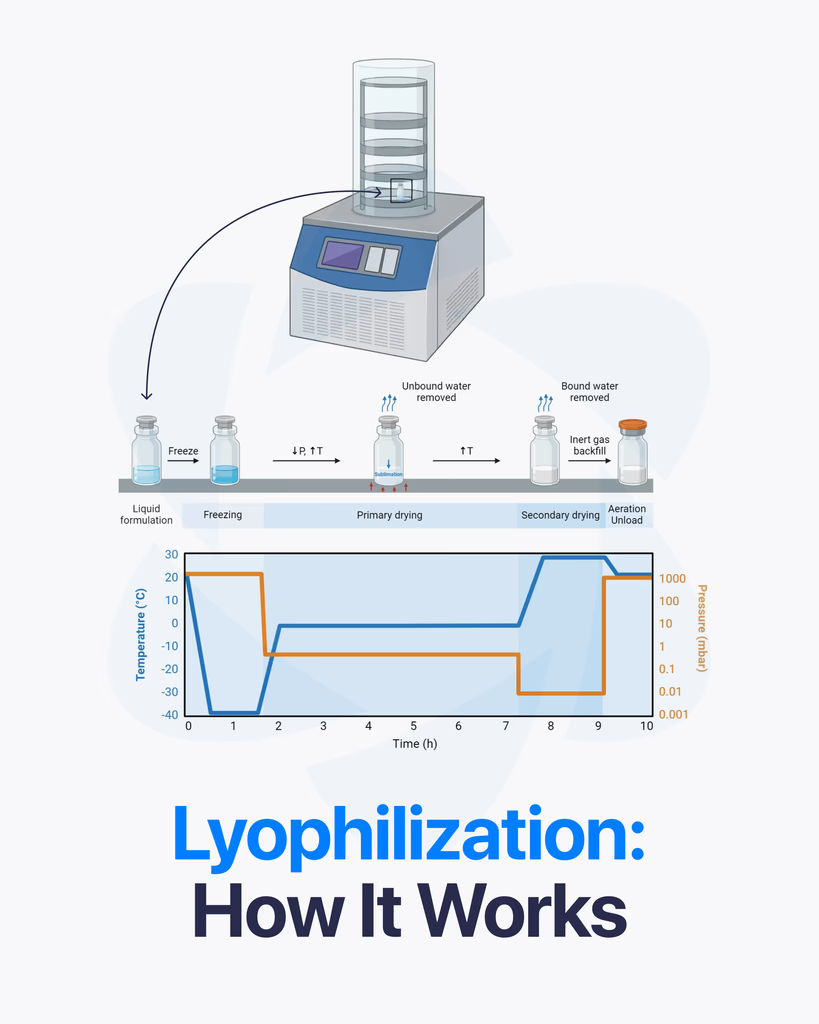
Lyophilization — commonly called freeze-drying — is a dehydration process that removes water from a compound through sublimation rather than evaporation. The sample is first frozen, then placed under vacuum, causing ice to transition directly from solid to vapor without passing through a liquid phase. The result is a stable, dry solid that retains the compound’s molecular structure.
For research peptides, lyophilization addresses a fundamental stability problem. Peptides in aqueous solution are susceptible to hydrolysis, oxidation, and microbial degradation. Studies examining peptide stability in solution have documented significant degradation within days to weeks under non-optimal conditions, depending on the compound’s sequence, pH sensitivity, and temperature exposure (Manning et al., 2010 — PubMed). The lyophilized state substantially reduces these degradation pathways by removing the water molecules that facilitate them.
The Three-Stage Lyophilization Process
Stage 1 — Freezing: The peptide solution is rapidly cooled, typically to between -40°C and -80°C. Rapid freezing creates smaller ice crystals, which reduces structural disruption to the peptide matrix. The rate of freezing affects the final product’s physical characteristics and reconstitution behavior.
Stage 2 — Primary Drying (Sublimation): The chamber pressure is reduced below the water vapor pressure, and shelf temperature is gradually raised. Frozen water sublimes directly to vapor and is collected by a condenser. This stage removes approximately 95% of the water content and accounts for the majority of the lyophilization cycle time.
Stage 3 — Secondary Drying (Desorption): The remaining bound water — water molecules adsorbed to the peptide surface rather than frozen — is removed by further increasing shelf temperature at low pressure. Residual moisture content in pharmaceutical-grade lyophilized compounds is typically targeted at 1–3% by weight. Residual moisture above this threshold accelerates degradation even in the dry state (Abdul-Fattah et al., 2007 — PubMed).
The final product is a lyophilized “cake” or powder in a sealed vial, suitable for long-term storage and shipment at ambient temperature when properly sealed.
Why the Research-Grade Supply Standard Matters Here
The purity and structural integrity of a lyophilized peptide is established at the time of manufacture and confirmed by batch testing — not at reconstitution. A compound that tests at 99.1% purity by HPLC in the lyophilized state will not improve during reconstitution. Conversely, a compound with an undisclosed impurity profile will carry those impurities into every experiment conducted with it.
This is why batch-specific certificate of analysis data is the only reliable baseline for research work. Each OPTMZ Peptides batch is independently verified by Krause Analytical (DEA-registered, ISO/IEC 17025-certified, Austin TX) using HPLC purity analysis, mass spectrometry identity confirmation, endotoxin testing, heavy metals screening by ICP-MS, microbial testing, pH stability, and visual inspection. Published COA results for all batches are searchable in the COA Vault.
Selecting the Right Reconstitution Solvent
Solvent selection is among the most consequential decisions in peptide reconstitution. The wrong solvent can cause aggregation, precipitation, or structural modification that renders the solution unusable.
Bacteriostatic Water (BAC Water) is the standard reconstitution solvent for most research peptides. It contains 0.9% benzyl alcohol, which inhibits microbial growth and extends the usability of the reconstituted solution — typically 28–30 days when stored at 2–8°C. BAC water is appropriate for the majority of peptides in the research catalog, including BPC-157, TB-500, CJC-1295, Ipamorelin, Sermorelin, and others. OPTMZ Peptides supplies Bacteriostatic Water 30mL for this purpose.
Acetic Acid 0.6% (dilute acetic acid) is used as a reconstitution solvent for peptides that exhibit poor solubility in neutral aqueous solutions. Growth hormone releasing peptides and some longer-chain peptides may require acetic acid as an initial solvent before dilution with BAC water.
Sterile Water is acceptable for immediate-use applications where the reconstituted solution will be used within 24 hours. It offers no antimicrobial protection and is not suitable for multi-day storage of reconstituted peptides.
DMSO (dimethyl sulfoxide) is appropriate for hydrophobic peptides that are insoluble in aqueous solutions. DMSO solutions are typically diluted with aqueous buffer immediately before use. Its use is more common in in-vitro cell culture applications than in other research contexts.
When solubility is uncertain, consult the compound’s published literature or the batch COA notes. Poorly soluble peptides may require sonication (brief low-power ultrasound treatment) or gentle heating to facilitate dissolution — never vortex vigorously, as mechanical shear can disrupt peptide conformation.
Step-by-Step Reconstitution Protocol
The following procedure applies to standard lyophilized peptide vials for laboratory research use.
Materials required:
Lyophilized peptide vial (labeled with batch number — confirm against COA Vault)
Reconstitution solvent (BAC Water or appropriate alternative)
Sterile 1mL or 3mL syringe
18–23 gauge needle for solvent withdrawal
Sterile swabs or alcohol wipes
Procedure:
Equilibrate the vial to room temperature before opening or injecting solvent. Temperature differentials between the cold vial and room-temperature solvent can cause pressure differentials and solution splatter. Allow 10–15 minutes at room temperature.
Swab the vial septum with a sterile alcohol wipe. Allow to air dry.
Calculate the volume of solvent required for the desired concentration (see Concentration Calculation section below) and draw this volume into the syringe.
Inject the solvent slowly against the inside wall of the vial — do not inject directly onto the lyophilized cake. Directing the stream along the glass wall allows gentle dissolution without disrupting the peptide matrix.
Gently swirl — do not vortex. Allow the vial to sit for 2–3 minutes, then swirl gently until the powder is fully dissolved. The solution should be clear and colorless (slight yellow tint is acceptable for some compounds). Cloudy or particulate solutions should not be used.
Visually inspect the solution before use. Any persistent particulate matter, unusual coloration, or precipitate warrants discarding the solution.
Label the vial with the reconstitution date and concentration. Store per the protocol below.
Concentration Calculation
Peptide vials are labeled with nominal weight (e.g., 5mg), but the effective research-grade net peptide content accounts for purity. To calculate actual peptide mass:
Net peptide content = Labeled weight × (Purity% / 100)
Example: A 5mg vial of BPC-157 with HPLC-verified purity of 99.3%: Net peptide content = 5mg × 0.993 = 4.965mg
To prepare a 1mg/mL working solution from this vial, add 4.965mL of BAC Water.
To prepare a 500mcg/mL solution, add 9.93mL of BAC Water.
This calculation matters for research accuracy. Vendors who do not publish HPLC purity data make this calculation impossible — researchers who assume 100% purity from an untested or impure compound will systematically miscalculate their working concentrations.
Storage of Reconstituted Peptide Solutions
Lyophilized (unreconstituted) peptides: Store at -20°C in a sealed, moisture-protected environment. Avoid repeated freeze-thaw cycles. Most lyophilized research peptides are stable for 12–24 months under these conditions when properly sealed.
Reconstituted peptide solutions: Store at 2–8°C (standard laboratory refrigerator). Use within 28–30 days when reconstituted with BAC Water. Avoid exposure to direct light; amber vials or foil wrapping is recommended for light-sensitive compounds. Do not freeze reconstituted solutions unless the specific compound’s stability data supports it — freezing reconstituted solutions can cause aggregation in some peptides.
Key handling rules:
Minimize the number of times the vial septum is punctured
Use a new sterile syringe for each withdrawal
Never return unused solution from a syringe to the vial
Purity Verification and the Reconstitution Process
The integrity of reconstitution work begins with verified source material. A well-executed reconstitution protocol applied to a low-purity, adulterated, or misidentified compound produces unreliable research data regardless of technique.
OPTMZ Peptides’ batch testing through Krause Analytical establishes purity by HPLC and compound identity by mass spectrometry before any batch enters inventory. Batches testing below 98.0% purity are rejected. The average purity of released batches is 98.5–99.9%. All COA data is publicly published — batch number, test date, purity percentage, and testing methodology are searchable in the COA Vault.
For researchers evaluating the quality of any research peptide supplier, the how we test methodology page documents OPTMZ’s full 7-method testing panel.
Dr. Leonard Haberman is Chief Science Officer at OPTMZ Peptides, overseeing analytical quality assurance and third-party laboratory partnerships with a focus on HPLC-based purity verification and research-grade peptide compound validation. All research peptides sold by OPTMZ Peptides are intended strictly for laboratory research use only.