For laboratory research use only. Not for human consumption.
Talk to our research support team: 512-998-2437
By Dr. Leonard Haberman, Chief Science Officer, OPTMZ Peptides | Published: March 2, 2026 | Last Updated: April 15, 2026
Lyophilized peptides are freeze-dried compounds in which water has been removed under vacuum to arrest the primary mechanisms of peptide degradation. The process depends on excipients — inactive supporting compounds that protect the active peptide during freeze-drying, maintain structural integrity during storage, and enable accurate reconstitution in the laboratory. Understanding both elements is foundational to evaluating research peptide quality.
Lyophilization — commonly called freeze-drying — is a dehydration process in which a peptide solution is frozen under controlled conditions, then placed under vacuum so that water sublimes directly from the solid phase without passing through liquid. The result is a dry, porous powder that retains the peptide’s molecular structure in a stable, storable form.
The process was developed as a preservation method for biologics and has become the standard production form for research-grade peptides because it addresses the two primary degradation mechanisms that affect aqueous solutions: hydrolysis and oxidation. Water activity is the dominant driver of chemical degradation in peptide preparations — lyophilization reduces it to near zero, substantially extending compound integrity under appropriate storage conditions (Chang BS, Hershenson S. Pharm Biotechnol. 2002 [PMID: 11849803]).
The white or off-white powder observed in research peptide vials is the lyophilized peptide cake. Its physical characteristics — density, texture, and color — reflect both the amino acid composition of the peptide and the excipient profile of the formulation. A well-lyophilized cake reconstitutes readily in aqueous solvents and presents as a uniform solution with no visible particulate.
A collapsed or discolored cake — one that has absorbed moisture, experienced temperature excursions, or been freeze-thaw cycled repeatedly — is a visual indicator of compromised integrity. Researchers examining vials before use should treat any significant deviation from a white, intact cake as grounds for verifying batch data against the published COA before proceeding.
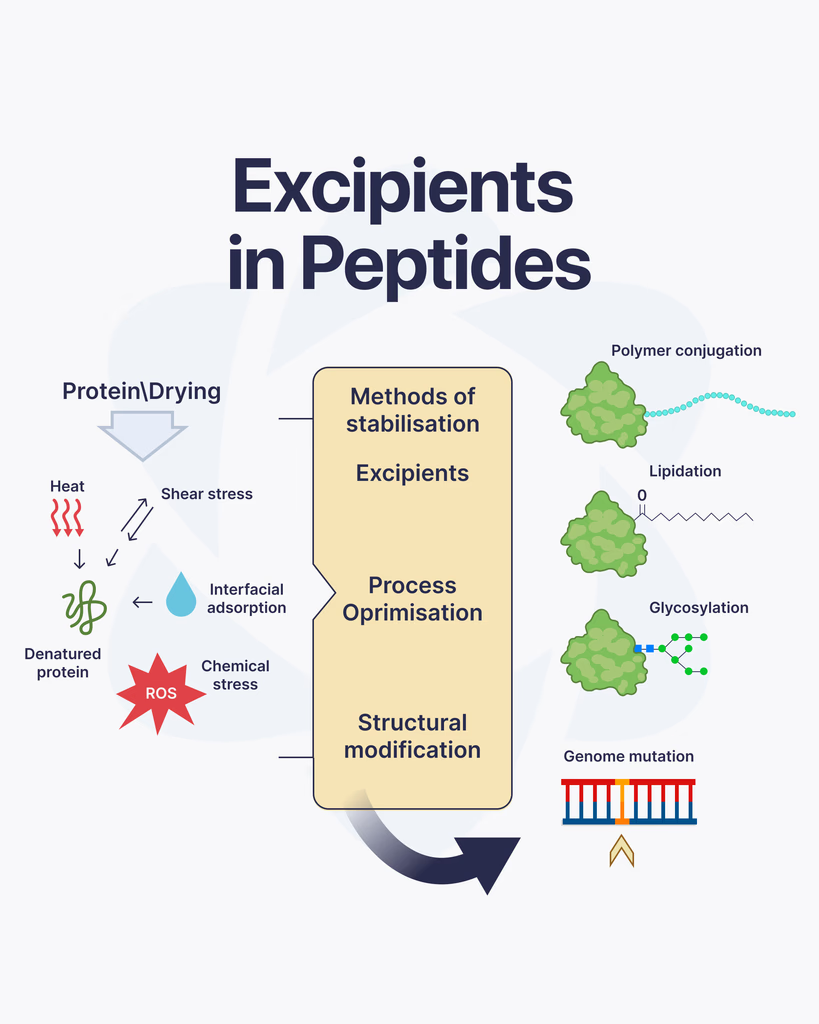
Excipients are pharmacologically inactive substances included alongside the active peptide to support stability, handling, and reconstitution. They do not contribute to the peptide’s research activity, but they directly determine whether the compound maintains its integrity from production through the researcher’s bench.
In lyophilized peptide formulations, excipients perform four distinct functions.
Bulking agents give the lyophilized cake physical volume and structural integrity. Without them, peptides present at low concentration may produce an amorphous, collapsed solid that is difficult to handle, slow to reconstitute, and vulnerable to static charge during transfer. Mannitol is the most widely used bulking agent in research-grade peptide lyophilization — it crystallizes during the freezing step, providing the scaffold that gives the final cake its characteristic appearance and handling properties.
Lyoprotectants interact with the peptide at the molecular level during the freeze-drying process. As water is removed, these compounds substitute for the hydrogen-bonding role of water molecules at polar residues on the peptide surface, preserving the native molecular conformation through the drying cycle. Carpenter and Crowe demonstrated that disaccharides — trehalose and sucrose in particular — preserve peptide and protein structure during lyophilization through this water-replacement mechanism (Carpenter JF, Crowe JH. Biochemistry. 1989 [PMID: 2819049]).
Without an appropriate lyoprotectant, the thermal and mechanical stress of freeze-drying can induce conformational changes, aggregation, or denaturation in sensitive peptide sequences — particularly those containing secondary structure elements or multiple reactive side chains.
Buffers control pH in both the pre-lyophilization solution and the reconstituted product. Peptides are pH-sensitive compounds; even small deviations during reconstitution can initiate hydrolysis, aggregation at isoelectric point, or racemization at susceptible residues. Histidine, phosphate, and acetate buffers are common in research-grade formulations, with the specific selection matched to each peptide’s stability profile.
Solubilizers facilitate complete reconstitution of the lyophilized powder into a uniform solution and are selected based on the peptide’s solubility characteristics and intended research application. For laboratory use, accurate concentration preparation depends on consistent, complete solubilization.
This is the formulation detail most directly relevant to how researchers interpret batch data.
HPLC purity as reported on a Certificate of Analysis reflects peptide content relative to detected impurities in the peptide fraction — it does not include excipient mass. A vial labeled 5 mg at 99.2% purity contains approximately 4.96 mg of active peptide, plus excipient weight that is separate from the purity calculation.
Net peptide content = purity percentage × labeled vial weight.
Excipient peaks appear in the HPLC chromatographic trace and must be correctly identified and distinguished from peptide-related impurity peaks. This requires calibrated instrumentation and qualified reference standards. Suppliers who report purity without specifying analytical method, instrument calibration status, or laboratory accreditation cannot guarantee that excipient peaks have been appropriately separated from the impurity calculation — which means the purity figure itself is unverifiable.
At OPTMZ Peptides, HPLC analysis performed by Krause Analytical identifies and separates excipient peaks from peptide-related impurities as part of the standard chromatographic workflow. Batch-level purity data, including test method documentation, is published in the COA Vault.
Lyophilized peptides are stable at −20°C in sealed, moisture-protected vials. The integrity of the excipient-peptide matrix established during lyophilization is disrupted by three primary factors.
Moisture ingress is the most consequential threat. Even small amounts of atmospheric water initiate solid-state hydrolysis and compromise the lyoprotectant matrix. Vials should be stored with desiccant and opened only at equilibrated temperature to prevent condensation forming on the cold powder surface.
Temperature cycling disrupts the crystalline excipient structure developed during lyophilization and accelerates degradation at peptide-excipient interfaces. Repeated freeze-thaw cycles before reconstitution should be avoided.
Oxidative exposure is compound-specific. Peptides containing methionine, cysteine, or tryptophan residues are susceptible to oxidation at air-exposed surfaces. These sequences require particular attention to vial sealing integrity.
Store unopened vials at −20°C with desiccant in a sealed secondary container
Allow vials to equilibrate to room temperature before opening — prevents condensation on the cold powder
Reconstitute in bacteriostatic water (BAC water) for extended solution stability
Following reconstitution, store at 2–8°C, protected from light
Use reconstituted peptide within 14–30 days depending on the compound and solvent used
Mannitol-based formulations generally produce more stable reconstituted solutions at temperatures above −20°C than sucrose-based formulations for many peptide sequences — a formulation-dependent consideration with documented stability implications (Kasper JC, Friess W. Eur J Pharm Biopharm. 2011 [PMID: 21557999]).
Lyophilized peptides stored at −20°C in sealed, moisture-protected primary packaging maintain structural integrity for 12–24 months under ideal conditions. This range is sequence-dependent — compounds with reactive side chains, particularly cysteine, methionine, and tryptophan residues, may require more conservative storage timelines due to oxidation susceptibility.
At room temperature, lyophilized stability decreases substantially. Elevated temperature drives solid-state hydrolysis and can promote Maillard-type reactions in formulations containing appropriate excipient substrates. For any research application where compound integrity is operationally significant, −20°C storage is the defensible standard.
Once reconstituted in bacteriostatic water, peptide solutions are typically stable for 14–30 days at 2–8°C. Non-bacteriostatic sterile water shortens this window further due to the absence of antimicrobial preservation.
The quality of a lyophilized peptide vial is determined before freeze-drying begins. The compound must be purified to specification — typically via preparative HPLC — and formulated with appropriate excipients before lyophilization. Excipients can preserve integrity. They cannot create it.
This is why batch-level purity verification at the point of production is the only meaningful quality signal for a lyophilized research peptide. A single HPLC result from the current batch, issued by an independently accredited laboratory, is more informative than any general claim about production standards or “batch testing” without a published COA.
Structural analogs with near-identical molecular weights exist for several research peptides in common use. A supplier relying on purity data without independent mass spectrometry identity confirmation cannot guarantee that the compound in a vial is structurally correct — only that it is largely pure. These are not the same claim. Full verification requires both. The methodology behind OPTMZ’s seven-method testing panel is described on the How We Test page.
All research peptides supplied by OPTMZ Peptides are independently tested by Krause Analytical — a DEA-registered, ISO/IEC 17025-accredited laboratory based in Austin, TX — before entering inventory. The testing panel includes seven methods on every batch: HPLC purity quantification, mass spectrometry identity confirmation, endotoxin (LAL method), heavy metals (ICP-MS), microbial screening, pH stability, and visual inspection.
The minimum accepted purity threshold across all compounds is 98%. Batches below this standard are rejected. Most batches test at 98.5–99.9%.
Batch-level Certificates of Analysis for all current and historical lots are published in the OPTMZ COA Vault, searchable by the batch number printed on each vial label. Researchers can independently verify purity percentage, identity confirmation status, and test date for any specific lot before use.
Dr. Leonard Haberman is Chief Science Officer at OPTMZ Peptides, overseeing analytical quality assurance and third-party laboratory partnerships with a focus on HPLC-based purity verification, mass spectrometry identity confirmation, and research-grade peptide compound validation.
All products are intended for research and identification purposes only. These products are not intended for human dosing, injection, or ingestion. The statements on this website have not been reviewed by the FDA. These research peptides are not intended to diagnose, treat, cure, or prevent any disease.
Every compound we sell has been independently tested and published — because researchers deserve suppliers they can verify, not just trust.
Lyophilized means freeze-dried. The peptide solution is frozen under controlled conditions and water is removed by sublimation under vacuum, producing a dry, stable powder. Lyophilization is the standard production form for research-grade peptides because it arrests the two primary degradation mechanisms — hydrolysis and oxidation — that degrade aqueous solutions during storage.Do lyophilized peptides need to be refrigerated?
Yes. Lyophilized peptides should be stored at −20°C (frozen) for long-term storage. Once reconstituted, store at 2–8°C (refrigerated) and use within 14–30 days. Room temperature storage accelerates solid-state degradation — particularly in peptides with reactive side chains such as methionine or cysteine. Moisture-protected packaging is required at all storage temperatures to prevent solid-state hydrolysis.
Lyophilized peptides stored at −20°C in sealed, moisture-protected vials maintain structural integrity for 12–24 months under ideal conditions. The specific timeline is sequence-dependent — peptides with cysteine, methionine, or tryptophan residues may require more conservative storage windows due to oxidation susceptibility. Batch-specific COA data from Krause Analytical is published in the OPTMZ COA Vault as a verified purity baseline for each compound.
Excipients are inactive substances included in the peptide formulation to support stability, handling, and reconstitution. Common examples include mannitol (a bulking agent that gives the lyophilized cake physical structure), trehalose or sucrose (lyoprotectants that preserve molecular conformation during freeze-drying), and pH buffers. Excipients do not contribute to the peptide’s research activity — they protect the active compound during production and storage.
HPLC purity as reported on a COA reflects peptide content relative to detected impurities in the peptide fraction — excipient mass is not included in the purity figure. Net peptide content per vial equals purity percentage × labeled vial weight. In OPTMZ’s Krause Analytical COAs, excipient peaks are identified and distinguished from peptide-related impurities in the chromatographic trace as part of the standard analytical workflow.
Research-grade peptides are produced and quality-controlled for in-vitro laboratory research by qualified professionals — they are not manufactured under the current Good Manufacturing Practices (cGMP) required for pharmaceutical compounds intended for human administration. Research-grade does not mean lower purity: OPTMZ Peptides maintains a minimum 98% HPLC purity standard verified by third-party analysis at Krause Analytical (ISO/IEC 17025-certified). The distinction is regulatory classification and intended use, not analytical purity threshold.
Restricted Access · Research Use Only
Independently lab tested, every batch
COAs published and searchable by batch number
Policy version 2026-05-14-ruo-v1.0