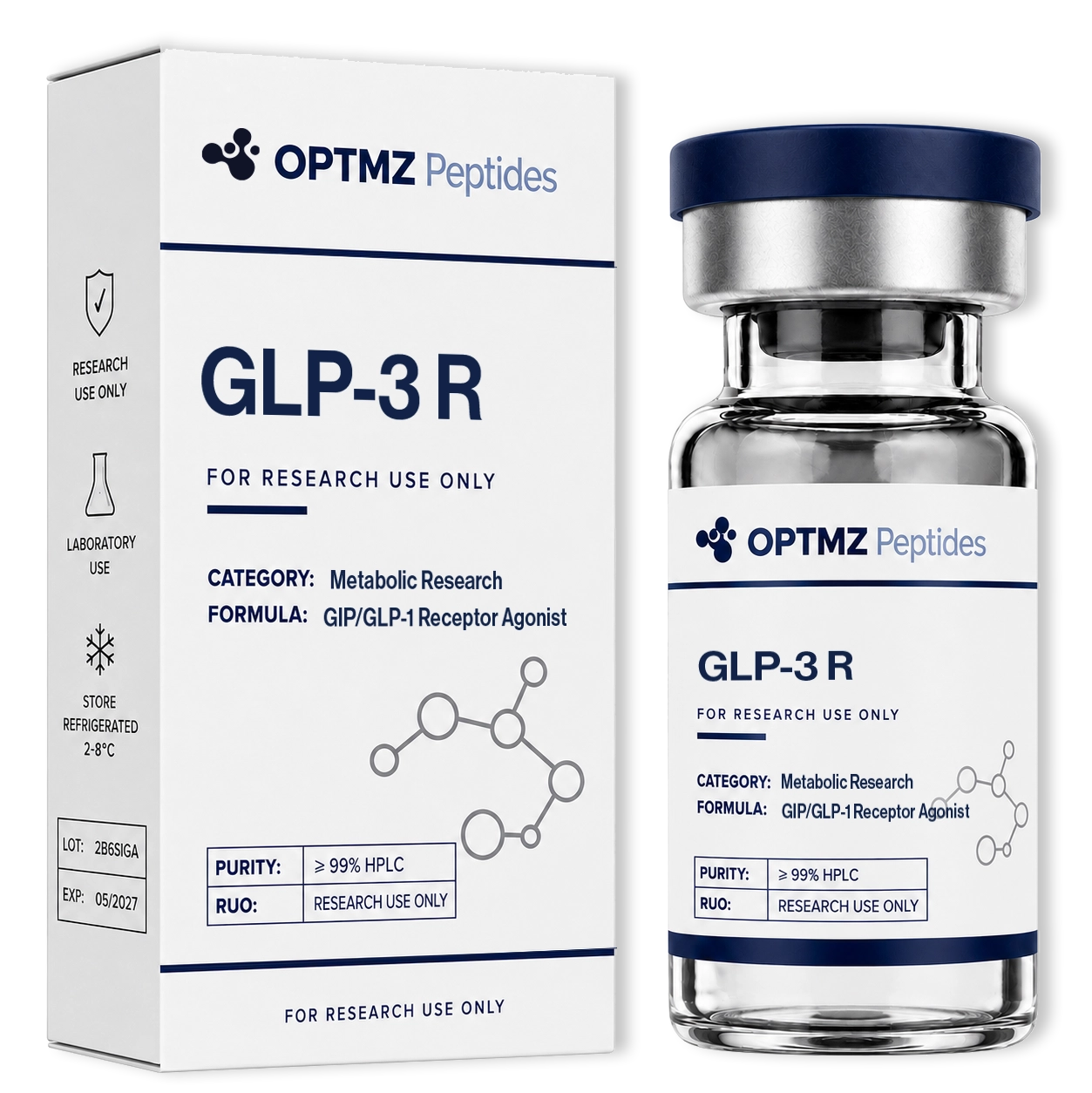
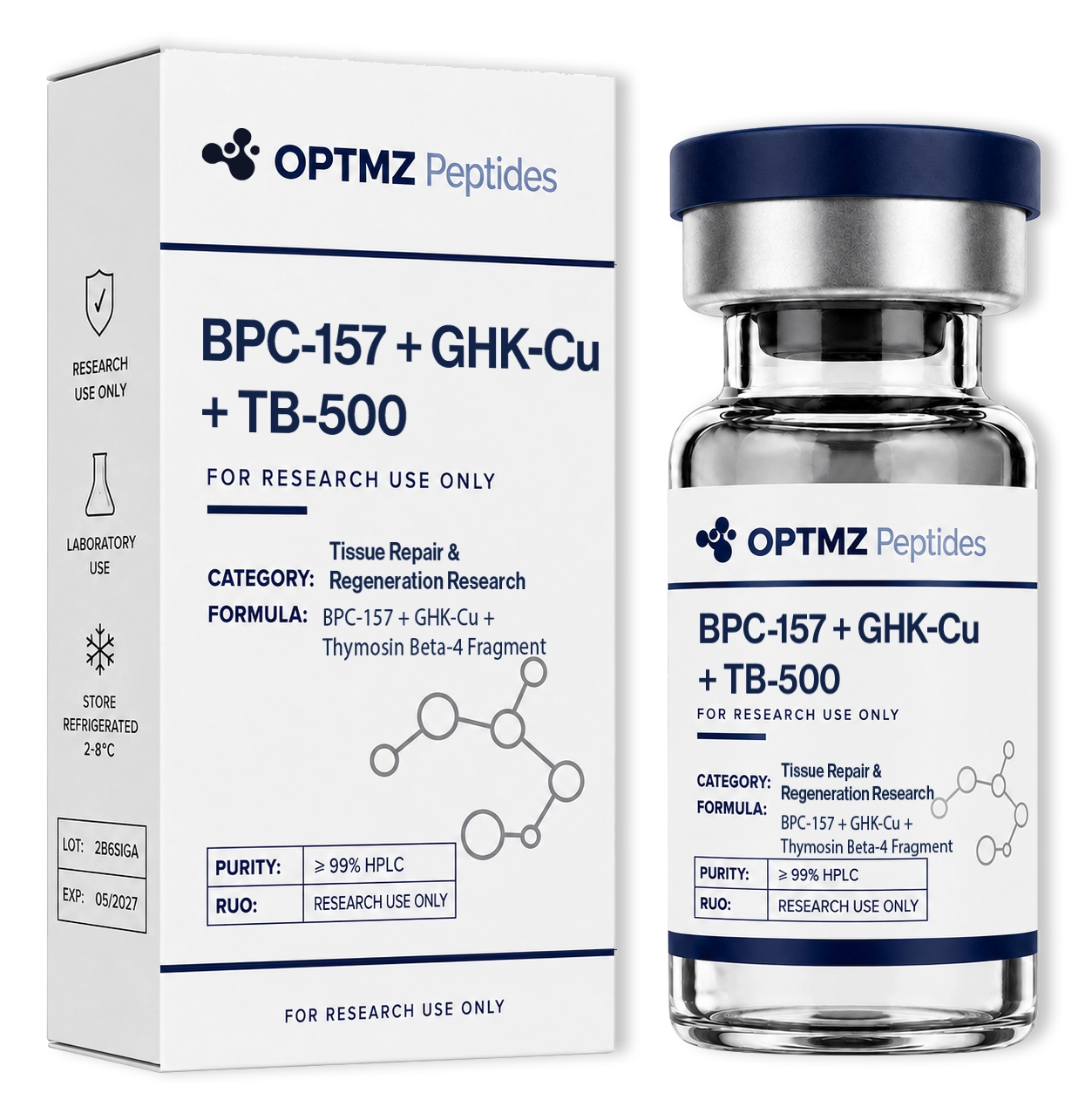
For laboratory research use only. Not for human consumption.

Talk to our research support team: 512-998-2437

Sale!Sale!
Have questions about

BPC 157 10mg+GHK CU50mg+TB500

Text us: 512-998-2437.

BPC 157 10mg+GHK CU50mg+TB500

Triple Research Peptide Blend

Price range: $135.00 through $1,250.00

Quantity

Batch Number :

2026/02

Purity Percentage :

99.5

Identity Confirmation :

Krause Analytics

Testing Methods Listed :

HPLC-UV/MS

Krause Analytical Credential Line :

145211

Test Date :

09/05/2026

All products currently listed on this site are for research purposed ONLY.

These products are for laboratory research only and not intended for medical use. They are not FDA-approved to diagnose, treat, cure, or prevent any disease. By purchasing, you certify they will be used solely for research and not for human or animal consumption.

All research peptides supplied by OPTMZ Peptides are intended strictly for laboratory research applications and are not designed for medical use. These materials are not approved by the U.S. Food and Drug Administration (FDA) to diagnose, treat, cure, or prevent any disease. By purchasing, the buyer confirms use strictly for scientific research purposes and not for human or animal consumption.

Product Overview

BPC-157 + GHK-Cu + TB-500 is a three-component research formulation combining BPC-157, copper tripeptide GHK-Cu, and TB-500.

BPC-157 is a 15-amino-acid research peptide investigated in cellular signaling and vascular-associated experimental models. GHK-Cu is a copper-binding tripeptide investigated in extracellular-matrix biology, fibroblast activity, collagen-associated pathways, and tissue-remodeling research. TB-500 is a synthetic seven-amino-acid fragment of thymosin β4 corresponding to residues 17–23 and containing an N-terminal acetyl group.

The current OPTMZ Peptides COA independently confirmed the identities of all three components by HPLC-UV-MS.

Technical Specifications

  • Product: BPC-157 + GHK-Cu + TB-500
  • Nominal Quantity: 70 mg total
  • BPC-157 Label Claim: 10 mg
  • GHK-Cu Label Claim: 50 mg
  • TB-500 Label Claim: 10 mg
  • Research Classification: Triple Research Peptide Blend
  • Compound Type: Multi-Peptide Research Formulation
  • Chromatographic Purity: 99.5%
  • Analysis Method: HPLC-UV-MS
  • Endotoxins: <0.5 EU/mL
  • Endotoxin Method: USP <85>
  • Batch/Lot: 2026/02

BPC-157

  • CAS Number: 137525-51-0
  • Molecular Formula: C₆₂H₉₈N₁₆O₂₂
  • Molecular Weight: 1419.5 g/mol
  • Sequence: GEPPPGKPADDAGLV
  • Measured Content: 10.1 mg
  • Percent of Label: 101.1%
  • Identity: Confirmed by mass spectral match

PubChem reports BPC-157 as a 15-amino-acid peptide with formula C₆₂H₉₈N₁₆O₂₂, molecular weight 1419.5 g/mol, and CAS 137525-51-0.

GHK-Cu

  • Label Claim: 50 mg
  • COA CAS Number: 49557-75-7
  • Sequence: Gly-His-Lys
  • Measured Content: 39.7 mg
  • Percent of Label: 79.3%
  • Identity: Confirmed by mass spectral match

The COA reports CAS 49557-75-7 for the GHK-Cu analyte. That CAS is associated in PubChem with the parent GHK tripeptide, while PubChem maintains separate records for copper-complexed forms of GHK.

For that reason, I would keep the COA-reported CAS number on this specific batch record but avoid claiming that it uniquely defines a single copper-complex stoichiometry.

TB-500

  • CAS Number: 885340-08-9
  • Molecular Formula: C₃₈H₆₈N₁₀O₁₄
  • Molecular Weight: 889.01 g/mol
  • Sequence: Ac-Leu-Lys-Lys-Thr-Glu-Thr-Gln
  • Measured Content: 13.4 mg
  • Percent of Label: 133.6%
  • Identity: Confirmed by mass spectral match

FDA describes TB-500 free base as the N-acetylated seven-amino-acid thymosin β4 fragment Ac-LKKTETQ, with CAS 885340-08-9, formula C₃₈H₆₈N₁₀O₁₄, and molecular weight 889.01 g/mol.

Analytical & Testing

Each tested batch of BPC-157 + GHK-Cu + TB-500 undergoes analytical evaluation to verify chromatographic purity, component identity, peptide content, and analytical consistency.

For the submitted OPTMZ Peptides sample, independent testing by Krause Analytical reported:

  • Chromatographic Purity: 99.5%
  • BPC-157: 10.1 mg
  • BPC-157 Percent of Label: 101.1%
  • BPC-157 Identity: Confirmed
  • GHK-Cu: 39.7 mg
  • GHK-Cu Percent of Label: 79.3%
  • GHK-Cu Identity: Confirmed
  • TB-500: 13.4 mg
  • TB-500 Percent of Label: 133.6%
  • TB-500 Identity: Confirmed
  • Testing Method: HPLC-UV-MS
  • Endotoxins: <0.5 EU/mL
  • Endotoxin Method: USP <85>
  • Batch/Lot: 2026/02

The laboratory states that all reported values are on a per-vial basis unless otherwise noted.

The accompanying chromatogram on page 2 shows multiple distinct principal peaks for sample 205074, while page 3 contains the mass-spectral report supporting the identity analysis.

Handling & Storage

BPC-157 + GHK-Cu + TB-500 should be handled by qualified professionals in controlled laboratory environments. Appropriate storage conditions should be maintained to preserve peptide stability and analytical integrity.

Avoid unnecessary exposure to heat, moisture, light, and repeated temperature fluctuations. Because the formulation contains three chemically distinct research components, preparation and storage procedures should follow validated laboratory protocols appropriate to the intended experimental system.

Research Context

The three constituents have been investigated separately across several areas of experimental biology.

Research involving BPC-157 includes:

  • Peptide signaling
  • Endothelial-cell research
  • Vascular-associated signaling
  • Cellular migration models
  • Angiogenesis-associated pathways
  • Gastrointestinal experimental models
  • Cellular stress-response research

Published literature has examined BPC-157 in a range of preclinical tissue-response and vascular models.

Research involving GHK-Cu includes:

  • Fibroblast biology
  • Collagen synthesis
  • Extracellular-matrix remodeling
  • Glycosaminoglycan research
  • Metalloproteinase regulation
  • Cellular remodeling
  • Copper-peptide biology
  • Skin and connective-tissue research

Published reviews describe GHK-Cu as a copper-binding tripeptide investigated for effects on collagen, glycosaminoglycans, metalloproteinases, fibroblast function, and tissue remodeling.

Research involving TB-500 includes:

  • Thymosin β4 fragment biology
  • Peptide metabolism
  • Cellular migration research
  • Fragment structure-function studies
  • Peptide stability
  • Actin-associated research context

FDA identifies TB-500 as the seven-amino-acid acetylated thymosin β4 fragment Ac-LKKTETQ but also notes that nonclinical pharmacological evidence supporting wound-healing claims for TB-500 itself remains limited.

These areas describe experimental research contexts and do not establish therapeutic efficacy or safety in humans.

Research Application Scope

BPC-157 + GHK-Cu + TB-500 provides three independently identifiable research compounds within one formulation for controlled experimental investigation.

The blend may be relevant to studies examining peptide signaling, fibroblast activity, extracellular-matrix biology, collagen-associated pathways, cellular migration, endothelial-cell behavior, vascular biology, and peptide structure-function relationships.

The COA confirms the presence and measured quantity of each component but does not establish that combining BPC-157, GHK-Cu, and TB-500 produces synergistic or additive biological activity.

Use Statement

For laboratory research use only. Intended strictly for in vitro and controlled experimental research applications.

Disclaimer

All products currently listed on this site are for research purposes ONLY.

Description

Technical Specifications

  • Product: BPC-157 + GHK-Cu + TB-500
  • Nominal Quantity: 70 mg total
  • BPC-157 Label Claim: 10 mg
  • GHK-Cu Label Claim: 50 mg
  • TB-500 Label Claim: 10 mg
  • Research Classification: Triple Research Peptide Blend
  • Compound Type: Multi-Peptide Research Formulation
  • Chromatographic Purity: 99.5%
  • Analysis Method: HPLC-UV-MS
  • Endotoxins: <0.5 EU/mL
  • Endotoxin Method: USP <85>
  • Batch/Lot: 2026/02

BPC-157

  • CAS Number: 137525-51-0
  • Molecular Formula: C₆₂H₉₈N₁₆O₂₂
  • Molecular Weight: 1419.5 g/mol
  • Sequence: GEPPPGKPADDAGLV
  • Measured Content: 10.1 mg
  • Percent of Label: 101.1%
  • Identity: Confirmed by mass spectral match

PubChem reports BPC-157 as a 15-amino-acid peptide with formula C₆₂H₉₈N₁₆O₂₂, molecular weight 1419.5 g/mol, and CAS 137525-51-0.

GHK-Cu

  • Label Claim: 50 mg
  • COA CAS Number: 49557-75-7
  • Sequence: Gly-His-Lys
  • Measured Content: 39.7 mg
  • Percent of Label: 79.3%
  • Identity: Confirmed by mass spectral match

The COA reports CAS 49557-75-7 for the GHK-Cu analyte. That CAS is associated in PubChem with the parent GHK tripeptide, while PubChem maintains separate records for copper-complexed forms of GHK.

For that reason, I would keep the COA-reported CAS number on this specific batch record but avoid claiming that it uniquely defines a single copper-complex stoichiometry.

TB-500

  • CAS Number: 885340-08-9
  • Molecular Formula: C₃₈H₆₈N₁₀O₁₄
  • Molecular Weight: 889.01 g/mol
  • Sequence: Ac-Leu-Lys-Lys-Thr-Glu-Thr-Gln
  • Measured Content: 13.4 mg
  • Percent of Label: 133.6%
  • Identity: Confirmed by mass spectral match

FDA describes TB-500 free base as the N-acetylated seven-amino-acid thymosin β4 fragment Ac-LKKTETQ, with CAS 885340-08-9, formula C₃₈H₆₈N₁₀O₁₄, and molecular weight 889.01 g/mol.

Analytical & Testing

Each tested batch of BPC-157 + GHK-Cu + TB-500 undergoes analytical evaluation to verify chromatographic purity, component identity, peptide content, and analytical consistency.

For the submitted OPTMZ Peptides sample, independent testing by Krause Analytical reported:

  • Chromatographic Purity: 99.5%
  • BPC-157: 10.1 mg
  • BPC-157 Percent of Label: 101.1%
  • BPC-157 Identity: Confirmed
  • GHK-Cu: 39.7 mg
  • GHK-Cu Percent of Label: 79.3%
  • GHK-Cu Identity: Confirmed
  • TB-500: 13.4 mg
  • TB-500 Percent of Label: 133.6%
  • TB-500 Identity: Confirmed
  • Testing Method: HPLC-UV-MS
  • Endotoxins: <0.5 EU/mL
  • Endotoxin Method: USP <85>
  • Batch/Lot: 2026/02

The laboratory states that all reported values are on a per-vial basis unless otherwise noted.

The accompanying chromatogram on page 2 shows multiple distinct principal peaks for sample 205074, while page 3 contains the mass-spectral report supporting the identity analysis.

Handling & Storage

BPC-157 + GHK-Cu + TB-500 should be handled by qualified professionals in controlled laboratory environments. Appropriate storage conditions should be maintained to preserve peptide stability and analytical integrity.

Avoid unnecessary exposure to heat, moisture, light, and repeated temperature fluctuations. Because the formulation contains three chemically distinct research components, preparation and storage procedures should follow validated laboratory protocols appropriate to the intended experimental system.

Research Context

The three constituents have been investigated separately across several areas of experimental biology.

Research involving BPC-157 includes:

  • Peptide signaling
  • Endothelial-cell research
  • Vascular-associated signaling
  • Cellular migration models
  • Angiogenesis-associated pathways
  • Gastrointestinal experimental models
  • Cellular stress-response research

Published literature has examined BPC-157 in a range of preclinical tissue-response and vascular models.

Research involving GHK-Cu includes:

  • Fibroblast biology
  • Collagen synthesis
  • Extracellular-matrix remodeling
  • Glycosaminoglycan research
  • Metalloproteinase regulation
  • Cellular remodeling
  • Copper-peptide biology
  • Skin and connective-tissue research

Published reviews describe GHK-Cu as a copper-binding tripeptide investigated for effects on collagen, glycosaminoglycans, metalloproteinases, fibroblast function, and tissue remodeling.

Research involving TB-500 includes:

  • Thymosin β4 fragment biology
  • Peptide metabolism
  • Cellular migration research
  • Fragment structure-function studies
  • Peptide stability
  • Actin-associated research context

FDA identifies TB-500 as the seven-amino-acid acetylated thymosin β4 fragment Ac-LKKTETQ but also notes that nonclinical pharmacological evidence supporting wound-healing claims for TB-500 itself remains limited.

These areas describe experimental research contexts and do not establish therapeutic efficacy or safety in humans.

Research Application Scope

BPC-157 + GHK-Cu + TB-500 provides three independently identifiable research compounds within one formulation for controlled experimental investigation.

The blend may be relevant to studies examining peptide signaling, fibroblast activity, extracellular-matrix biology, collagen-associated pathways, cellular migration, endothelial-cell behavior, vascular biology, and peptide structure-function relationships.

The COA confirms the presence and measured quantity of each component but does not establish that combining BPC-157, GHK-Cu, and TB-500 produces synergistic or additive biological activity.

Use Statement

For laboratory research use only. Intended strictly for in vitro and controlled experimental research applications.

Disclaimer

All products currently listed on this site are for research purposes ONLY.

Additional information

Pcs

Single Vial, Pack of 10

Strength

70mg

Reviews

There are no reviews yet.

Be the first to review “BPC 157 10mg+GHK CU50mg+TB500”

Your email address will not be published. Required fields are marked *

Research Profile

Research Classification

Triple Research Peptide Blend / Multi-Peptide Research Formulation

Research Discipline

Cell Biology; Peptide Biology; Vascular Biology; Fibroblast Biology; Extracellular-Matrix Biology; Copper-Peptide Research; Molecular Signaling

Primary Molecular Target

Multiple experimental targets/pathways; no single established shared molecular target Relevant experimental contexts include: BPC-157: vascular and cellular signaling pathways GHK-Cu: copper-dependent cellular signaling, extracellular-matrix and fibroblast-associated pathways TB-500: thymosin β4 fragment / actin-associated research context The combined formulation itself does not have a validated single molecular target.

Evidence Level

Preclinical Research The scientific context for these compounds consists primarily of biochemical, cellular, animal, and other preclinical research. Evidence for the three-component formulation itself is more limited than evidence for the individual constituents.
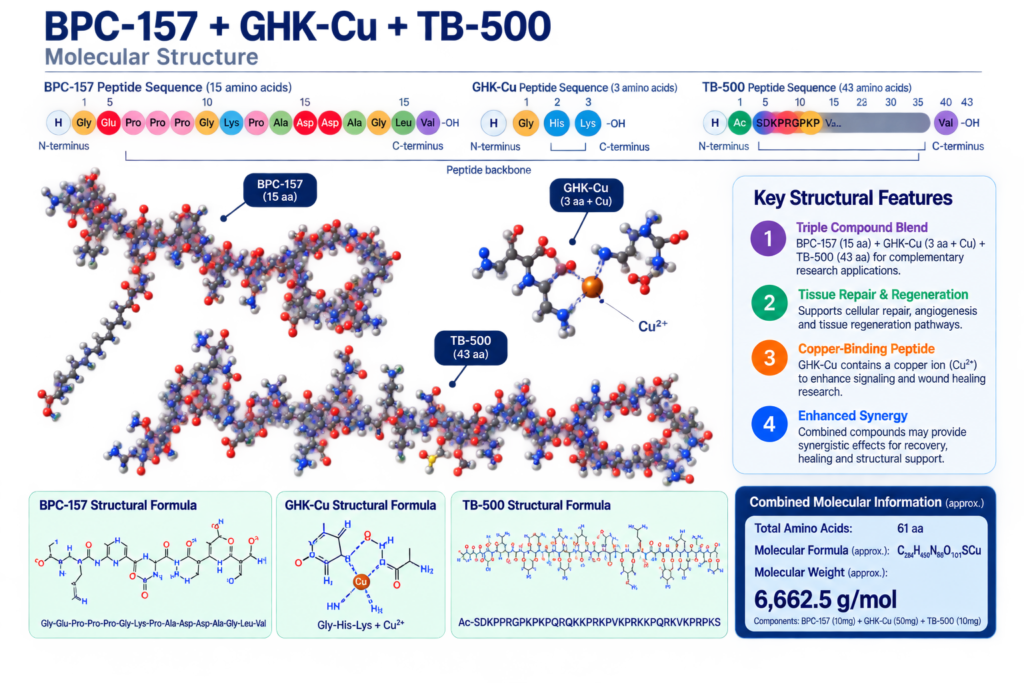
Molecular Structure

This research formulation contains three structurally distinct peptide-based compounds: BPC-157, a 15-amino-acid peptide; GHK-Cu, a copper-coordinated Gly-His-Lys tripeptide complex; and TB-500, an N-terminally acetylated seven-amino-acid fragment corresponding to thymosin β4 residues 17–23. The current analytical report confirmed the identity of all three analytes by HPLC-UV-MS.

Chemical Identity

Molecular FormulaBPC-157: C₆₂H₉₈N₁₆O₂₂ GHK-Cu: Copper-complex formula depends on the specific coordination/speciation represented. PubChem contains GHK-Cu records including C₁₄H₂₁CuN₆O₄⁻; the laboratory COA does not specify the exact copper-complex stoichiometry. TB-500 Free Base: C₃₈H₆₈N₁₀O₁₄
Molecular WeightBPC-157: 1419.5 g/mol GHK-Cu: Depends on the exact copper-complex species; PubChem reports 400.90 g/mol for one copper-tripeptide record. TB-500 Free Base: 889.01 g/mol
CAS NumberBPC-157: 137525-51-0 GHK-Cu / COA Reported: 49557-75-7 TB-500: 885340-08-9 The first and third identifiers correspond to BPC-157 and TB-500 respectively. The GHK-Cu CAS should be retained as COA-reported because 49557-75-7 is also associated with GHK itself in PubChem rather than uniquely defining every GHK-copper complex.

Amino Acid Sequence

BPC-157: Gly-Glu-Pro-Pro-Pro-Gly-Lys-Pro-Ala-Asp-Asp-Ala-Gly-Leu-Val GEPPPGKPADDAGLV GHK-Cu: Gly-His-Lys GHK TB-500: Ac-Leu-Lys-Lys-Thr-Glu-Thr-Gln Ac-LKKTETQ

Experimental Research Applications

Peptide signaling research
Fibroblast biology
Extracellular-matrix studies
Collagen-associated research
Cellular migration models
Endothelial-cell research
Vascular biology
Copper-peptide research
Cytoskeletal-associated research
Peptide structure-function studies
Cellular remodeling research
Multi-peptide interaction studies

Experimental Systems

Published research involving the individual constituents includes:

Fibroblast cell-culture systems
Endothelial-cell models
Collagen-production models
Extracellular-matrix experimental systems
Copper-peptide biochemical systems
Cellular migration models
Preclinical tissue-response models
Peptide metabolism systems
In vitro biochemical assays

These systems relate to research on the individual compounds and should not be interpreted as validation of the combined three-component formulation.

Specific Assays

HPLC-UV purity analysis
LC-MS identity analysis
Mass-spectral matching
USP endotoxin testing
Fibroblast proliferation assays
Collagen-production assays
Cell-migration assays
Extracellular-matrix expression assays
Metalloproteinase analysis
Endothelial-cell assays
Peptide stability and metabolism assays

GHK-Cu has specifically been evaluated experimentally in fibroblast proliferation and collagen-production models.

Measured Endpoints

Chromatographic purity
Component identity
Individual peptide content
Endotoxin concentration
Fibroblast proliferation
Collagen production
Extracellular-matrix remodeling
Cellular migration
Endothelial-cell response
Metalloproteinase-associated activity
Peptide stability and metabolism

For the actual OPTMZ product, the measured analytical endpoints were purity, identity, individual component content, and endotoxin concentration.

Analytical Characterization

Independent analytical testing of OPTMZ Peptides GLOW, nominally 70 mg total, batch/lot 2026/02, by Krause Analytical reported:

Chromatographic Purity: 99.5%
BPC-157 Content: 10.1 mg
BPC-157 Label Claim: 10 mg
BPC-157 Percent of Label: 101.1%
BPC-157 Identity: Confirmed
GHK-Cu Content: 39.7 mg
GHK-Cu Label Claim: 50 mg
GHK-Cu Percent of Label: 79.3%
GHK-Cu Identity: Confirmed
TB-500 Content: 13.4 mg
TB-500 Label Claim: 10 mg
TB-500 Percent of Label: 133.6%
TB-500 Identity: Confirmed
Analysis Method: HPLC-UV-MS
Endotoxins: <0.5 EU/mL Endotoxin Method: USP
Lab Number: 205074
Project: 145211
Report Issued: May 19, 2026

The laboratory reports that values are per vial unless otherwise noted.
Text us, our dedicated team is here to help.

Reach out and get a response within minutes