
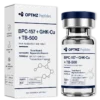
Triple Research Peptide Blend / Multi-Peptide Research Formulation
Cell Biology; Peptide Biology; Vascular Biology; Fibroblast Biology; Extracellular-Matrix Biology; Copper-Peptide Research; Molecular Signaling
Multiple experimental targets/pathways; no single established shared molecular target Relevant experimental contexts include: BPC-157: vascular and cellular signaling pathways GHK-Cu: copper-dependent cellular signaling, extracellular-matrix and fibroblast-associated pathways TB-500: thymosin β4 fragment / actin-associated research context The combined formulation itself does not have a validated single molecular target.
Preclinical Research The scientific context for these compounds consists primarily of biochemical, cellular, animal, and other preclinical research. Evidence for the three-component formulation itself is more limited than evidence for the individual constituents.
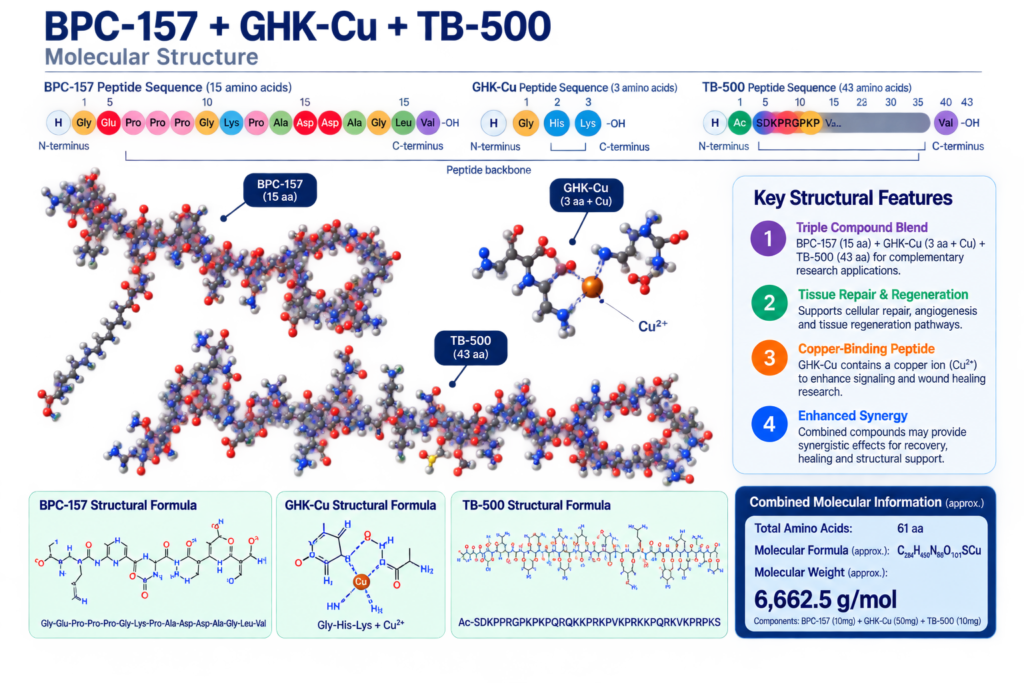
This research formulation contains three structurally distinct peptide-based compounds: BPC-157, a 15-amino-acid peptide; GHK-Cu, a copper-coordinated Gly-His-Lys tripeptide complex; and TB-500, an N-terminally acetylated seven-amino-acid fragment corresponding to thymosin β4 residues 17–23. The current analytical report confirmed the identity of all three analytes by HPLC-UV-MS.
BPC-157: Gly-Glu-Pro-Pro-Pro-Gly-Lys-Pro-Ala-Asp-Asp-Ala-Gly-Leu-Val GEPPPGKPADDAGLV GHK-Cu: Gly-His-Lys GHK TB-500: Ac-Leu-Lys-Lys-Thr-Glu-Thr-Gln Ac-LKKTETQ
Peptide signaling research
Fibroblast biology
Extracellular-matrix studies
Collagen-associated research
Cellular migration models
Endothelial-cell research
Vascular biology
Copper-peptide research
Cytoskeletal-associated research
Peptide structure-function studies
Cellular remodeling research
Multi-peptide interaction studies
Published research involving the individual constituents includes:
Fibroblast cell-culture systems
Endothelial-cell models
Collagen-production models
Extracellular-matrix experimental systems
Copper-peptide biochemical systems
Cellular migration models
Preclinical tissue-response models
Peptide metabolism systems
In vitro biochemical assays
These systems relate to research on the individual compounds and should not be interpreted as validation of the combined three-component formulation.
HPLC-UV purity analysis
LC-MS identity analysis
Mass-spectral matching
USP endotoxin testing
Fibroblast proliferation assays
Collagen-production assays
Cell-migration assays
Extracellular-matrix expression assays
Metalloproteinase analysis
Endothelial-cell assays
Peptide stability and metabolism assays
GHK-Cu has specifically been evaluated experimentally in fibroblast proliferation and collagen-production models.
Chromatographic purity
Component identity
Individual peptide content
Endotoxin concentration
Fibroblast proliferation
Collagen production
Extracellular-matrix remodeling
Cellular migration
Endothelial-cell response
Metalloproteinase-associated activity
Peptide stability and metabolism
For the actual OPTMZ product, the measured analytical endpoints were purity, identity, individual component content, and endotoxin concentration.
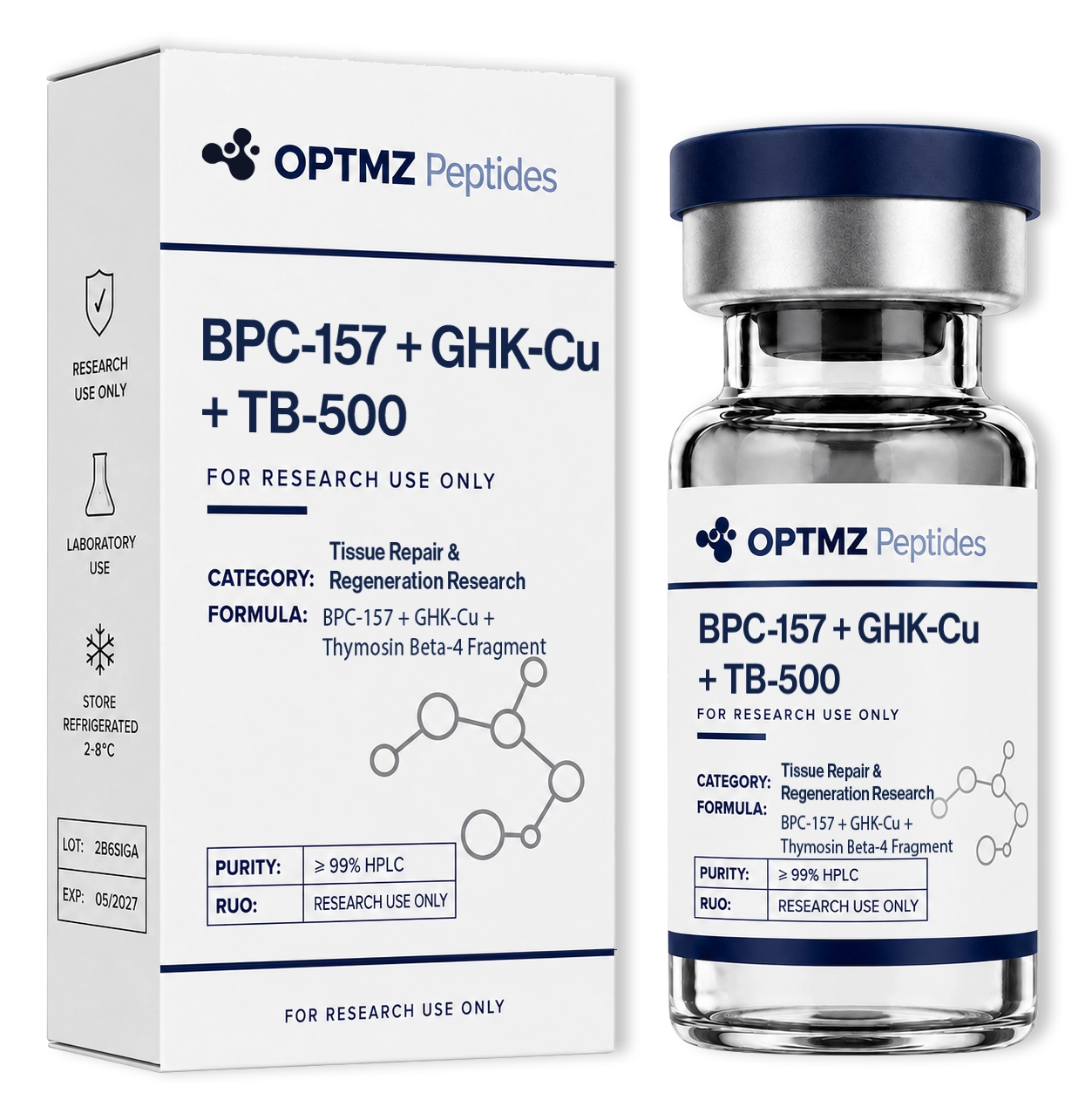
Independent analytical testing of OPTMZ Peptides GLOW, nominally 70 mg total, batch/lot 2026/02, by Krause Analytical reported:
Chromatographic Purity: 99.5%
BPC-157 Content: 10.1 mg
BPC-157 Label Claim: 10 mg
BPC-157 Percent of Label: 101.1%
BPC-157 Identity: Confirmed
GHK-Cu Content: 39.7 mg
GHK-Cu Label Claim: 50 mg
GHK-Cu Percent of Label: 79.3%
GHK-Cu Identity: Confirmed
TB-500 Content: 13.4 mg
TB-500 Label Claim: 10 mg
TB-500 Percent of Label: 133.6%
TB-500 Identity: Confirmed
Analysis Method: HPLC-UV-MS
Endotoxins: <0.5 EU/mL
Endotoxin Method: USP
Lab Number: 205074
Project: 145211
Report Issued: May 19, 2026
The laboratory reports that values are per vial unless otherwise noted.
Restricted Access · Research Use Only
Independently lab tested, every batch
COAs published and searchable by batch number
Policy version 2026-05-14-ruo-v1.0
Reviews
There are no reviews yet.