For laboratory research use only. Not for human consumption.

Talk to our research support team: 512-998-2437

Have questions about

Body Protection Compound 157 + Thymosin Beta-4 Fragment

Text us: 512-998-2437.

Body Protection Compound 157 + Thymosin Beta-4 Fragment

Dual Research Peptide

Price range: $99.00 through $879.00

Quantity

Batch Number :

2026/02

Purity Percentage :

99.32

Identity Confirmation :

Krause Analytical

Testing Methods Listed :

Identity (LC-MS) Ac-SDKP/BPC-157 Purity (HPLC-UV)

Krause Analytical Credential Line :

2606080482

Test Date :

02/03/2026

All products currently listed on this site are for research purposed ONLY.

These products are for laboratory research only and not intended for medical use. They are not FDA-approved to diagnose, treat, cure, or prevent any disease. By purchasing, you certify they will be used solely for research and not for human or animal consumption.

Research Use Only

All research peptides provided by OPTMZ Peptides are intended strictly for laboratory research applications and are not designed for medical use. These compounds are not approved by the U.S. Food and Drug Administration (FDA) to diagnose, treat, cure, or prevent any disease. By purchasing, the buyer confirms use strictly for scientific research and not for human or animal consumption.

Product Overview

The Body Protection Compound 157 + Thymosin Beta-4 Fragment (BPC-157 + TB-500) blend is a combination of two synthetic research peptides frequently examined in controlled laboratory environments.

BPC-157 is a synthetic peptide derived from a fragment of a gastric protein sequence, while TB-500 is a synthetic version of thymosin beta-4 (Tβ4). This blend is studied in in vitro research settings for its interaction with cellular pathways, including angiogenic signaling, cytoskeletal activity, and cellular response mechanisms.

Technical Specifications

BPC-157

  • CAS Number: 137525-51-0
  • Molecular Formula: C₆₂H₉₈N₁₆O₂₂
  • Molecular Weight: 1419.556 g/mol
  • PubChem ID: 108101

TB-500

  • CAS Number: 77591-33-4
  • Molecular Formula: C₆₂H₉₈N₁₆O₂₂
  • Molecular Weight: 1419.556 g/mol
  • PubChem ID: 108101
  • Purity: ≥99% (HPLC tested)
  • Form: Lyophilized powder
  • Synthesis Method: Solid-phase peptide synthesis

Analytical & Testing

Each batch of the BPC-157 + TB-500 blend undergoes high-performance liquid chromatography (HPLC) and mass spectrometry (MS) analysis to verify purity, identity, and analytical consistency. A corresponding Certificate of Analysis (COA) is available for each batch.

Handling & Storage

This blend should be handled by qualified professionals in controlled laboratory environments. Proper storage conditions should be maintained to preserve compound stability and structural integrity.

Research Context

In preclinical research models, the BPC-157 + TB-500 blend has been examined across structural, vascular, and cellular systems. Research focus includes:

  • Collagen-related pathways
  • Extracellular matrix interactions
  • Angiogenic signaling models
  • Cytoskeletal and cellular activity

These observations are limited to controlled experimental environments and support ongoing laboratory investigations.

Research Application Scope

This peptide blend continues to be evaluated for its relevance in experimental biology, particularly within studies involving cellular structure, vascular behavior, and biochemical signaling pathways.

Use Statement

For laboratory research use only. Intended strictly for in vitro research applications.

Disclaimer

All products currently listed on this site are for research purposes ONLY.

Description

Technical Specifications

BPC-157

  • CAS Number: 137525-51-0
  • Molecular Formula: C₆₂H₉₈N₁₆O₂₂
  • Molecular Weight: 1419.556 g/mol
  • PubChem ID: 108101

TB-500

  • CAS Number: 77591-33-4
  • Molecular Formula: C₆₂H₉₈N₁₆O₂₂
  • Molecular Weight: 1419.556 g/mol
  • PubChem ID: 108101
  • Purity: ≥99% (HPLC tested)
  • Form: Lyophilized powder
  • Synthesis Method: Solid-phase peptide synthesis

Analytical & Testing

Each batch of the BPC-157 + TB-500 blend undergoes high-performance liquid chromatography (HPLC) and mass spectrometry (MS) analysis to verify purity, identity, and analytical consistency. A corresponding Certificate of Analysis (COA) is available for each batch.

Handling & Storage

This blend should be handled by qualified professionals in controlled laboratory environments. Proper storage conditions should be maintained to preserve compound stability and structural integrity.

Research Context

In preclinical research models, the BPC-157 + TB-500 blend has been examined across structural, vascular, and cellular systems. Research focus includes:

  • Collagen-related pathways
  • Extracellular matrix interactions
  • Angiogenic signaling models
  • Cytoskeletal and cellular activity

These observations are limited to controlled experimental environments and support ongoing laboratory investigations.

Research Application Scope

This peptide blend continues to be evaluated for its relevance in experimental biology, particularly within studies involving cellular structure, vascular behavior, and biochemical signaling pathways.

Use Statement

For laboratory research use only. Intended strictly for in vitro research applications.

Disclaimer

All products currently listed on this site are for research purposes ONLY.

Additional information

Pcs

Single Vial, Pack of 10

Strength

5mg, 10mg

Reviews

There are no reviews yet.

Be the first to review “Body Protection Compound 157 + Thymosin Beta-4 Fragment”

Your email address will not be published. Required fields are marked *

Research Profile

Research Classification

Dual Research Peptide / Peptide Combination

Research Discipline

Cell Biology; Molecular Biology; Vascular Biology; Fibroblast Biology; Extracellular-Matrix Research; Peptide Biology

Primary Molecular Target

BPC-157: Multiple experimentally investigated cellular signaling pathways, including endothelial and angiogenesis-associated signaling. Ac-SDKP: TGF-β/Smad-associated signaling, fibroblast-associated pathways, extracellular-matrix regulation, and endothelial-cell signaling. Because this is a combination research product, there is no single established molecular target shared by both components.

Evidence Level

Preclinical Research This is the appropriate classification because the research context described above is predominantly derived from laboratory and preclinical investigation. It should not be presented as established clinical efficacy.
Molecular Structure

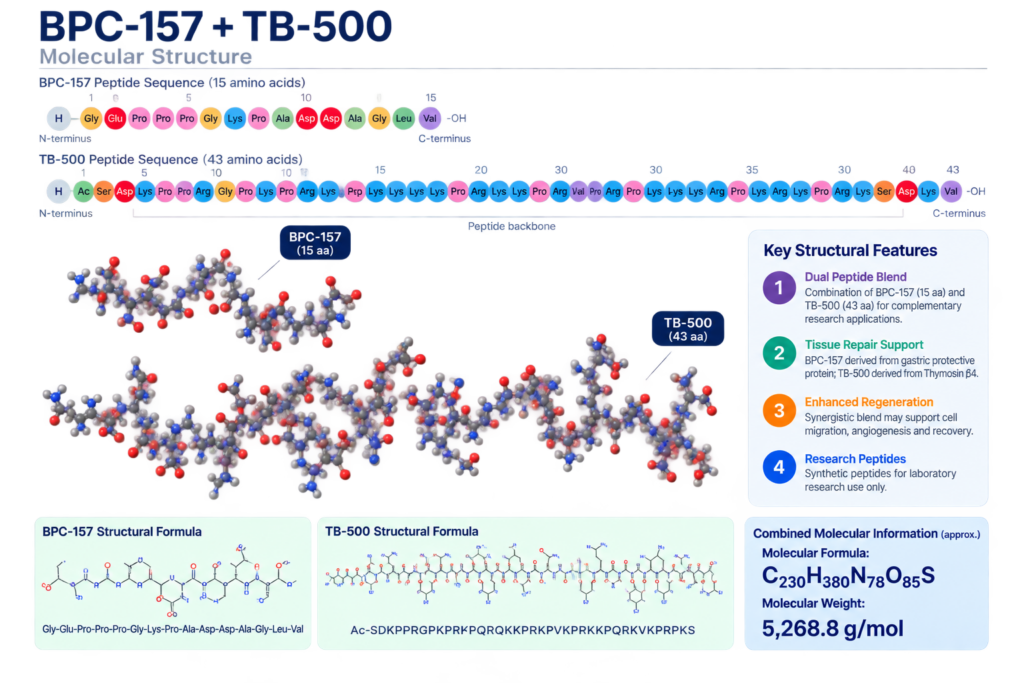
This research formulation contains two distinct peptide structures: BPC-157, a synthetic 15-amino-acid peptide, and Ac-SDKP (N-acetyl-seryl-aspartyl-lysyl-proline), an N-terminally acetylated tetrapeptide derived from Thymosin Beta-4. Independent LC-MS analysis of the tested product identified both BPC-157 and Ac-SDKP as the constituent analytes.

Chemical Identity

Molecular FormulaBPC-157: C₆₂H₉₈N₁₆O₂₂ Ac-SDKP: C₂₀H₃₃N₅O₉ Note: These are the individual molecular formulas of the two components rather than a single molecular formula for the combined formulation.
Molecular WeightBPC-157: approximately 1419.5 g/mol Ac-SDKP: approximately 487.5 g/mol Note: Molecular weights are reported separately because this is a two-component research formulation.
CAS NumberBPC-157: 137525-51-0 Ac-SDKP: 127103-11-1

Amino Acid Sequence

BPC-157: GEPPPGKPADDAGLV Thymosin Beta-4 Fragment (Ac-SDKP): Ac-Ser-Asp-Lys-Pro

Experimental Research Applications

Peptide signaling research
Cellular migration studies
Endothelial-cell research
Angiogenesis-associated experimental models
Fibroblast biology
Extracellular-matrix research
Collagen-production models
TGF-β-associated signaling studies
Cellular stress-response research
Peptide structure-function studies

Experimental Systems

Experimental systems reported in research involving the individual components include:

Cultured endothelial-cell systems
Fibroblast cell-culture models
Human cardiac fibroblast models
Endothelial proliferation and migration models
Extracellular-matrix experimental systems
Angiogenesis-associated models
Preclinical tissue-response models
Biochemical peptide-signaling systems

These systems describe published research involving the individual peptides and should not be interpreted as evidence that the combined formulation itself has been validated in each system.

Specific Assays

Cell migration assays
Endothelial proliferation assays
Tube-formation assays
Fibroblast differentiation assays
Collagen-expression assays
Western blot / protein-expression analysis
TGF-β/Smad signaling assays
ERK1/2 pathway analysis
Angiogenesis-associated assays
HPLC purity analysis
LC-MS identity confirmation
Limulus Amebocyte Lysate (LAL) endotoxin assay

Measured Endpoints

Experimental endpoints reported in research involving the individual components include:

Cellular migration
Endothelial-cell proliferation
Tube formation
Fibroblast differentiation
Collagen production
Extracellular-matrix signaling
TGF-β/Smad pathway activity
ERK1/2 signaling
Angiogenesis-associated responses
Cellular signaling responses

Analytical endpoints for the actual tested product include peptide identity, chromatographic purity, individual peptide content, appearance, and endotoxin assay results.

Analytical Characterization

Independent analytical testing of OPTMZ Peptides lot BB20 by Freedom Diagnostics reported:

Product: BPC 10 mg + TB 10 mg
Identity (LC-MS): Ac-SDKP / BPC-157
Purity (HPLC-UV): 99.32%
BPC-157 Net Content: 11.22 mg
Ac-SDKP Net Content: 11.80 mg
Appearance: White Lyophilized Powder
Endotoxin Replicate 1: Pass
Endotoxin Replicate 2: Pass
Assay Sensitivity: ≤0.05 EU/mL
Analytical Method: HPLC with UV detection coupled with mass spectrometry (LC-MS)
Endotoxin Method: Limulus Amebocyte Lysate assay in accordance with USP

The COA chromatogram displays separate principal peaks labeled Ac-SDKP and BPC-157, with corresponding mass-confirmation data.
Text us, our dedicated team is here to help.

Reach out and get a response within minutes