For laboratory research use only. Not for human consumption.

Talk to our research support team: 512-998-2437

Sale!Sale!
Have questions about

GHK-Cu

Text us: 512-998-2437.

GHK-Cu

Copper-Binding Tripeptide

Price range: $25.00 through $450.00

Quantity

Batch Number :

2026/02

Purity Percentage :

99.71

Identity Confirmation :

Krause Analytics

Testing Methods Listed :

HPLC-UV/MS

Krause Analytical Credential Line :

Test Date :

02/09/2026

All products currently listed on this site are for research purposed ONLY.

These products are for laboratory research only and not intended for medical use. They are not FDA-approved to diagnose, treat, cure, or prevent any disease. By purchasing, you certify they will be used solely for research and not for human or animal consumption.

Research Use Only

All research peptides supplied by OPTMZ Peptides are intended strictly for laboratory research applications and are not designed for medical use. These materials are not approved by the U.S. Food and Drug Administration (FDA) to diagnose, treat, cure, or prevent any disease. By purchasing, the buyer confirms use strictly for scientific research purposes and not for human or animal consumption.

Product Overview

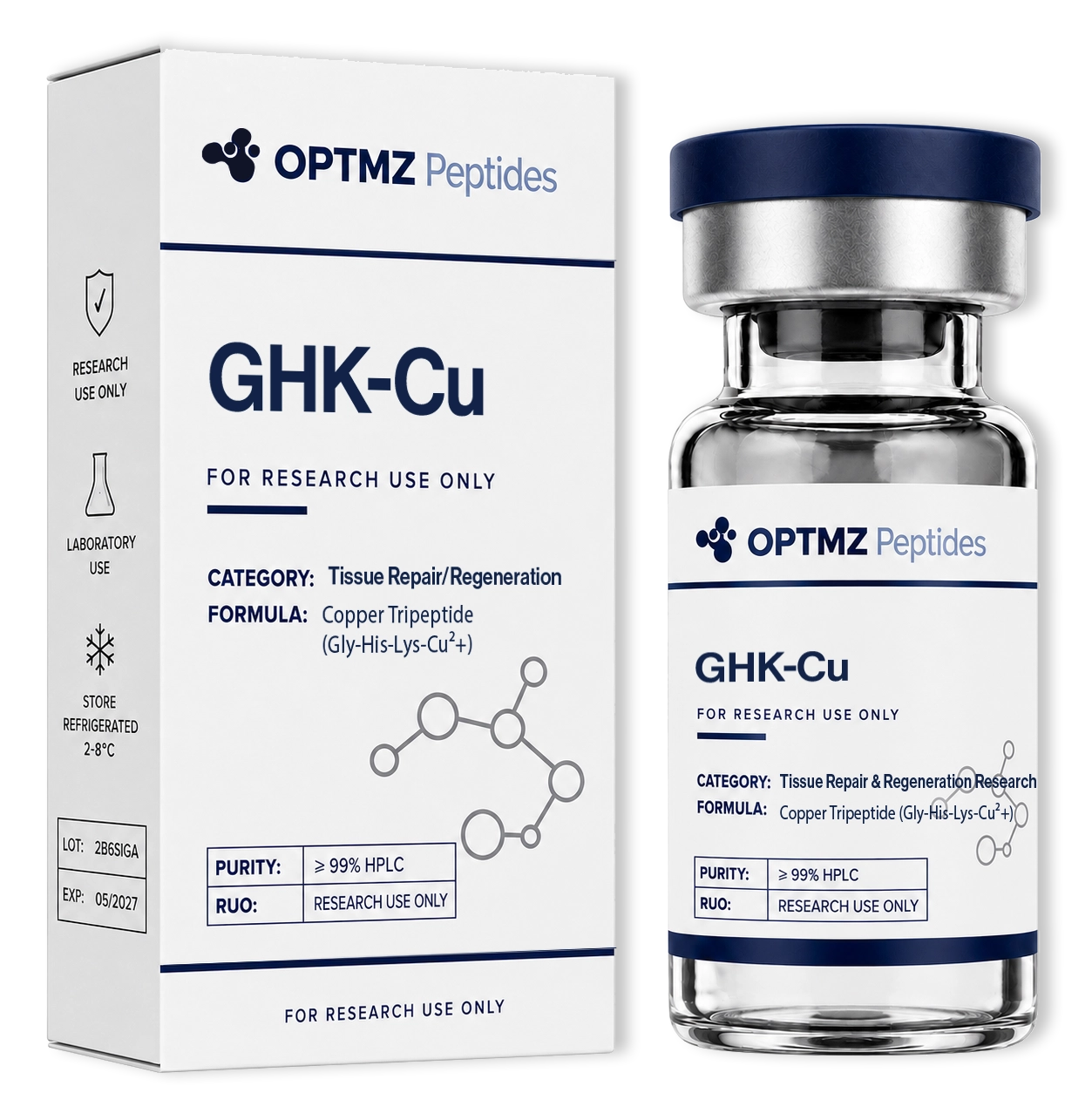
GHK-Cu is a copper-binding tripeptide complex consisting of the naturally occurring peptide glycyl-L-histidyl-L-lysine (GHK) coordinated with copper.

GHK-Cu is investigated in controlled laboratory environments for its role in copper coordination, extracellular-matrix biology, fibroblast signaling, collagen-associated pathways, tissue-remodeling models, oxidative-stress responses, and cellular gene-expression research.

The histidine residue within GHK contributes importantly to copper coordination, giving the complex biochemical properties distinct from the uncomplexed GHK tripeptide.

Technical Specifications

  • Product: GHK-Cu
  • Quantity: 50 mg label claim
  • Research Classification: Copper-Binding Tripeptide
  • Compound Type: Copper-Peptide Coordination Complex
  • Peptide Component: Glycyl-L-Histidyl-L-Lysine (GHK)
  • Peptide Length: 3 amino acids
  • Amino Acid Sequence: Gly-His-Lys
  • Sequence Code: GHK
  • COA-Reported CAS Number: 49557-75-7
  • Chromatographic Purity: >99.9%
  • Identity: GHK-Cu confirmed by HPLC-UV-MS
  • Measured Content: 43.4 mg
  • Percent of Label: 86.7%
  • Analysis Method: HPLC-UV-MS
  • Laboratory: Krause Analytical
  • Lab Number: 200515
  • Project: 145030
  • Date Received: January 29, 2026
  • Report Issued: February 9, 2026

The lot-specific purity, measured content, identity, and CAS number come directly from the Krause Analytical COA.

Analytical & Testing

Each tested batch of GHK-Cu undergoes analytical evaluation to verify chromatographic purity, identity, compound content, and analytical consistency.

For the submitted OPTMZ Peptides sample, Krause Analytical reported:

  • Chromatographic Purity: >99.9%
  • Identity: GHK-Cu — Confirmed
  • Measured Content: 43.4 mg
  • Label Claim: 50 mg
  • Percent of Label: 86.7%
  • Testing Method: HPLC-UV-MS
  • CAS Number: 49557-75-7
  • Lab Number: 200515
  • Project: 145030

The laboratory states that the analyzed sample met its internal quality-assurance criteria unless otherwise flagged.

The chromatogram on page 2 shows a dominant chromatographic peak at approximately 0.57 minutes, while the mass-spectrum/reference-spectrum comparison shows closely corresponding major signals for sample 200515 and the GHK-Cu reference, including prominent signals around m/z 342 and 403.

Endotoxin Status: Not reported on this COA.

This batch should therefore not be described as endotoxin-tested, endotoxin-free, or as having passed endotoxin testing based on this certificate.

Handling & Storage

GHK-Cu should be handled by qualified professionals in controlled laboratory environments. Appropriate storage conditions should be maintained to preserve peptide integrity and copper-peptide complex stability.

Avoid unnecessary exposure to heat, moisture, light, and repeated temperature fluctuations. Experimental preparation, storage, and handling should follow validated laboratory procedures appropriate to the intended research application.

Research Context

GHK-Cu is investigated extensively in peptide biology, extracellular-matrix research, fibroblast biology, copper homeostasis, and cellular remodeling models.

Research areas include:

  • Copper-peptide coordination
  • Fibroblast biology
  • Collagen-associated pathways
  • Extracellular-matrix signaling
  • Matrix metalloproteinase research
  • Tissue-remodeling models
  • Cellular migration
  • Gene-expression regulation
  • Oxidative-stress pathways
  • Antioxidant enzyme research
  • Inflammatory signaling models
  • Angiogenesis-associated research
  • Skin and connective-tissue biology
  • Hair-follicle research
  • Cellular repair signaling

GHK was originally identified as a naturally occurring copper-binding peptide in human plasma. Research subsequently examined GHK-Cu across multiple experimental systems involving extracellular-matrix remodeling, cellular signaling, and gene expression.

These observations describe experimental research contexts and should not be interpreted as established therapeutic or cosmetic effects of the OPTMZ research product.

Research Application Scope

GHK-Cu is relevant to controlled experimental investigations involving copper-dependent peptide biology, extracellular-matrix regulation, fibroblast behavior, collagen-associated signaling, matrix remodeling, oxidative-stress pathways, and cellular gene-expression responses.

The molecule is particularly useful in research examining how a small endogenous peptide can coordinate a transition metal and influence biochemical and cellular processes differently from the corresponding unbound peptide.

Use Statement

For laboratory research use only. Intended strictly for in vitro and controlled experimental research applications.

Disclaimer

All products currently listed on this site are for research purposes ONLY.

Description

Technical Specifications

  • Product: GHK-Cu
  • Quantity: 50 mg label claim
  • Research Classification: Copper-Binding Tripeptide
  • Compound Type: Copper-Peptide Coordination Complex
  • Peptide Component: Glycyl-L-Histidyl-L-Lysine (GHK)
  • Peptide Length: 3 amino acids
  • Amino Acid Sequence: Gly-His-Lys
  • Sequence Code: GHK
  • COA-Reported CAS Number: 49557-75-7
  • Chromatographic Purity: >99.9%
  • Identity: GHK-Cu confirmed by HPLC-UV-MS
  • Measured Content: 43.4 mg
  • Percent of Label: 86.7%
  • Analysis Method: HPLC-UV-MS
  • Laboratory: Krause Analytical
  • Lab Number: 200515
  • Project: 145030
  • Date Received: January 29, 2026
  • Report Issued: February 9, 2026

The lot-specific purity, measured content, identity, and CAS number come directly from the Krause Analytical COA.

Analytical & Testing

Each tested batch of GHK-Cu undergoes analytical evaluation to verify chromatographic purity, identity, compound content, and analytical consistency.

For the submitted OPTMZ Peptides sample, Krause Analytical reported:

  • Chromatographic Purity: >99.9%
  • Identity: GHK-Cu — Confirmed
  • Measured Content: 43.4 mg
  • Label Claim: 50 mg
  • Percent of Label: 86.7%
  • Testing Method: HPLC-UV-MS
  • CAS Number: 49557-75-7
  • Lab Number: 200515
  • Project: 145030

The laboratory states that the analyzed sample met its internal quality-assurance criteria unless otherwise flagged.

The chromatogram on page 2 shows a dominant chromatographic peak at approximately 0.57 minutes, while the mass-spectrum/reference-spectrum comparison shows closely corresponding major signals for sample 200515 and the GHK-Cu reference, including prominent signals around m/z 342 and 403.

Endotoxin Status: Not reported on this COA.

This batch should therefore not be described as endotoxin-tested, endotoxin-free, or as having passed endotoxin testing based on this certificate.

Handling & Storage

GHK-Cu should be handled by qualified professionals in controlled laboratory environments. Appropriate storage conditions should be maintained to preserve peptide integrity and copper-peptide complex stability.

Avoid unnecessary exposure to heat, moisture, light, and repeated temperature fluctuations. Experimental preparation, storage, and handling should follow validated laboratory procedures appropriate to the intended research application.

Research Context

GHK-Cu is investigated extensively in peptide biology, extracellular-matrix research, fibroblast biology, copper homeostasis, and cellular remodeling models.

Research areas include:

  • Copper-peptide coordination
  • Fibroblast biology
  • Collagen-associated pathways
  • Extracellular-matrix signaling
  • Matrix metalloproteinase research
  • Tissue-remodeling models
  • Cellular migration
  • Gene-expression regulation
  • Oxidative-stress pathways
  • Antioxidant enzyme research
  • Inflammatory signaling models
  • Angiogenesis-associated research
  • Skin and connective-tissue biology
  • Hair-follicle research
  • Cellular repair signaling

GHK was originally identified as a naturally occurring copper-binding peptide in human plasma. Research subsequently examined GHK-Cu across multiple experimental systems involving extracellular-matrix remodeling, cellular signaling, and gene expression.

These observations describe experimental research contexts and should not be interpreted as established therapeutic or cosmetic effects of the OPTMZ research product.

Research Application Scope

GHK-Cu is relevant to controlled experimental investigations involving copper-dependent peptide biology, extracellular-matrix regulation, fibroblast behavior, collagen-associated signaling, matrix remodeling, oxidative-stress pathways, and cellular gene-expression responses.

The molecule is particularly useful in research examining how a small endogenous peptide can coordinate a transition metal and influence biochemical and cellular processes differently from the corresponding unbound peptide.

Use Statement

For laboratory research use only. Intended strictly for in vitro and controlled experimental research applications.

Disclaimer

All products currently listed on this site are for research purposes ONLY.

Additional information

Pcs

Single Vial, Pack of 10

Strength

50mg, 100mg

Reviews

There are no reviews yet.

Be the first to review “GHK-Cu”

Your email address will not be published. Required fields are marked *

Research Profile

Research Classification

Copper-Binding Tripeptide / Copper-Peptide Coordination Complex

Research Discipline

Peptide Biology; Metallobiochemistry; Extracellular-Matrix Biology; Cell Biology; Connective-Tissue Research; Molecular Biology

Primary Molecular Target

No single validated receptor target established A more scientifically accurate description is: Copper coordination / extracellular-matrix and gene-regulatory signaling networks GHK-Cu is not best characterized as a conventional single-receptor agonist. Research instead involves multiple cellular and biochemical pathways associated with copper transport, extracellular-matrix regulation, fibroblast signaling, oxidative stress, and gene expression.

Evidence Level

Preclinical / Experimental Research GHK-Cu has a substantial biochemical, cellular, tissue, and preclinical research literature. Some human/cosmetic research involving copper peptides also exists, but claims made for the OPTMZ research material should remain limited to laboratory research rather than implying established clinical efficacy.
Molecular Structure

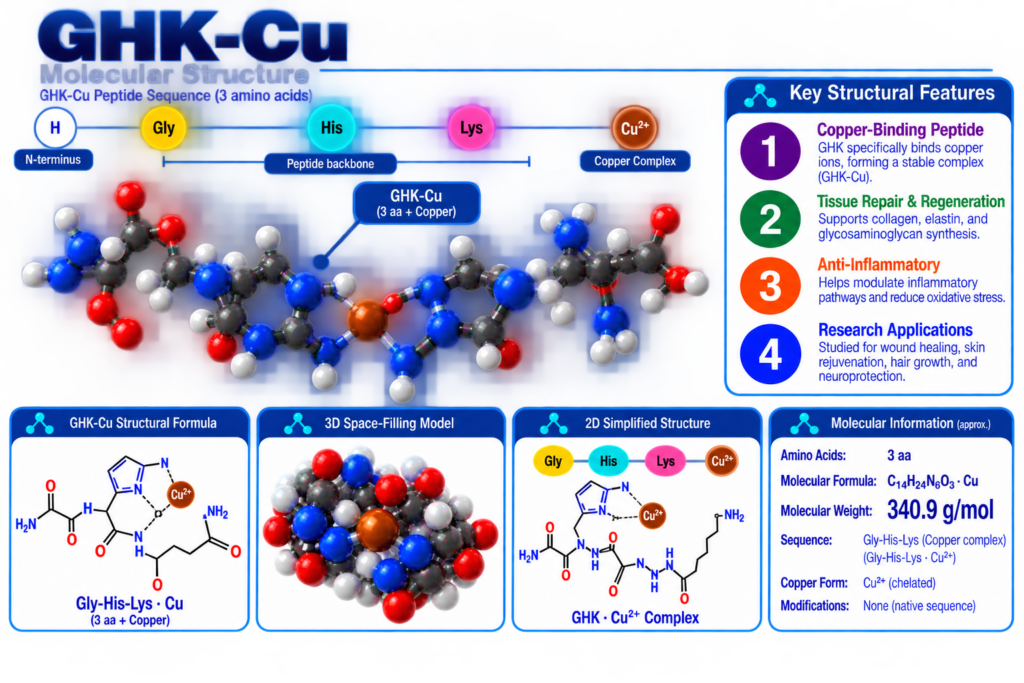
GHK-Cu is a copper-peptide coordination complex formed from the tripeptide glycyl-L-histidyl-L-lysine (Gly-His-Lys; GHK) and a copper ion. The peptide contains glycine, histidine, and lysine residues, with the histidine imidazole group and peptide-associated donor atoms participating in copper coordination. This metal-binding architecture distinguishes GHK-Cu from uncomplexed GHK and is central to research involving its biochemical properties.

Chemical Identity

Molecular FormulaImportant: GHK-Cu is a coordination complex, and commercial/reference materials may be represented in different protonation, salt, or hydration states. I would use this field for the core 1:1 GHK:copper complex rather than implying that every lyophilized preparation necessarily has an identical salt/hydration composition.
Molecular WeightApproximately 401.9 g/mol — core GHK-Cu complex As with the formula, apparent/formulated molecular weight can vary depending on salt and hydration state.
CAS Number49557-75-7 — COA-reported Krause Analytical reports CAS 49557-75-7 for the actual tested OPTMZ GHK-Cu material. For your WooCommerce page, I would prioritize the COA-reported identifier for the specific tested material rather than silently substituting another identifier associated with a different GHK/copper representation.

Amino Acid Sequence

7. Amino Acid Sequence amino_acid_sequence Gly-His-Lys One-letter sequence: GHK Peptide component: Glycyl-L-histidyl-L-lysine Metal complex: GHK + Cu²⁺ → GHK-Cu

Experimental Research Applications

Copper-peptide coordination studies
Fibroblast biology
Collagen-associated pathway research
Extracellular-matrix studies
Matrix-remodeling research
Cellular migration assays
Gene-expression studies
Oxidative-stress research
Antioxidant pathway analysis
Matrix metalloproteinase research
Angiogenesis-associated models
Connective-tissue biology
Hair-follicle experimental models
Peptide-metal structure-function studies

Experimental Systems

Relevant experimental systems include:

Human dermal fibroblast cultures
Keratinocyte systems
Extracellular-matrix models
Collagen-production models
Cellular migration systems
Oxidative-stress cell models
Gene-expression profiling systems
Connective-tissue models
Hair-follicle cell systems
Angiogenesis-associated cell models
Peptide-metal binding systems
Tissue-remodeling experimental models

Specific Assays

HPLC-UV chromatographic purity analysis
LC-MS identity confirmation
Mass-spectral analysis
Copper-binding assays
Collagen synthesis assays
Fibroblast proliferation assays
Cellular migration assays
Gene-expression profiling
qPCR
Matrix metalloproteinase assays
Oxidative-stress assays
Reactive oxygen species assays
Antioxidant enzyme assays
Extracellular-matrix analysis
Angiogenesis-associated assays

For the actual OPTMZ lot, Krause Analytical specifically documented HPLC-UV-MS analysis.

Measured Endpoints

Chromatographic purity
GHK-Cu identity
GHK-Cu content
Copper-binding behavior
Collagen-associated expression
Extracellular-matrix production
Fibroblast activity
Cellular migration
Matrix metalloproteinase activity
Gene-expression changes
Oxidative-stress markers
Reactive oxygen species
Antioxidant enzyme activity
Angiogenesis-associated responses

For the actual OPTMZ sample, the directly measured analytical endpoints were chromatographic purity, GHK-Cu identity, and GHK-Cu content.

Analytical Characterization

Independent analytical testing of OPTMZ Peptides GHK-Cu 50 mg, lab sample 200515, by Krause Analytical reported:

Chromatographic Purity: >99.9%
GHK-Cu Content: 43.4 mg
Label Claim: 50 mg
Percent of Label: 86.7%
Identity: GHK-Cu confirmed
CAS Number: 49557-75-7
Analysis Method: HPLC-UV-MS
Lab Number: 200515
Project: 145030
Date Received: January 29, 2026
Report Issued: February 9, 2026
Endotoxin Testing: Not reported on current COA

The COA states that the data are from the analyzed sample and meet Krause Analytical's internal quality-assurance criteria unless otherwise flagged.

Page 2 additionally provides the chromatogram and the sample-versus-reference mass spectra supporting the analytical characterization.
Text us, our dedicated team is here to help.

Reach out and get a response within minutes