
Growth Hormone Secretagogue / Ghrelin Receptor Agonist
Endocrinology; Peptide Biology; Ghrelin Receptor Research; Pituitary Biology; Metabolic Research; Gastrointestinal Physiology
Growth Hormone Secretagogue Receptor (GHSR / GHS-R1a), also known as the ghrelin receptor GHRP-2 is described in published human research as a synthetic ghrelin agonist acting through the growth hormone secretagogue receptor.
Clinical Research GHRP-2 has been evaluated in controlled human studies in addition to substantial preclinical research. Human investigations have examined GH secretion, appetite, and food intake. This classification refers to the existence of human research and does not imply FDA approval or established therapeutic efficacy.
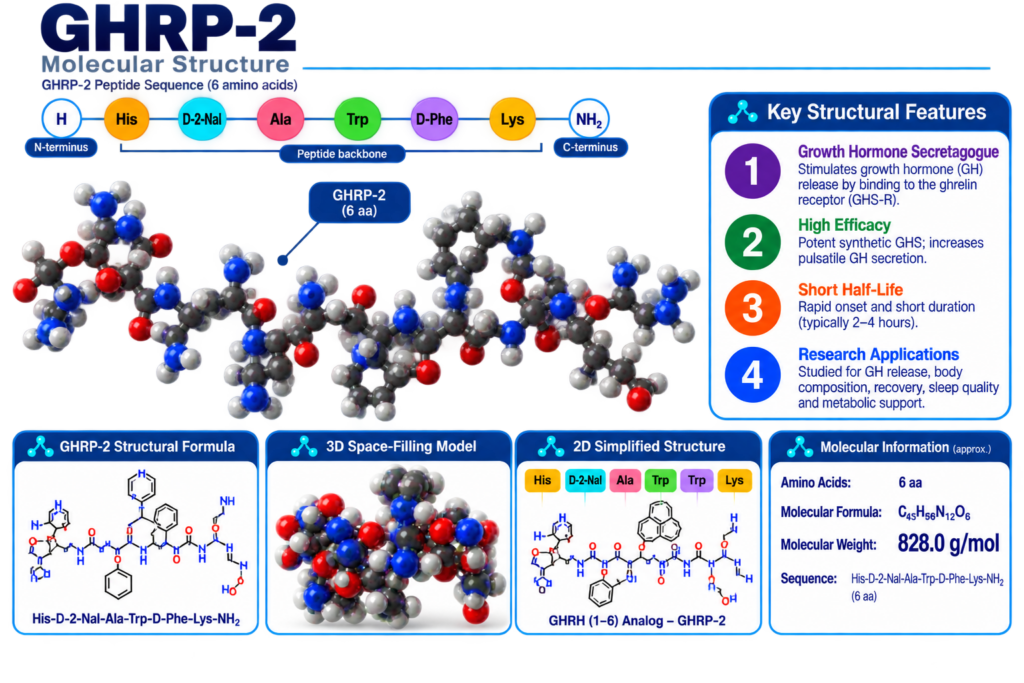
GHRP-2 is a synthetic six-residue growth hormone secretagogue incorporating several non-natural amino-acid residues. Its sequence is D-Ala-D-2-Nal-Ala-Trp-D-Phe-Lys-NH₂, including D-alanine, D-2-naphthylalanine, and D-phenylalanine residues. These structural modifications distinguish GHRP-2 from endogenous peptide hormones and contribute to its utility as an experimental GHSR agonist.
158861-67-7 PubChem substance records associate this CAS number with GHRP-2 / Pralmorelin.
GHSR receptor signaling studies
Growth hormone secretion research
Pituitary somatotroph research
Ghrelin-receptor pharmacology
Appetite and food-intake research
Endocrine signaling studies
Gastrointestinal physiology research
GH secretagogue comparisons
Peptide structure-function research
Growth hormone pathway analysis
Rat pituitary-cell cultures
Pituitary somatotroph systems
Human endocrine studies
Human food-intake studies
Ghrelin-receptor signaling models
Gastrointestinal physiology models
Growth hormone response models
Experimental systems with altered GHRH receptor signaling
Human studies have examined both GH release and food-intake responses to GHRP-2.
HPLC-UV purity analysis
LC-MS identity confirmation
Mass-spectral analysis
LAL endotoxin assay
Serum growth hormone assays
GH secretion assays
GHSR signaling assays
Pituitary-cell GH-release assays
Food-intake measurement
Endocrine hormone profiling
Gastrointestinal motility assays
Receptor-signaling studies
For the actual OPTMZ lot, the COA specifically documents HPLC-UV, LC-MS, and USP LAL endotoxin testing.
Chromatographic purity
Peptide identity
Net peptide content
Endotoxin assay result
Growth hormone concentration
GH secretory response
GHSR-associated signaling
Food intake
Appetite-associated responses
Pituitary-cell activity
Gastrointestinal physiological responses
For the actual OPTMZ product, the directly measured analytical endpoints were purity, identity, GHRP-2 content, appearance, and endotoxin assay performance.
Independent analytical testing of OPTMZ Peptides GHRP-2 5 mg, lot G25, by Freedom Diagnostics reported:
Purity (HPLC-UV): 99.52%
Identity (LC-MS): GHRP-2 confirmed
Measured Net Content: 5.39 mg
Label Claim: 5 mg
Appearance: White lyophilized powder
Endotoxin Replicate 1: Pass
Endotoxin Replicate 2: Pass
Assay Sensitivity: ≤0.05 EU/mL
Analytical Method: HPLC with UV detection coupled with LC-MS
Endotoxin Method: Limulus Amebocyte Lysate assay in accordance with USP
Accession #: 2606080462
Date Received: June 8, 2026
Report Issued: June 9, 2026
These results come directly from the Freedom Diagnostics Certificate of Analysis for the submitted lot.

Restricted Access · Research Use Only
Independently lab tested, every batch
COAs published and searchable by batch number
Policy version 2026-05-14-ruo-v1.0
Reviews
There are no reviews yet.