
For laboratory research use only. Not for human consumption.
Talk to our research support team: 512-998-2437
$70.00 – $650.00Price range: $70.00 through $650.00
These products are for laboratory research only and not intended for medical use. They are not FDA-approved to diagnose, treat, cure, or prevent any disease. By purchasing, you certify they will be used solely for research and not for human or animal consumption.
Research Use Only
All research compounds supplied by OPTMZ Peptides are intended strictly for laboratory research applications and are not designed for medical use. These materials are not approved by the U.S. Food and Drug Administration (FDA) to diagnose, treat, cure, or prevent any disease. By purchasing, the buyer confirms use strictly for scientific research purposes and not for human or animal consumption.
Product Overview
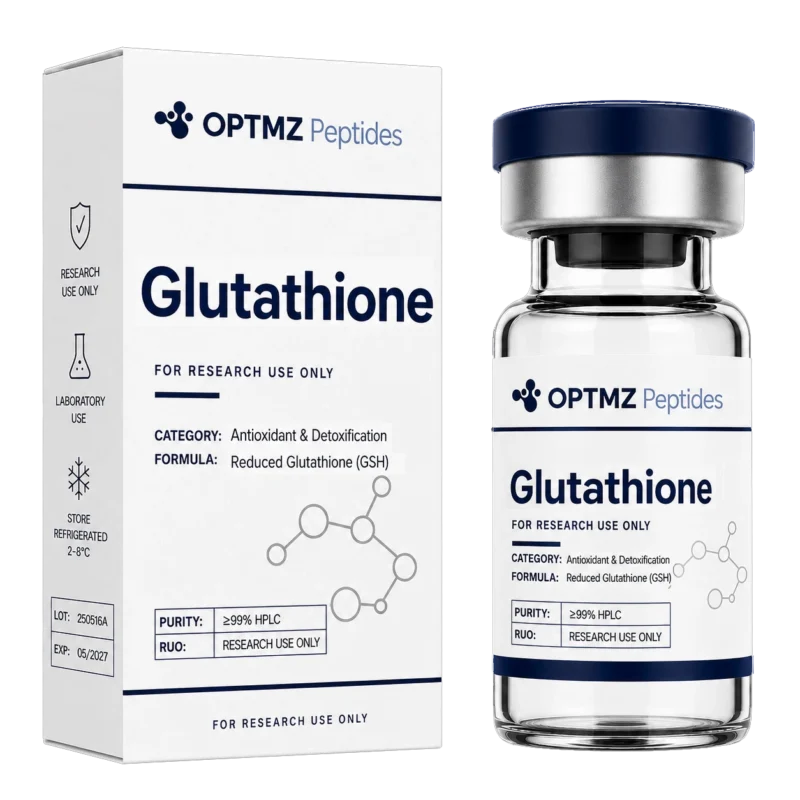
Glutathione is a naturally occurring tripeptide composed of glutamate, cysteine, and glycine. It is extensively investigated in controlled laboratory environments for its involvement in cellular redox regulation, antioxidant defense systems, oxidative-stress pathways, thiol biology, and biochemical detoxification mechanisms.
Glutathione exists primarily in reduced (GSH) and oxidized (GSSG) states, making the GSH/GSSG system an important experimental model for studying cellular redox balance and oxidative processes.
The CAS number, purity, measured content, identity result, and batch information above come directly from the independent laboratory report for this product.
I would not add a molecular formula or molecular weight based solely on this COA, because the report does not state whether the tested material should be represented using a particular glutathione form or specification. If you provide the manufacturer’s specification sheet, we can add those fields confidently.
Each tested batch of Glutathione undergoes analytical evaluation to verify purity, identity, and analytical consistency. A corresponding Certificate of Analysis (COA) is available for the tested lot.
For the current OPTMZ Peptides batch, independent testing by Krause Analytical reported:
The laboratory specifies that values are reported on a per-vial basis unless otherwise noted.
The accompanying COA also includes the chromatogram on page 2 and the mass-spectral report on page 3, providing supporting analytical documentation for sample 205092.
Glutathione should be handled by qualified professionals in controlled laboratory environments. Appropriate storage conditions should be maintained to preserve compound stability and minimize oxidation or degradation.
Avoid unnecessary exposure to heat, moisture, and environmental conditions that could affect compound integrity. Laboratory handling and preparation should follow validated protocols appropriate to the intended experimental application.
Glutathione is extensively investigated in biochemical and cellular research because of its central role in intracellular redox systems.
Research areas include:
These research areas describe experimental and biochemical contexts and do not establish therapeutic efficacy or safety in humans.
Glutathione continues to serve as an important experimental compound in studies involving cellular redox regulation, antioxidant systems, oxidative-stress mechanisms, enzymatic pathways, mitochondrial biology, and biochemical metabolism.
Its ability to transition between reduced and oxidized states makes the glutathione system particularly relevant to laboratory investigations examining cellular oxidative balance and redox-dependent biochemical processes.
For laboratory research use only. Intended strictly for in vitro research applications.
All products currently listed on this site are for research purposes ONLY.
The CAS number, purity, measured content, identity result, and batch information above come directly from the independent laboratory report for this product.
I would not add a molecular formula or molecular weight based solely on this COA, because the report does not state whether the tested material should be represented using a particular glutathione form or specification. If you provide the manufacturer’s specification sheet, we can add those fields confidently.
Each tested batch of Glutathione undergoes analytical evaluation to verify purity, identity, and analytical consistency. A corresponding Certificate of Analysis (COA) is available for the tested lot.
For the current OPTMZ Peptides batch, independent testing by Krause Analytical reported:
The laboratory specifies that values are reported on a per-vial basis unless otherwise noted.
The accompanying COA also includes the chromatogram on page 2 and the mass-spectral report on page 3, providing supporting analytical documentation for sample 205092.
Glutathione should be handled by qualified professionals in controlled laboratory environments. Appropriate storage conditions should be maintained to preserve compound stability and minimize oxidation or degradation.
Avoid unnecessary exposure to heat, moisture, and environmental conditions that could affect compound integrity. Laboratory handling and preparation should follow validated protocols appropriate to the intended experimental application.
Glutathione is extensively investigated in biochemical and cellular research because of its central role in intracellular redox systems.
Research areas include:
These research areas describe experimental and biochemical contexts and do not establish therapeutic efficacy or safety in humans.
Glutathione continues to serve as an important experimental compound in studies involving cellular redox regulation, antioxidant systems, oxidative-stress mechanisms, enzymatic pathways, mitochondrial biology, and biochemical metabolism.
Its ability to transition between reduced and oxidized states makes the glutathione system particularly relevant to laboratory investigations examining cellular oxidative balance and redox-dependent biochemical processes.
For laboratory research use only. Intended strictly for in vitro research applications.
All products currently listed on this site are for research purposes ONLY.
| Pcs | Single Vial, Pack of 10 |
|---|---|
| Strength | 1500 mg |

Restricted Access · Research Use Only
Independently lab tested, every batch
COAs published and searchable by batch number
Policy version 2026-05-14-ruo-v1.0
Reviews
There are no reviews yet.