
Gonadotropin-Releasing Hormone / GnRH Receptor Agonist
Reproductive Endocrinology; Peptide Biology; Pituitary Biology; GnRH Receptor Research; Neuroendocrinology; Reproductive Biology
Gonadotropin-Releasing Hormone Receptor (GnRHR / GnRH1R) GnRHR is the principal receptor through which GnRH regulates anterior pituitary gonadotroph signaling and gonadotropin secretion.
Established Clinical Research Gonadorelin has extensive experimental and human clinical research history, and the molecule has also been used in regulated pharmaceutical products. This classification describes the evidence base surrounding the molecule and does not mean the OPTMZ research product is FDA-approved or intended for clinical use.
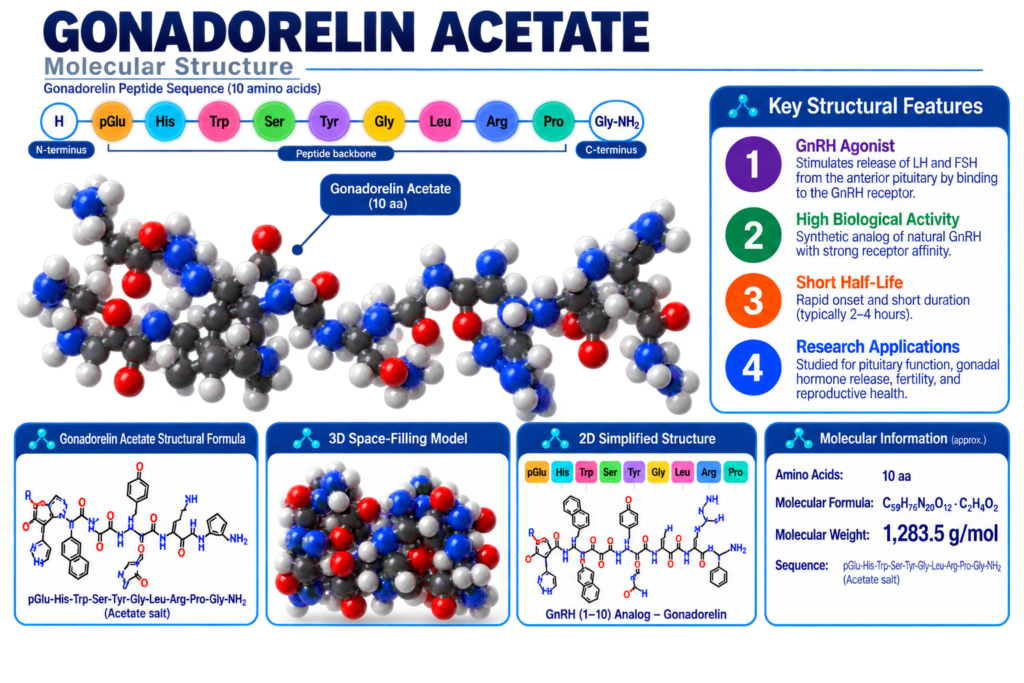
Gonadorelin is a synthetic decapeptide structurally identical to endogenous gonadotropin-releasing hormone (GnRH). It consists of ten amino-acid residues with an N-terminal pyroglutamyl residue and an amidated C-terminus. This compact peptide structure functions as the endogenous ligand framework for the GnRH receptor and serves as a reference molecule for studying GnRH receptor signaling and modified GnRH analogs.
pGlu-His-Trp-Ser-Tyr-Gly-Leu-Arg-Pro-Gly-NH₂ One-letter-style representation: pE-H-W-S-Y-G-L-R-P-G-NH₂ This is the native mammalian GnRH decapeptide sequence; FDA documentation notes that gonadorelin has the same amino-acid sequence as the natural hormone.
GnRH receptor signaling studies
GnRH receptor-binding research
Pituitary gonadotroph studies
LH secretion research
FSH secretion research
Hypothalamic-pituitary-gonadal axis research
Pulsatile GnRH signaling models
GnRH receptor desensitization studies
GnRH agonist/antagonist comparison
Reproductive endocrine signaling
Peptide structure-function analysis
Relevant published experimental systems include:
GnRH receptor-expressing cell systems
Isolated pituitary-cell models
Anterior pituitary gonadotroph models
Receptor-transfected cell systems
GnRH receptor-binding models
Gonadotropin secretion systems
Reproductive endocrine models
Human ovarian tissue research systems
Comparative GnRH agonist/antagonist models
GnRH receptor-binding studies have been performed in isolated pituitary cells and receptor-expression systems.
HPLC-UV purity analysis
LC-MS identity confirmation
Mass-confirmation analysis
LAL endotoxin assay
GnRH receptor-binding assays
Competitive ligand-binding assays
LH secretion assays
FSH secretion assays
Gonadotroph response assays
Receptor activation assays
Intracellular signaling assays
Receptor desensitization/internalization studies
For the actual OPTMZ lot, Freedom Diagnostics specifically documents HPLC-UV, LC-MS, and USP LAL endotoxin testing.
Chromatographic purity
Peptide identity
Net peptide content
Endotoxin assay result
GnRH receptor binding
LH release
FSH release
Gonadotroph signaling
Receptor activation
Ligand-binding affinity
Receptor desensitization
Intracellular signaling responses
For the actual OPTMZ sample, the directly measured analytical endpoints were identity, purity, net content, appearance, and endotoxin assay performance.
Independent analytical testing of OPTMZ Peptides Gonadorelin Acetate 5 mg, lot GND5, by Freedom Diagnostics reported:
Purity (HPLC-UV): 99.94%
Identity (LC-MS): Gonadorelin confirmed
Measured Net Content: 5.84 mg
Label Claim: 5 mg
Appearance: White lyophilized powder
Endotoxin Replicate 1: PASS
Endotoxin Replicate 2: PASS
Assay Sensitivity: ≤0.05 EU/mL
Endotoxin Method: Limulus Amebocyte Lysate assay in accordance with USP
Analytical Method: HPLC with UV detection coupled with LC-MS
Lot: GND5
Accession #: 2606080472
Received: June 8, 2026
Reported: June 9, 2026
These values come directly from the Freedom Diagnostics Certificate of Analysis for the submitted sample.

Restricted Access · Research Use Only
Independently lab tested, every batch
COAs published and searchable by batch number
Policy version 2026-05-14-ruo-v1.0
Reviews
There are no reviews yet.