For laboratory research use only. Not for human consumption.

Talk to our research support team: 512-998-2437

Have questions about

Hexarelin

Text us: 512-998-2437.

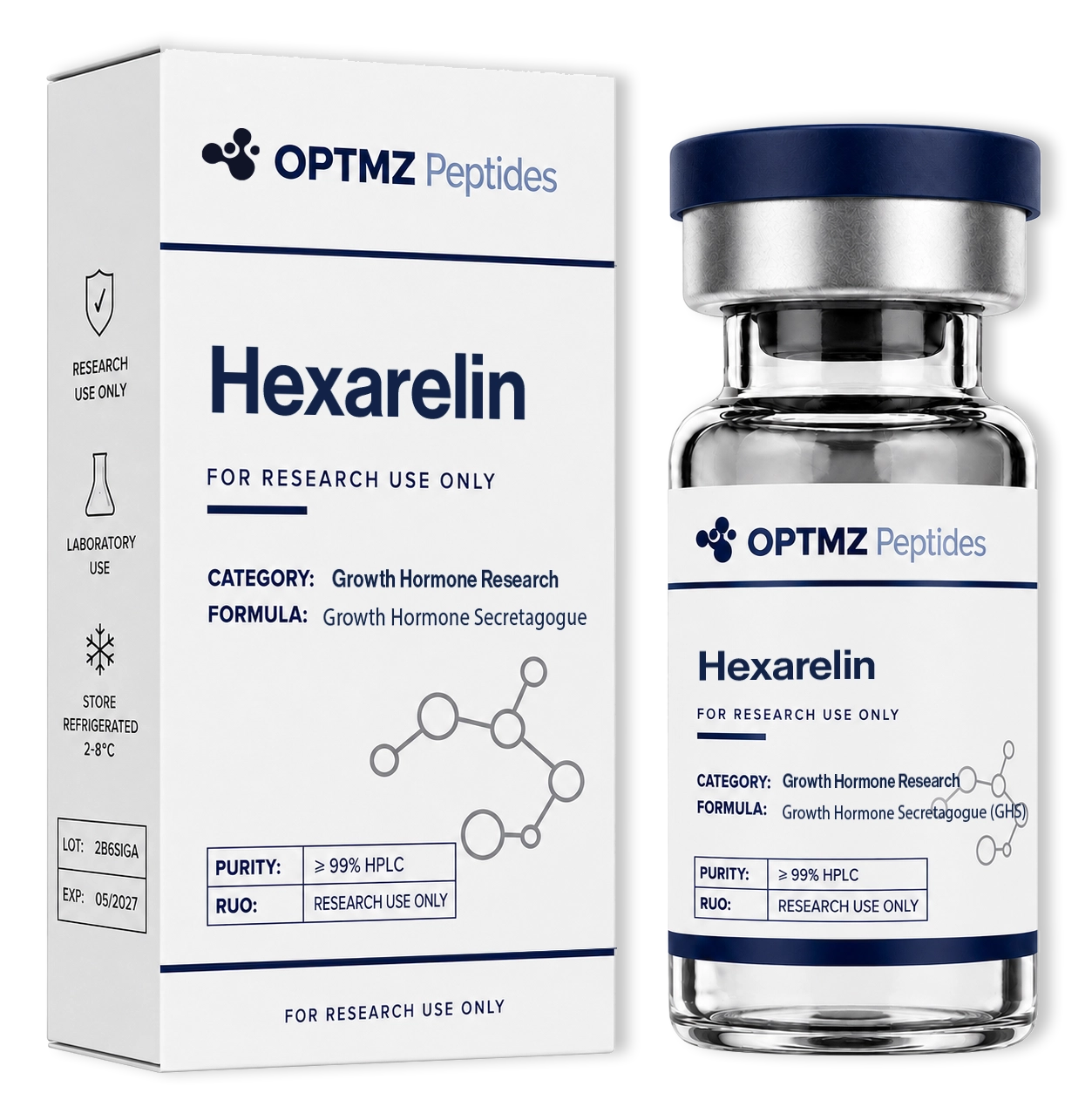
Hexarelin

Growth Hormone Secretagogue

Price range: $79.00 through $629.00

Quantity

Batch Number :

2026/02

Purity Percentage :

99.6

Identity Confirmation :

Krause Analytics

Testing Methods Listed :

HPLC-UV/MS

Krause Analytical Credential Line :

205071

Test Date :

02/03/2026

All products currently listed on this site are for research purposed ONLY.

These products are for laboratory research only and not intended for medical use. They are not FDA-approved to diagnose, treat, cure, or prevent any disease. By purchasing, you certify they will be used solely for research and not for human or animal consumption.

Research Use Only

All research peptides supplied by OPTMZ Peptides are intended strictly for laboratory research applications and are not designed for medical use. These materials are not approved by the U.S. Food and Drug Administration (FDA) to diagnose, treat, cure, or prevent any disease. By purchasing, the buyer confirms use strictly for scientific research purposes and not for human or animal consumption.

Product Overview

Hexarelin, also known as Examorelin, is a synthetic hexapeptide growth hormone secretagogue investigated in controlled experimental and clinical research for its interaction with growth hormone secretagogue receptor signaling.

Hexarelin has the sequence His-D-2-methyl-Trp-Ala-Trp-D-Phe-Lys-NH₂ and belongs to the growth hormone-releasing peptide family. Early human studies characterized Hexarelin as a potent GH-releasing hexapeptide, while subsequent research examined its activity at pituitary and hypothalamic growth hormone secretagogue receptors.

Technical Specifications

  • Product: Hexarelin Acetate
  • Analyte Identified: Hexarelin (Examorelin)
  • Quantity: 10 mg label claim
  • Research Classification: Growth Hormone Secretagogue
  • Compound Type: Synthetic Hexapeptide / GHSR Agonist
  • Primary Research Target: Growth Hormone Secretagogue Receptor (GHSR / GHS-R1a)
  • CAS Number: 140703-51-1
  • PubChem CID: 6918297
  • Molecular Formula: C₄₇H₅₈N₁₂O₆
  • Molecular Weight: Approximately 887.0 g/mol
  • Peptide Length: 6 residues
  • Sequence: His-D-2-methyl-Trp-Ala-Trp-D-Phe-Lys-NH₂
  • Chromatographic Purity: 99.6%
  • Identity: Hexarelin (Examorelin) confirmed by HPLC-UV-MS
  • Measured Content: 9.5 mg
  • Percent of Label: 95.4%
  • Analysis Method: HPLC-UV-MS
  • Endotoxins: <0.5 EU/mL
  • Endotoxin Method: USP <85>
  • Batch/Lot: 2026/02

The purity, identity, measured content, CAS number, and endotoxin result above come directly from the Krause Analytical report for the submitted OPTMZ sample.

PubChem identifies Examorelin/Hexarelin as molecular formula C₄₇H₅₈N₁₂O₆ and PubChem CID 6918297.

Important distinction: Your COA title says Hexarelin Acetate, but the analytical result identifies the analyte as Hexarelin (Examorelin) and reports CAS 140703-51-1. The COA does not separately characterize acetate stoichiometry. I would therefore use the COA-verified Hexarelin identity and avoid publishing a separate acetate molecular formula unless your manufacturer’s specification sheet confirms the exact salt form.

Analytical & Testing

Each tested batch of Hexarelin undergoes analytical evaluation to verify chromatographic purity, identity, peptide content, and analytical consistency.

For the submitted OPTMZ Peptides sample, Krause Analytical reported:

  • Chromatographic Purity: 99.6%
  • Identity: Hexarelin (Examorelin) — Confirmed
  • Measured Content: 9.5 mg
  • Label Claim: 10 mg
  • Percent of Label: 95.4%
  • Testing Method: HPLC-UV-MS
  • CAS Number: 140703-51-1
  • Endotoxins: <0.5 EU/mL
  • Endotoxin Method: USP <85>
  • Batch/Lot: 2026/02

The laboratory states that reported values are on a per-vial basis unless otherwise noted.

The COA also contains the chromatogram on page 2 and the mass spectrum on page 3 supporting the analytical identity assessment.

Handling & Storage

Hexarelin should be handled by qualified professionals in controlled laboratory environments. Appropriate storage conditions should be maintained to preserve peptide stability and structural integrity.

Avoid unnecessary exposure to heat, moisture, light, and repeated temperature fluctuations. Experimental preparation, storage, and handling should follow validated laboratory procedures appropriate to the intended research application.

Research Context

Hexarelin has been investigated in experimental and clinical research involving growth hormone secretagogue signaling, pituitary physiology, hypothalamic signaling, and endocrine regulation.

Research areas include:

  • Growth hormone secretagogue receptor signaling
  • Growth hormone release
  • Pituitary signaling
  • Hypothalamic signaling
  • Somatotroph biology
  • GH pulse regulation
  • Growth hormone secretagogue pharmacology
  • Ghrelin-receptor biology
  • Endocrine feedback mechanisms
  • Cardiovascular experimental research
  • Metabolic signaling

Human studies describe Hexarelin as a synthetic hexapeptide capable of stimulating growth hormone release in healthy subjects.

Research has also examined Hexarelin’s effects at pituitary and hypothalamic levels and its influence on GH, prolactin, ACTH, and cortisol secretion.

Repeated-administration studies have evaluated its effects on 24-hour GH secretion and GH secretory pulse mass.

These findings describe experimental and clinical research observations and do not establish approved therapeutic use of the research material supplied here.

Research Application Scope

Hexarelin is relevant to controlled experimental investigations involving GHSR biology, pituitary signaling, GH secretion, hypothalamic-pituitary communication, peptide pharmacology, and growth hormone secretagogue structure-function relationships.

Because Hexarelin acts through the growth hormone secretagogue receptor, it is mechanistically distinct from GHRH analogs such as Tesamorelin and CJC-1295, which act primarily through GHRHR.

Experimental literature has also identified Hexarelin-associated binding sites outside classical endocrine tissues, which has contributed to broader research into cardiovascular and peripheral signaling mechanisms.

Use Statement

For laboratory research use only. Intended strictly for in vitro and controlled experimental research applications.

Disclaimer

All products currently listed on this site are for research purposes ONLY.

Description

Technical Specifications

  • Product: Hexarelin Acetate
  • Analyte Identified: Hexarelin (Examorelin)
  • Quantity: 10 mg label claim
  • Research Classification: Growth Hormone Secretagogue
  • Compound Type: Synthetic Hexapeptide / GHSR Agonist
  • Primary Research Target: Growth Hormone Secretagogue Receptor (GHSR / GHS-R1a)
  • CAS Number: 140703-51-1
  • PubChem CID: 6918297
  • Molecular Formula: C₄₇H₅₈N₁₂O₆
  • Molecular Weight: Approximately 887.0 g/mol
  • Peptide Length: 6 residues
  • Sequence: His-D-2-methyl-Trp-Ala-Trp-D-Phe-Lys-NH₂
  • Chromatographic Purity: 99.6%
  • Identity: Hexarelin (Examorelin) confirmed by HPLC-UV-MS
  • Measured Content: 9.5 mg
  • Percent of Label: 95.4%
  • Analysis Method: HPLC-UV-MS
  • Endotoxins: <0.5 EU/mL
  • Endotoxin Method: USP <85>
  • Batch/Lot: 2026/02

The purity, identity, measured content, CAS number, and endotoxin result above come directly from the Krause Analytical report for the submitted OPTMZ sample.

PubChem identifies Examorelin/Hexarelin as molecular formula C₄₇H₅₈N₁₂O₆ and PubChem CID 6918297.

Important distinction: Your COA title says Hexarelin Acetate, but the analytical result identifies the analyte as Hexarelin (Examorelin) and reports CAS 140703-51-1. The COA does not separately characterize acetate stoichiometry. I would therefore use the COA-verified Hexarelin identity and avoid publishing a separate acetate molecular formula unless your manufacturer’s specification sheet confirms the exact salt form.

Analytical & Testing

Each tested batch of Hexarelin undergoes analytical evaluation to verify chromatographic purity, identity, peptide content, and analytical consistency.

For the submitted OPTMZ Peptides sample, Krause Analytical reported:

  • Chromatographic Purity: 99.6%
  • Identity: Hexarelin (Examorelin) — Confirmed
  • Measured Content: 9.5 mg
  • Label Claim: 10 mg
  • Percent of Label: 95.4%
  • Testing Method: HPLC-UV-MS
  • CAS Number: 140703-51-1
  • Endotoxins: <0.5 EU/mL
  • Endotoxin Method: USP <85>
  • Batch/Lot: 2026/02

The laboratory states that reported values are on a per-vial basis unless otherwise noted.

The COA also contains the chromatogram on page 2 and the mass spectrum on page 3 supporting the analytical identity assessment.

Handling & Storage

Hexarelin should be handled by qualified professionals in controlled laboratory environments. Appropriate storage conditions should be maintained to preserve peptide stability and structural integrity.

Avoid unnecessary exposure to heat, moisture, light, and repeated temperature fluctuations. Experimental preparation, storage, and handling should follow validated laboratory procedures appropriate to the intended research application.

Research Context

Hexarelin has been investigated in experimental and clinical research involving growth hormone secretagogue signaling, pituitary physiology, hypothalamic signaling, and endocrine regulation.

Research areas include:

  • Growth hormone secretagogue receptor signaling
  • Growth hormone release
  • Pituitary signaling
  • Hypothalamic signaling
  • Somatotroph biology
  • GH pulse regulation
  • Growth hormone secretagogue pharmacology
  • Ghrelin-receptor biology
  • Endocrine feedback mechanisms
  • Cardiovascular experimental research
  • Metabolic signaling

Human studies describe Hexarelin as a synthetic hexapeptide capable of stimulating growth hormone release in healthy subjects.

Research has also examined Hexarelin’s effects at pituitary and hypothalamic levels and its influence on GH, prolactin, ACTH, and cortisol secretion.

Repeated-administration studies have evaluated its effects on 24-hour GH secretion and GH secretory pulse mass.

These findings describe experimental and clinical research observations and do not establish approved therapeutic use of the research material supplied here.

Research Application Scope

Hexarelin is relevant to controlled experimental investigations involving GHSR biology, pituitary signaling, GH secretion, hypothalamic-pituitary communication, peptide pharmacology, and growth hormone secretagogue structure-function relationships.

Because Hexarelin acts through the growth hormone secretagogue receptor, it is mechanistically distinct from GHRH analogs such as Tesamorelin and CJC-1295, which act primarily through GHRHR.

Experimental literature has also identified Hexarelin-associated binding sites outside classical endocrine tissues, which has contributed to broader research into cardiovascular and peripheral signaling mechanisms.

Use Statement

For laboratory research use only. Intended strictly for in vitro and controlled experimental research applications.

Disclaimer

All products currently listed on this site are for research purposes ONLY.

Additional information

Pcs

Single Vial, Pack of 10

Strength

10mg

Reviews

There are no reviews yet.

Be the first to review “Hexarelin”

Your email address will not be published. Required fields are marked *

Research Profile

Research Classification

Growth Hormone Secretagogue / Ghrelin Receptor Agonist

Research Discipline

Endocrinology; Peptide Biology; Ghrelin Receptor Research; Pituitary Biology; Hypothalamic Biology; Pharmacology; Cardiovascular Research

Primary Molecular Target

Growth Hormone Secretagogue Receptor (GHSR / GHS-R1a) Hexarelin belongs to the growth hormone secretagogue family and acts through specific GHS receptors at pituitary and hypothalamic sites. Additional research has examined peripheral Hexarelin-binding sites, including CD36-associated signaling in cardiovascular systems, but GHSR remains the primary endocrine target relevant to GH secretagogue research.

Evidence Level

Clinical Research Hexarelin has been evaluated in controlled human studies examining GH release, endocrine hormone responses, and repeated-administration effects, in addition to substantial preclinical research. This classification refers to the existence of human research and does not imply FDA approval or established therapeutic efficacy.
Molecular Structure

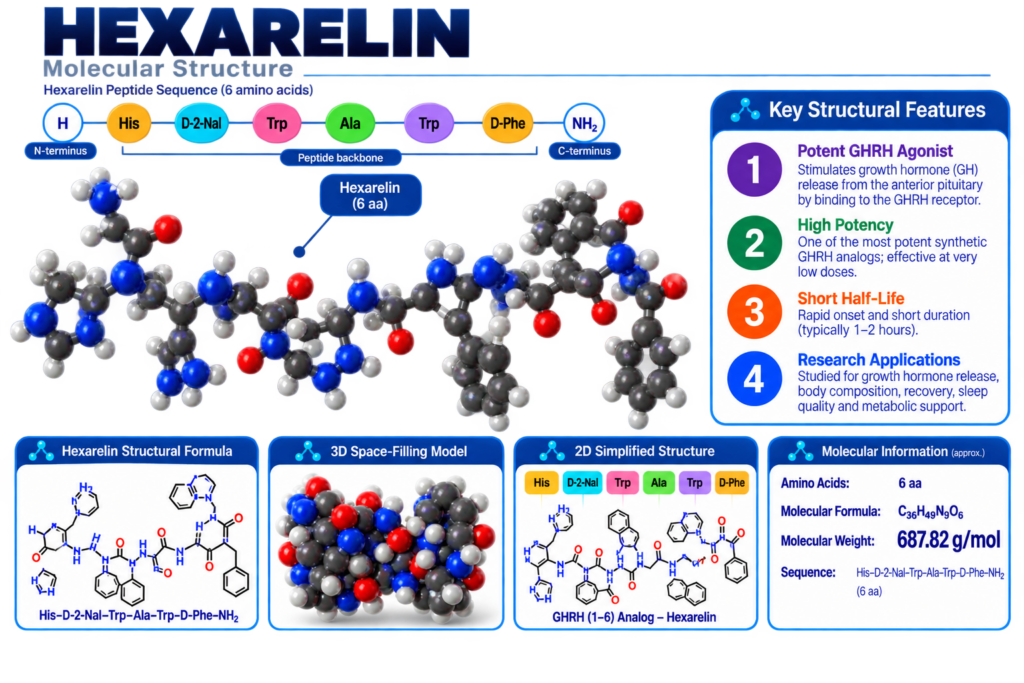
Hexarelin is a synthetic six-residue growth hormone secretagogue with the sequence His-D-2-methyl-Trp-Ala-Trp-D-Phe-Lys-NH₂. The structure incorporates D-amino-acid residues and a 2-methyl-tryptophan substitution designed to produce a stable growth hormone-releasing peptide analog. Early pharmacological studies describe it as a potent GHRP-family secretagogue.

Chemical Identity

Molecular FormulaC₄₇H₅₈N₁₂O₆ This is the PubChem formula for Examorelin/Hexarelin.
Molecular WeightApproximately 887.0 g/mol PubChem reports a monoisotopic molecular weight of approximately 886.46 Da for Examorelin.
CAS Number140703-51-1 This CAS number is reported directly by Krause Analytical for the tested Hexarelin sample

Amino Acid Sequence

His-D-2-methyl-Trp-Ala-Trp-D-Phe-Lys-NH₂ Published human research describes Hexarelin using this six-residue sequence.

Experimental Research Applications

GHSR receptor signaling studies
Growth hormone release research
Pituitary signaling studies
Hypothalamic signaling research
Growth hormone secretagogue pharmacology
GH pulsatility research
Endocrine feedback studies
Ghrelin-receptor pathway studies
Cardiovascular experimental models
Peptide structure-function analysis

Experimental Systems

Published Hexarelin research systems include:

Human endocrine studies
Healthy adult volunteer studies
Pituitary-associated experimental systems
Hypothalamic signaling models
Peripheral lymphocyte models
Rat cardiovascular models
Myocardial infarction models
Endocrine tissue binding studies
GH secretion models

Human studies have directly evaluated Hexarelin-induced GH release and repeated secretagogue exposure.

Specific Assays

HPLC-UV chromatographic purity analysis
LC-MS identity confirmation
Mass-spectral analysis
Serum GH assays
Prolactin assays
ACTH assays
Cortisol assays
GH pulse analysis
Receptor-binding assays
GHSR expression analysis
Endocrine hormone profiling
USP endotoxin testing

For the actual OPTMZ lot, Krause Analytical specifically performed HPLC-UV-MS analysis and USP endotoxin testing.

Measured Endpoints

Chromatographic purity
Hexarelin identity
Hexarelin content
Endotoxin concentration
Growth hormone concentration
GH secretory pulse mass
Prolactin concentration
ACTH concentration
Cortisol concentration
GHSR-associated signaling
Endocrine tissue binding
Cardiovascular physiological responses

Published human experiments measured GH and other pituitary-adrenal hormones following Hexarelin exposure.

For the actual OPTMZ sample, the directly measured analytical endpoints were purity, identity, Hexarelin content, and endotoxin concentration.

Analytical Characterization

Independent analytical testing of OPTMZ Peptides Hexarelin Acetate 10 mg, batch/lot 2026/02, by Krause Analytical reported:

Chromatographic Purity: 99.6%
Hexarelin Content: 9.5 mg
Label Claim: 10 mg
Percent of Label: 95.4%
Identity: Hexarelin (Examorelin) confirmed
CAS Number: 140703-51-1
Analysis Method: HPLC-UV-MS
Endotoxins: <0.5 EU/mL Endotoxin Method: USP
Lab Number: 205071
Project: 145211
Date Received: April 28, 2026
Report Issued: May 22, 2026

The laboratory states that analytical values are reported on a per-vial basis unless otherwise noted.

The report also provides the underlying chromatographic data on page 2 and mass-spectral data on page 3.

Text us, our dedicated team is here to help.

Reach out and get a response within minutes