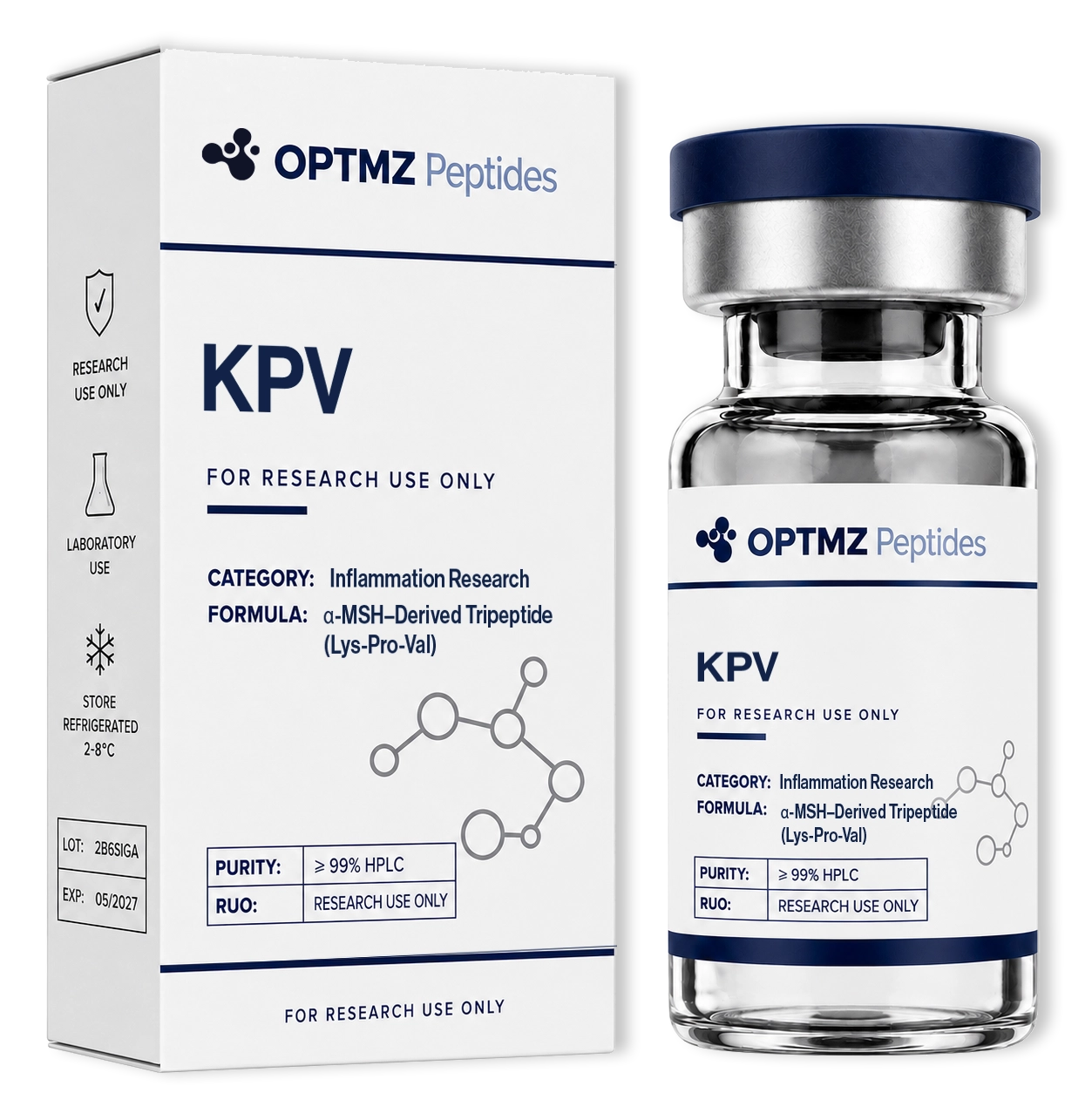
For laboratory research use only. Not for human consumption.

Talk to our research support team: 512-998-2437

Sale!Sale!
Have questions about

KPV

Text us: 512-998-2437.

KPV

Anti-Inflammatory Research Peptide

Price range: $60.00 through $550.00

Quantity

Batch Number :

2026/02

Purity Percentage :

99.6

Identity Confirmation :

Confirmed KPV

Testing Methods Listed :

HPLC-UV/MS

Krause Analytical Credential Line :

205091

Test Date :

13/05/2026

All products currently listed on this site are for research purposed ONLY.

These products are for laboratory research only and not intended for medical use. They are not FDA-approved to diagnose, treat, cure, or prevent any disease. By purchasing, you certify they will be used solely for research and not for human or animal consumption.

Research Use Only

All research peptides supplied by OPTMZ Peptides are intended strictly for laboratory research applications and are not designed for medical use. These materials are not approved by the U.S. Food and Drug Administration (FDA) to diagnose, treat, cure, or prevent any disease. By purchasing, the buyer confirms use strictly for scientific research purposes and not for human or animal consumption.

Product Overview

KPV is a synthetic tripeptide composed of the amino acids lysine, proline, and valine. It corresponds to the C-terminal amino-acid sequence 11–13 of alpha-melanocyte-stimulating hormone (α-MSH) and is investigated in controlled laboratory environments for its interactions with inflammatory signaling, intestinal epithelial biology, immune-cell pathways, and peptide transport mechanisms.

Experimental research has examined KPV in cellular and animal models involving NF-κB and MAP kinase signaling, pro-inflammatory cytokine expression, intestinal epithelial cells, immune cells, and peptide transporter 1 (PepT1)-mediated cellular uptake.

Technical Specifications

  • Product: KPV
  • Quantity: 10 mg label claim
  • Research Classification: Anti-Inflammatory Research Peptide
  • Compound Type: Tripeptide
  • Amino Acid Sequence: Lys-Pro-Val (KPV)
  • Peptide Length: 3 amino acids
  • CAS Number: 112965-21-6
  • Purity: 99.6% chromatographic purity
  • Identity: Confirmed by mass spectral match
  • Measured Content: 8.86 mg
  • Percent of Label: 88.6%
  • Analysis Method: HPLC-UV-MS
  • Endotoxins: <0.5 EU/mL
  • Endotoxin Method: USP <85>
  • Batch/Lot: 2026/02

The CAS number, chromatographic purity, measured content, identity confirmation, and endotoxin result above come directly from the Krause Analytical COA for the tested OPTMZ sample.

Analytical & Testing

Each tested batch of KPV undergoes analytical evaluation to verify chromatographic purity, identity, peptide content, and analytical consistency. A corresponding Certificate of Analysis is maintained for the tested lot.

For the submitted OPTMZ Peptides sample, independent testing by Krause Analytical reported:

  • Chromatographic Purity: 99.6%
  • Identity: Confirmed by mass spectral match
  • Measured Content: 8.86 mg
  • Label Claim: 10 mg
  • Percent of Label: 88.6%
  • Testing Method: HPLC-UV-MS
  • Endotoxins: <0.5 EU/mL
  • Endotoxin Method: USP <85>
  • CAS Number: 112965-21-6
  • Batch/Lot: 2026/02

The laboratory specifies that all values are reported on a per-vial basis unless otherwise noted.

The accompanying COA also includes the underlying chromatogram on page 2, which shows a dominant principal peak, and the mass-spectral report on page 3 supporting the identity analysis.

Handling & Storage

KPV should be handled by qualified professionals in controlled laboratory environments. Appropriate storage conditions should be maintained to preserve peptide stability and structural integrity.

Avoid unnecessary exposure to heat, moisture, and repeated temperature fluctuations. Experimental preparation, storage, and handling should follow validated laboratory procedures appropriate to the intended research application.

Research Context

KPV has been investigated in experimental systems involving inflammatory signaling, intestinal epithelial biology, immune-cell signaling, and melanocortin-derived peptide biology.

Research areas include:

  • NF-κB signaling
  • MAP kinase signaling
  • Pro-inflammatory cytokine expression
  • PepT1-mediated peptide transport
  • Intestinal epithelial-cell biology
  • Immune-cell signaling
  • Inflammatory pathway research
  • α-MSH-derived peptide biology
  • Cellular peptide uptake
  • Gastrointestinal experimental models
  • Peptide structure-function relationships

A published study using human intestinal epithelial cells and Jurkat T cells found KPV uptake was associated with PepT1 and examined NF-κB, MAP kinase pathways, and pro-inflammatory cytokine secretion. The same study also evaluated KPV in DSS- and TNBS-induced mouse colitis models.

Other experimental research has examined KPV in DSS and CD45RB-high transfer models of intestinal inflammation and reported that some observed activity persisted in mice with nonfunctional MC1R, suggesting that KPV’s experimental signaling cannot simply be attributed to conventional MC1R activation.

These findings describe preclinical experimental research and do not establish therapeutic efficacy or safety in humans.

Research Application Scope

KPV continues to be evaluated as an experimental research peptide for investigating inflammatory signaling, intestinal peptide transport, epithelial-cell responses, immune-cell biology, and molecular pathways associated with α-MSH-derived peptides.

Its three-amino-acid Lys-Pro-Val structure represents the C-terminal tripeptide of α-MSH. Despite lacking much of the parent peptide’s structure, KPV has retained biological activity in multiple experimental inflammatory models, making it useful for investigating structure-function relationships among melanocortin-derived peptides.

Use Statement

For laboratory research use only. Intended strictly for in vitro and controlled experimental research applications.

Disclaimer

All products currently listed on this site are for research purposes ONLY.

Description

Technical Specifications

  • Product: KPV
  • Quantity: 10 mg label claim
  • Research Classification: Anti-Inflammatory Research Peptide
  • Compound Type: Tripeptide
  • Amino Acid Sequence: Lys-Pro-Val (KPV)
  • Peptide Length: 3 amino acids
  • CAS Number: 112965-21-6
  • Purity: 99.6% chromatographic purity
  • Identity: Confirmed by mass spectral match
  • Measured Content: 8.86 mg
  • Percent of Label: 88.6%
  • Analysis Method: HPLC-UV-MS
  • Endotoxins: <0.5 EU/mL
  • Endotoxin Method: USP <85>
  • Batch/Lot: 2026/02

The CAS number, chromatographic purity, measured content, identity confirmation, and endotoxin result above come directly from the Krause Analytical COA for the tested OPTMZ sample.

Analytical & Testing

Each tested batch of KPV undergoes analytical evaluation to verify chromatographic purity, identity, peptide content, and analytical consistency. A corresponding Certificate of Analysis is maintained for the tested lot.

For the submitted OPTMZ Peptides sample, independent testing by Krause Analytical reported:

  • Chromatographic Purity: 99.6%
  • Identity: Confirmed by mass spectral match
  • Measured Content: 8.86 mg
  • Label Claim: 10 mg
  • Percent of Label: 88.6%
  • Testing Method: HPLC-UV-MS
  • Endotoxins: <0.5 EU/mL
  • Endotoxin Method: USP <85>
  • CAS Number: 112965-21-6
  • Batch/Lot: 2026/02

The laboratory specifies that all values are reported on a per-vial basis unless otherwise noted.

The accompanying COA also includes the underlying chromatogram on page 2, which shows a dominant principal peak, and the mass-spectral report on page 3 supporting the identity analysis.

Handling & Storage

KPV should be handled by qualified professionals in controlled laboratory environments. Appropriate storage conditions should be maintained to preserve peptide stability and structural integrity.

Avoid unnecessary exposure to heat, moisture, and repeated temperature fluctuations. Experimental preparation, storage, and handling should follow validated laboratory procedures appropriate to the intended research application.

Research Context

KPV has been investigated in experimental systems involving inflammatory signaling, intestinal epithelial biology, immune-cell signaling, and melanocortin-derived peptide biology.

Research areas include:

  • NF-κB signaling
  • MAP kinase signaling
  • Pro-inflammatory cytokine expression
  • PepT1-mediated peptide transport
  • Intestinal epithelial-cell biology
  • Immune-cell signaling
  • Inflammatory pathway research
  • α-MSH-derived peptide biology
  • Cellular peptide uptake
  • Gastrointestinal experimental models
  • Peptide structure-function relationships

A published study using human intestinal epithelial cells and Jurkat T cells found KPV uptake was associated with PepT1 and examined NF-κB, MAP kinase pathways, and pro-inflammatory cytokine secretion. The same study also evaluated KPV in DSS- and TNBS-induced mouse colitis models.

Other experimental research has examined KPV in DSS and CD45RB-high transfer models of intestinal inflammation and reported that some observed activity persisted in mice with nonfunctional MC1R, suggesting that KPV’s experimental signaling cannot simply be attributed to conventional MC1R activation.

These findings describe preclinical experimental research and do not establish therapeutic efficacy or safety in humans.

Research Application Scope

KPV continues to be evaluated as an experimental research peptide for investigating inflammatory signaling, intestinal peptide transport, epithelial-cell responses, immune-cell biology, and molecular pathways associated with α-MSH-derived peptides.

Its three-amino-acid Lys-Pro-Val structure represents the C-terminal tripeptide of α-MSH. Despite lacking much of the parent peptide’s structure, KPV has retained biological activity in multiple experimental inflammatory models, making it useful for investigating structure-function relationships among melanocortin-derived peptides.

Use Statement

For laboratory research use only. Intended strictly for in vitro and controlled experimental research applications.

Disclaimer

All products currently listed on this site are for research purposes ONLY.

Additional information

Pcs

Single Vial, Pack of 10

Strength

10mg

Reviews

There are no reviews yet.

Be the first to review “KPV”

Your email address will not be published. Required fields are marked *

Research Profile

Research Classification

Anti-Inflammatory Research Peptide / Melanocortin-Derived Tripeptide

Research Discipline

Immunology; Cell Biology; Gastrointestinal Biology; Molecular Signaling; Peptide Biology

Primary Molecular Target

Peptide Transporter 1 (PepT1/SLC15A1); NF-κB and MAPK-associated inflammatory signaling pathways KPV has been experimentally demonstrated to undergo PepT1-mediated uptake in intestinal epithelial and immune-cell systems. Its downstream experimental effects include modulation of NF-κB and MAP kinase signaling.

Evidence Level

The research supporting these applications consists predominantly of cellular, biochemical, and animal-model studies rather than established human clinical evidence.
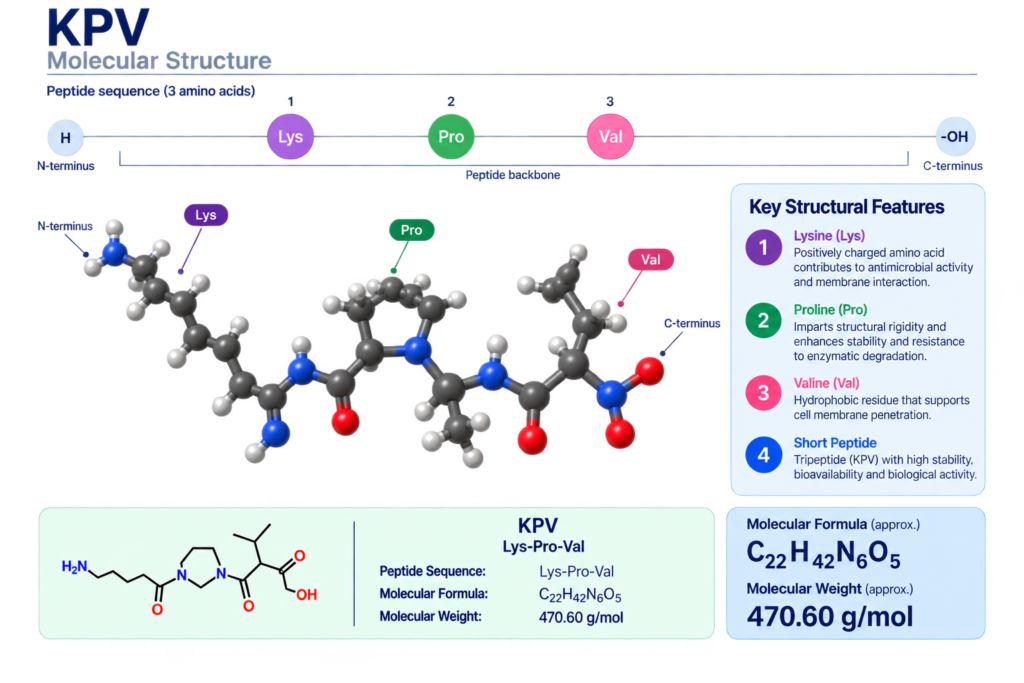
Molecular Structure

KPV is a linear tripeptide composed of lysine, proline, and valine (Lys-Pro-Val). It corresponds to the C-terminal three-amino-acid sequence of α-melanocyte-stimulating hormone (α-MSH 11–13). Its compact structure has made KPV useful in experimental investigations of melanocortin-derived peptide signaling and peptide structure-function relationships.

Chemical Identity

Molecular FormulaC₁₆H₃₀N₄O₄
Molecular Weight342.44 g/mol
CAS Number112965-21-6

Amino Acid Sequence

Lys-Pro-Val

Experimental Research Applications

Inflammatory signaling research
NF-κB pathway studies
MAP kinase pathway studies
Cytokine-expression research
PepT1 peptide-transport studies
Intestinal epithelial-cell research
Immune-cell signaling
Melanocortin-derived peptide research
Peptide uptake studies
Gastrointestinal experimental models
Peptide structure-function analysis

Experimental Systems

Published experimental systems involving KPV include:

Caco2-BBE human intestinal epithelial cells
HT29-Cl.19A intestinal epithelial cells
Jurkat human T cells
Human keratinocyte models
PepT1 transport systems
DSS-induced mouse colitis models
TNBS-induced mouse colitis models
CD45RB-high transfer colitis models
MC1R-deficient experimental models

These are published research systems and do not represent approved clinical applications

Specific Assays

NF-κB luciferase reporter assays
Western blot analysis
Real-time RT-PCR
ELISA
PepT1 uptake/competition assays
Radiolabeled KPV uptake assays
MAP kinase phosphorylation analysis
Cytokine-expression assays
Histological analysis
Myeloperoxidase (MPO) activity assays
HPLC-UV purity analysis
Mass-spectral identity analysis
USP endotoxin testing

The cellular research literature specifically reports NF-κB luciferase, Western blot, RT-PCR, ELISA, and peptide-uptake experiments.

Measured Endpoints

NF-κB activation
IκB-α degradation and phosphorylation
ERK1/2 phosphorylation
JNK phosphorylation
p38 MAPK phosphorylation
Pro-inflammatory cytokine expression
Cytokine secretion
PepT1-mediated peptide uptake
Histological inflammatory changes
MPO activity
Cellular inflammatory responses

For the OPTMZ product itself, analytical endpoints include chromatographic purity, identity, KPV content, and endotoxin concentration.

Analytical Characterization

Independent analytical testing of OPTMZ Peptides KPV 10 mg, batch/lot 2026/02, by Krause Analytical reported:

Chromatographic Purity: 99.6%
KPV Content: 8.86 mg
Label Claim: 10 mg
Percent of Label: 88.6%
Identity: Mass spectral match confirmed
CAS Number: 112965-21-6
Analysis Method: HPLC-UV-MS
Endotoxins: <0.5 EU/mL Endotoxin Method: USP
Lab Number: 205091
Project: 145211

The COA states that values are reported per vial unless otherwise noted.

Text us, our dedicated team is here to help.

Reach out and get a response within minutes