For laboratory research use only. Not for human consumption.

Talk to our research support team: 512-998-2437

Sale!Sale!
Have questions about

NAD+

Text us: 512-998-2437.

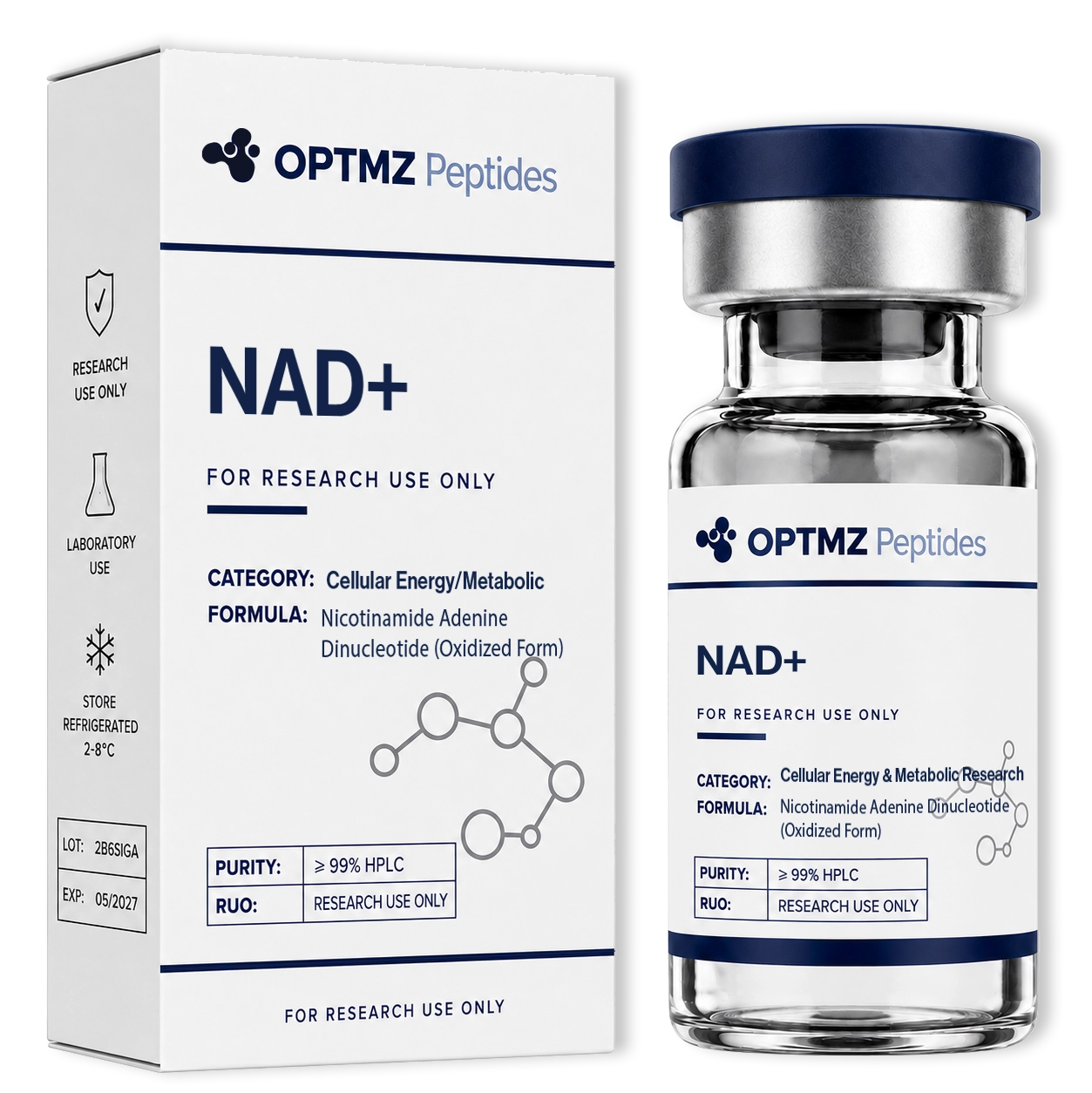
NAD+

Cellular Redox Coenzyme

Price range: $50.00 through $750.00

Quantity

Batch Number :

2026/02

Purity Percentage :

99.89

Identity Confirmation :

Krause Analytics

Testing Methods Listed :

HPLC-UV/MS

Krause Analytical Credential Line :

Test Date :

02/03/2026

All products currently listed on this site are for research purposed ONLY.

These products are for laboratory research only and not intended for medical use. They are not FDA-approved to diagnose, treat, cure, or prevent any disease. By purchasing, you certify they will be used solely for research and not for human or animal consumption.

Research Use Only

All research compounds supplied by OPTMZ Peptides are intended strictly for laboratory research applications and are not designed for medical use. These materials are not approved by the U.S. Food and Drug Administration (FDA) to diagnose, treat, cure, or prevent any disease. By purchasing, the buyer confirms use strictly for scientific research purposes and not for human or animal consumption.

Product Overview

NAD+ (nicotinamide adenine dinucleotide) is an endogenous nucleotide-derived coenzyme central to cellular redox chemistry, energy metabolism, mitochondrial function, and enzyme-mediated signaling.

NAD+ participates in reversible oxidation-reduction reactions through conversion between its oxidized NAD+ and reduced NADH forms. It also serves as a substrate for NAD+-consuming enzymes including sirtuins, poly(ADP-ribose) polymerases (PARPs), and CD38-associated pathways.

Unlike many products in the OPTMZ Peptides catalog, NAD+ is not a peptide. It is more accurately classified as a cellular redox coenzyme and nucleotide-derived metabolite.

Technical Specifications

  • Product: NAD+
  • Full Name: Nicotinamide Adenine Dinucleotide
  • Quantity: 100 mg label claim
  • Research Classification: Cellular Redox Coenzyme
  • Compound Type: Dinucleotide Coenzyme
  • Primary Research Context: Cellular redox metabolism / mitochondrial bioenergetics / NAD+-dependent enzyme signaling
  • CAS Number: 53-84-9
  • Molecular Formula: C₂₁H₂₇N₇O₁₄P₂
  • Molecular Weight: Approximately 663.43 g/mol
  • Chromatographic Purity: 99.89%
  • Identity: NAD+ confirmed by HPLC-UV-MS
  • Measured Content: 82.5 mg
  • Percent of Label: 82.5%
  • Analysis Method: HPLC-UV-MS
  • Laboratory: Krause Analytical
  • Lab Number: 200516
  • Project: 145030
  • Date Received: January 29, 2026
  • Report Issued: February 6, 2026

The lot-specific purity, measured content, identity, and CAS number come directly from the Krause Analytical COA.

Analytical & Testing

Each tested batch of NAD+ undergoes analytical evaluation to verify chromatographic purity, identity, compound content, and analytical consistency.

For the submitted OPTMZ sample, Krause Analytical reported:

  • Chromatographic Purity: 99.89%
  • Identity: NAD+ — Confirmed
  • Measured Content: 82.5 mg
  • Label Claim: 100 mg
  • Percent of Label: 82.5%
  • Testing Method: HPLC-UV-MS
  • CAS Number: 53-84-9
  • Lab Number: 200516
  • Project: 145030

The laboratory states that the data presented are from the analyzed sample and meet its internal quality-assurance criteria unless otherwise flagged.

Endotoxin Status: Not reported on this COA. This lot should therefore not be described as endotoxin-tested or endotoxin-passing based on the supplied document.

Handling & Storage

NAD+ should be handled by qualified professionals in controlled laboratory environments. Appropriate storage conditions should be maintained to preserve chemical stability and analytical integrity.

Avoid unnecessary exposure to heat, moisture, light, and repeated temperature fluctuations. Experimental preparation, storage, and handling should follow validated laboratory procedures appropriate to the intended research application.

Research Context

NAD+ is investigated extensively across biochemistry, cell biology, mitochondrial biology, and metabolic research.

Research areas include:

  • Cellular redox metabolism
  • NAD+/NADH balance
  • Mitochondrial bioenergetics
  • Glycolytic metabolism
  • Oxidative phosphorylation
  • Sirtuin signaling
  • PARP activity
  • CD38-associated NAD+ metabolism
  • Cellular stress responses
  • DNA-repair-associated signaling
  • Metabolic enzyme regulation
  • Mitochondrial function
  • Cellular aging research
  • Circadian metabolism
  • Energy homeostasis

NAD+ functions as an electron-accepting coenzyme in numerous dehydrogenase reactions and is converted to NADH during cellular metabolism. Beyond redox chemistry, NAD+ is consumed by several major enzyme families involved in signaling and cellular regulation.

These research contexts describe established biochemical functions of NAD+ and do not establish therapeutic efficacy of the OPTMZ research material.

Research Application Scope

NAD+ is relevant to controlled experimental investigations involving cellular energy metabolism, mitochondrial function, redox balance, NAD+-dependent enzyme activity, DNA-associated signaling, cellular stress responses, and metabolic regulation.

Because NAD+ serves both as a redox cofactor and a substrate for regulatory enzymes, it is particularly useful for studying the relationship between cellular energy state and intracellular signaling.

Use Statement

For laboratory research use only. Intended strictly for in vitro and controlled experimental research applications.

Disclaimer

All products currently listed on this site are for research purposes ONLY.

Description

Technical Specifications

  • Product: NAD+
  • Full Name: Nicotinamide Adenine Dinucleotide
  • Quantity: 100 mg label claim
  • Research Classification: Cellular Redox Coenzyme
  • Compound Type: Dinucleotide Coenzyme
  • Primary Research Context: Cellular redox metabolism / mitochondrial bioenergetics / NAD+-dependent enzyme signaling
  • CAS Number: 53-84-9
  • Molecular Formula: C₂₁H₂₇N₇O₁₄P₂
  • Molecular Weight: Approximately 663.43 g/mol
  • Chromatographic Purity: 99.89%
  • Identity: NAD+ confirmed by HPLC-UV-MS
  • Measured Content: 82.5 mg
  • Percent of Label: 82.5%
  • Analysis Method: HPLC-UV-MS
  • Laboratory: Krause Analytical
  • Lab Number: 200516
  • Project: 145030
  • Date Received: January 29, 2026
  • Report Issued: February 6, 2026

The lot-specific purity, measured content, identity, and CAS number come directly from the Krause Analytical COA.

Analytical & Testing

Each tested batch of NAD+ undergoes analytical evaluation to verify chromatographic purity, identity, compound content, and analytical consistency.

For the submitted OPTMZ sample, Krause Analytical reported:

  • Chromatographic Purity: 99.89%
  • Identity: NAD+ — Confirmed
  • Measured Content: 82.5 mg
  • Label Claim: 100 mg
  • Percent of Label: 82.5%
  • Testing Method: HPLC-UV-MS
  • CAS Number: 53-84-9
  • Lab Number: 200516
  • Project: 145030

The laboratory states that the data presented are from the analyzed sample and meet its internal quality-assurance criteria unless otherwise flagged.

Endotoxin Status: Not reported on this COA. This lot should therefore not be described as endotoxin-tested or endotoxin-passing based on the supplied document.

Handling & Storage

NAD+ should be handled by qualified professionals in controlled laboratory environments. Appropriate storage conditions should be maintained to preserve chemical stability and analytical integrity.

Avoid unnecessary exposure to heat, moisture, light, and repeated temperature fluctuations. Experimental preparation, storage, and handling should follow validated laboratory procedures appropriate to the intended research application.

Research Context

NAD+ is investigated extensively across biochemistry, cell biology, mitochondrial biology, and metabolic research.

Research areas include:

  • Cellular redox metabolism
  • NAD+/NADH balance
  • Mitochondrial bioenergetics
  • Glycolytic metabolism
  • Oxidative phosphorylation
  • Sirtuin signaling
  • PARP activity
  • CD38-associated NAD+ metabolism
  • Cellular stress responses
  • DNA-repair-associated signaling
  • Metabolic enzyme regulation
  • Mitochondrial function
  • Cellular aging research
  • Circadian metabolism
  • Energy homeostasis

NAD+ functions as an electron-accepting coenzyme in numerous dehydrogenase reactions and is converted to NADH during cellular metabolism. Beyond redox chemistry, NAD+ is consumed by several major enzyme families involved in signaling and cellular regulation.

These research contexts describe established biochemical functions of NAD+ and do not establish therapeutic efficacy of the OPTMZ research material.

Research Application Scope

NAD+ is relevant to controlled experimental investigations involving cellular energy metabolism, mitochondrial function, redox balance, NAD+-dependent enzyme activity, DNA-associated signaling, cellular stress responses, and metabolic regulation.

Because NAD+ serves both as a redox cofactor and a substrate for regulatory enzymes, it is particularly useful for studying the relationship between cellular energy state and intracellular signaling.

Use Statement

For laboratory research use only. Intended strictly for in vitro and controlled experimental research applications.

Disclaimer

All products currently listed on this site are for research purposes ONLY.

Additional information

Pcs

Single Vial, Pack of 10

Strength

500mg, 1000mg

Reviews

There are no reviews yet.

Be the first to review “NAD+”

Your email address will not be published. Required fields are marked *

Research Profile

Research Classification

Cellular Redox Coenzyme / NAD Metabolism Research Compound

Research Discipline

Biochemistry; Mitochondrial Biology; Metabolic Biology; Cellular Redox Biology; Molecular Biology; Enzymology

Primary Molecular Target

Multiple NAD+-dependent enzymes and metabolic pathways Key experimentally relevant systems include: Oxidoreductases / dehydrogenases Sirtuins (SIRT family) Poly(ADP-ribose) polymerases (PARPs) CD38-associated NADase activity NAD+ is therefore better characterized as a cofactor and enzyme substrate than as a single-target receptor ligand.

Evidence Level

Established Biology / Clinical Research The biochemical roles of NAD+ in redox metabolism and enzyme signaling are firmly established, and NAD+ metabolism has also been extensively investigated in human physiology and clinical research. This classification refers to the scientific evidence surrounding the molecule, not the regulatory status or intended use of the OPTMZ research product.
Molecular Structure

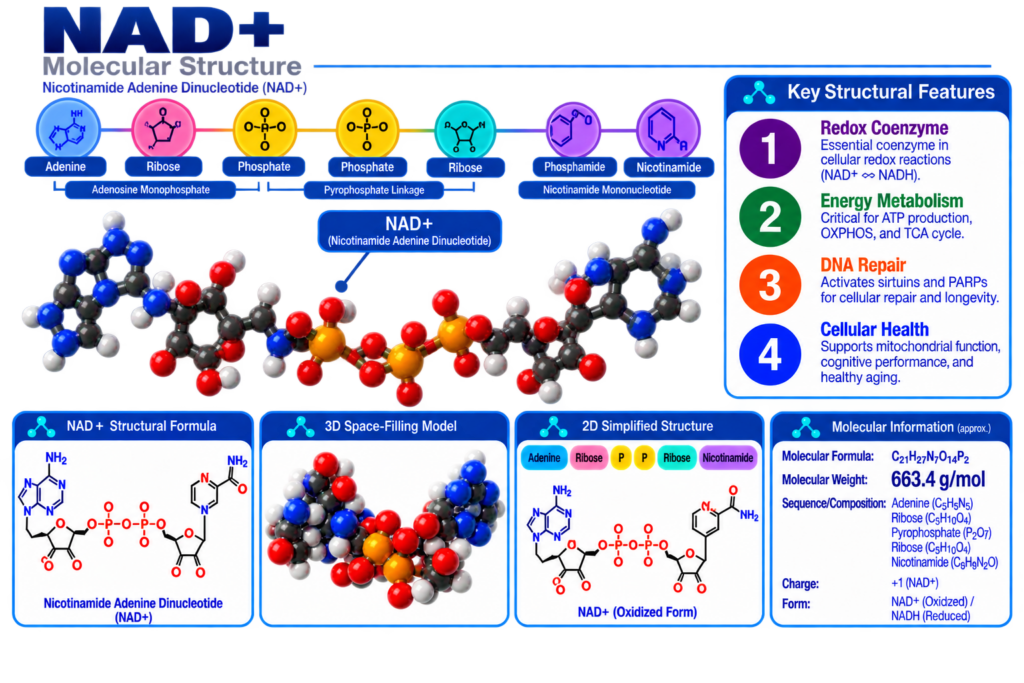
NAD+ is a dinucleotide coenzyme composed of two ribonucleotide units connected through a pyrophosphate bridge. One nucleotide contains an adenine base, while the second contains a nicotinamide moiety that participates directly in reversible electron-transfer reactions. The oxidized form, NAD+, accepts a hydride equivalent during redox reactions to form NADH.

Chemical Identity

Molecular FormulaC₂₁H₂₇N₇O₁₄P₂
Molecular WeightApproximately 663.43 g/mol
CAS Number53-84-9 This CAS number is also reported directly by Krause Analytical for the tested OPTMZ sample.

Amino Acid Sequence

N/A — NAD+ is not a peptide. It is a nucleotide-derived dinucleotide coenzyme and therefore has no amino-acid sequence.

Experimental Research Applications

NAD+/NADH redox studies
Cellular energy metabolism
Mitochondrial bioenergetics
Oxidative phosphorylation research
Glycolytic metabolism
Sirtuin activity studies
PARP-associated research
CD38-associated NAD metabolism
DNA-damage response research
Cellular stress signaling
Metabolic enzyme analysis
Cellular aging models
Circadian metabolism research
Mitochondrial function studies

Experimental Systems

Relevant experimental systems include:

Isolated mitochondrial systems
Mammalian cell cultures
Metabolic enzyme systems
NAD+/NADH redox assays
Sirtuin enzyme systems
PARP activity models
CD38-expressing cell systems
Skeletal-muscle metabolic models
Hepatic metabolic models
Cellular stress models
Mitochondrial respiration systems
Biochemical enzyme-reaction systems

Specific Assays

HPLC-UV chromatographic purity analysis
LC-MS identity confirmation
NAD+/NADH ratio assays
Enzymatic cycling assays
Fluorometric NAD+ assays
Colorimetric NAD+ assays
Sirtuin activity assays
PARP activity assays
CD38 activity assays
Mitochondrial respiration assays
ATP-production assays
Oxygen-consumption analysis
Metabolomics
Cellular redox assays

For the actual OPTMZ product, Krause Analytical specifically documented HPLC-UV-MS analysis.

Measured Endpoints

Chromatographic purity
NAD+ identity
NAD+ content
NAD+/NADH ratio
Cellular NAD+ concentration
Sirtuin activity
PARP activity
CD38-associated NAD+ consumption
ATP production
Oxygen consumption
Mitochondrial respiration
Cellular redox state
Metabolic flux
Enzyme activity

For the actual OPTMZ sample, the directly measured analytical endpoints were chromatographic purity, identity, and NAD+ content.

Analytical Characterization

Independent analytical testing of OPTMZ NAD+ 100 mg, lab sample 200516, by Krause Analytical reported:

Chromatographic Purity: 99.89%
NAD+ Content: 82.5 mg
Label Claim: 100 mg
Percent of Label: 82.5%
Identity: Confirmed
CAS Number: 53-84-9
Analysis Method: HPLC-UV-MS
Lab Number: 200516
Project: 145030
Date Received: January 29, 2026
Report Issued: February 6, 2026
Endotoxin Testing: Not reported on current COA

These values come directly from the Krause Analytical Certificate of Analysis.
Text us, our dedicated team is here to help.

Reach out and get a response within minutes