
For laboratory research use only. Not for human consumption.
Talk to our research support team: 512-998-2437
$32.99 – $315.00Price range: $32.99 through $315.00
These products are for laboratory research only and not intended for medical use. They are not FDA-approved to diagnose, treat, cure, or prevent any disease. By purchasing, you certify they will be used solely for research and not for human or animal consumption.
Research Use Only
All research peptides supplied by OPTMZ Peptides are intended strictly for laboratory research applications and are not designed for medical use. These materials are not approved by the U.S. Food and Drug Administration (FDA) to diagnose, treat, cure, or prevent any disease. By purchasing, the buyer confirms use strictly for scientific research purposes and not for human or animal consumption.
Product Overview
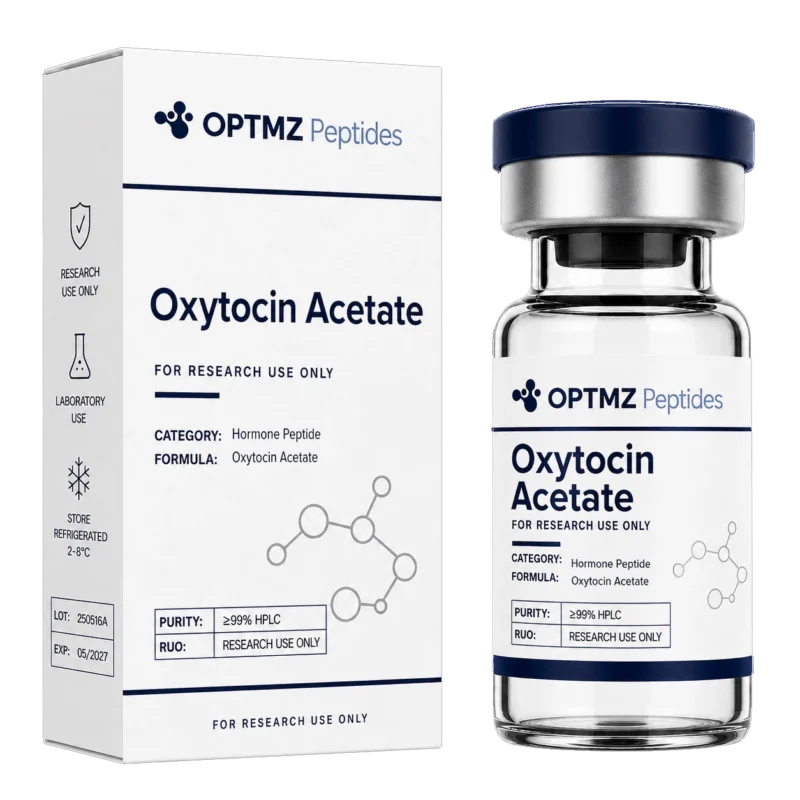
Oxytocin Acetate is a synthetic research form of the naturally occurring oxytocin peptide. Oxytocin is a cyclic nonapeptide composed of nine amino acids and is extensively investigated in neuroendocrine, receptor-signaling, behavioral neuroscience, and cellular research.
In controlled experimental systems, oxytocin is studied primarily for its interaction with the oxytocin receptor (OXTR), a G-protein-coupled receptor involved in intracellular signaling pathways. The acetate form is commonly utilized as a laboratory research material for investigations requiring a characterized form of the peptide.
Technical identifier note: The supplied COA identifies the material as Oxytocin Acetate 10 mg, while its LC-MS identity result is reported as Oxytocin. The COA does not provide a CAS number, molecular formula, molecular weight, or PubChem identifier for the specific acetate material.
For that reason, I would not populate those fields from an unrelated oxytocin database entry until the exact salt/solvate specification supplied by your manufacturer is confirmed. That keeps your technical information defensible.
Each tested batch of Oxytocin Acetate undergoes analytical evaluation to verify purity, identity, and analytical consistency. A corresponding Certificate of Analysis (COA) is available for the tested lot.
For the current OPTMZ Peptides lot, independent analytical testing reported:
The laboratory reports HPLC with UV detection coupled with mass spectrometry (LC-MS). Endotoxin testing was performed using the Limulus Amebocyte Lysate assay in accordance with USP <85> under validated laboratory conditions.
Oxytocin Acetate should be handled by qualified professionals in controlled laboratory environments. Appropriate storage conditions should be maintained to preserve peptide stability and structural integrity.
Avoid unnecessary exposure to heat, moisture, and repeated temperature fluctuations. Preparation, handling, and storage procedures should follow validated laboratory protocols appropriate to the intended experimental application.
Oxytocin has been extensively investigated in laboratory models involving neuroendocrine biology, receptor signaling, neuroscience, and cellular communication.
Research areas include:
These areas represent experimental research contexts and do not establish therapeutic efficacy or safety for human use.
Oxytocin Acetate continues to be evaluated in experimental biology, particularly within studies involving oxytocin receptor activation, neuropeptide signaling, neuroendocrine pathways, GPCR biology, intracellular signaling, and peptide-receptor interactions.
Its compact nine-amino-acid cyclic structure makes oxytocin an important model compound for laboratory investigations involving peptide-hormone structure, receptor binding, and downstream cellular signaling.
For laboratory research use only. Intended strictly for in vitro research applications.
All products currently listed on this site are for research purposes ONLY.
Technical identifier note: The supplied COA identifies the material as Oxytocin Acetate 10 mg, while its LC-MS identity result is reported as Oxytocin. The COA does not provide a CAS number, molecular formula, molecular weight, or PubChem identifier for the specific acetate material.
For that reason, I would not populate those fields from an unrelated oxytocin database entry until the exact salt/solvate specification supplied by your manufacturer is confirmed. That keeps your technical information defensible.
Each tested batch of Oxytocin Acetate undergoes analytical evaluation to verify purity, identity, and analytical consistency. A corresponding Certificate of Analysis (COA) is available for the tested lot.
For the current OPTMZ Peptides lot, independent analytical testing reported:
The laboratory reports HPLC with UV detection coupled with mass spectrometry (LC-MS). Endotoxin testing was performed using the Limulus Amebocyte Lysate assay in accordance with USP <85> under validated laboratory conditions.
Oxytocin Acetate should be handled by qualified professionals in controlled laboratory environments. Appropriate storage conditions should be maintained to preserve peptide stability and structural integrity.
Avoid unnecessary exposure to heat, moisture, and repeated temperature fluctuations. Preparation, handling, and storage procedures should follow validated laboratory protocols appropriate to the intended experimental application.
Oxytocin has been extensively investigated in laboratory models involving neuroendocrine biology, receptor signaling, neuroscience, and cellular communication.
Research areas include:
These areas represent experimental research contexts and do not establish therapeutic efficacy or safety for human use.
Oxytocin Acetate continues to be evaluated in experimental biology, particularly within studies involving oxytocin receptor activation, neuropeptide signaling, neuroendocrine pathways, GPCR biology, intracellular signaling, and peptide-receptor interactions.
Its compact nine-amino-acid cyclic structure makes oxytocin an important model compound for laboratory investigations involving peptide-hormone structure, receptor binding, and downstream cellular signaling.
For laboratory research use only. Intended strictly for in vitro research applications.
All products currently listed on this site are for research purposes ONLY.
| Pcs | Single Vial, Pack of 10 |
|---|
Restricted Access · Research Use Only
Independently lab tested, every batch
COAs published and searchable by batch number
Policy version 2026-05-14-ruo-v1.0
Reviews
There are no reviews yet.