For laboratory research use only. Not for human consumption.

Talk to our research support team: 512-998-2437

Sale!Sale!
Have questions about

Tesamorelin

Text us: 512-998-2437.

Tesamorelin

GHRH Analog

Price range: $71.00 through $690.00

Quantity

Batch Number :

2026/02

Purity Percentage :

99.9

Identity Confirmation :

Krause Analytics

Testing Methods Listed :

HPLC-UV/MS Endotoxins

Krause Analytical Credential Line :

Test Date :

02/03/2026

All products currently listed on this site are for research purposed ONLY.

These products are for laboratory research only and not intended for medical use. They are not FDA-approved to diagnose, treat, cure, or prevent any disease. By purchasing, you certify they will be used solely for research and not for human or animal consumption.

Research Use Only

All research peptides supplied by OPTMZ Peptides are intended strictly for laboratory research applications and are not designed for medical use. These materials are not approved by the U.S. Food and Drug Administration (FDA) to diagnose, treat, cure, or prevent any disease. By purchasing, the buyer confirms use strictly for scientific research purposes and not for human or animal consumption.

Product Overview

Tesamorelin is a synthetic analog of human growth hormone-releasing hormone (GHRH/GRF) investigated for its interaction with the growth hormone-releasing hormone receptor (GHRHR) and downstream GH/IGF-1 signaling.

Tesamorelin is structurally based on the 44-amino-acid human GHRH sequence with a trans-3-hexenoic acid modification at the N-terminus. FDA labeling describes tesamorelin as binding and stimulating human GRF receptors with potency similar to endogenous GRF, leading to growth-hormone release and increased circulating IGF-1.

Technical Specifications

  • Product: Tesamorelin
  • Quantity: 10 mg label claim
  • Research Classification: GHRH Analog
  • Compound Type: Synthetic Growth Hormone-Releasing Hormone Analog
  • Primary Research Target: Growth Hormone-Releasing Hormone Receptor (GHRHR / GRF receptor)
  • CAS Number: 218949-48-5
  • PubChem CID: 16137828
  • Molecular Formula: C₂₂₁H₃₆₆N₇₂O₆₇S
  • Molecular Weight: Approximately 5136 g/mol
  • Peptide Length: 44 amino acids
  • Chromatographic Purity: >99.9%
  • Identity: Confirmed by mass spectral match
  • Measured Content: 9.95 mg
  • Percent of Label: 99.5%
  • Analysis Method: HPLC-UV-MS
  • Endotoxins: <0.5 EU/mL
  • Endotoxin Method: USP <85>
  • Batch/Lot: 2026/02

The CAS number, purity, measured content, identity, and endotoxin result above come directly from the Krause Analytical COA for the submitted OPTMZ sample.

PubChem reports tesamorelin free base with molecular formula C₂₂₁H₃₆₆N₇₂O₆₇S and molecular weight approximately 5136 g/mol.

Important distinction: Tesamorelin acetate is a separate salt form. PubChem reports tesamorelin acetate with formula C₂₂₃H₃₇₀N₇₂O₆₉S, molecular weight 5196 g/mol, and CAS 901758-09-6. Because your COA identifies CAS 218949-48-5, I would use the free-base specifications above for this product page rather than acetate specifications.

Analytical & Testing

Each tested batch of Tesamorelin undergoes analytical evaluation to verify chromatographic purity, identity, peptide content, and analytical consistency.

For the submitted OPTMZ Peptides sample, Krause Analytical reported:

  • Chromatographic Purity: >99.9%
  • Identity: Tesamorelin — Confirmed
  • Measured Content: 9.95 mg
  • Label Claim: 10 mg
  • Percent of Label: 99.5%
  • Testing Method: HPLC-UV-MS
  • CAS Number: 218949-48-5
  • Endotoxins: <0.5 EU/mL
  • Endotoxin Method: USP <85>
  • Batch/Lot: 2026/02

The laboratory states that all reported values are on a per-vial basis unless otherwise noted.

The COA also includes the chromatogram on page 2 and mass-spectral report on page 3 supporting the analytical identity assessment.

Handling & Storage

Tesamorelin should be handled by qualified professionals in controlled laboratory environments. Appropriate storage conditions should be maintained to preserve peptide stability and structural integrity.

Avoid unnecessary exposure to heat, moisture, light, and repeated temperature fluctuations. Experimental preparation, storage, and handling should follow validated laboratory procedures appropriate to the intended research application.

Research Context

Tesamorelin has been investigated extensively in endocrine and metabolic research involving the GHRH/GH/IGF-1 axis.

Research areas include:

  • GHRH receptor signaling
  • Growth hormone secretion
  • IGF-1 signaling
  • GH pulsatility
  • Pituitary somatotroph biology
  • Endocrine regulation
  • Pharmacokinetic/pharmacodynamic modeling
  • Visceral adipose-tissue research
  • Body-composition research
  • Liver-fat research
  • Metabolic signaling

FDA prescribing information states that tesamorelin binds and stimulates human GRF receptors in vitro and increases GH secretion, which subsequently stimulates IGF-1 production.

Controlled human research has evaluated tesamorelin’s effects on endogenous GH pulsatility and insulin sensitivity in healthy men.

Randomized clinical research has also evaluated tesamorelin in adults with HIV-associated abdominal fat accumulation, including studies measuring visceral adipose tissue and other metabolic endpoints.

These findings describe established clinical research on pharmaceutical tesamorelin and do not establish approved therapeutic use of the research material supplied here.

Research Application Scope

Tesamorelin is relevant to controlled investigations involving GHRH receptor biology, growth hormone secretion, IGF-1 signaling, pituitary endocrine physiology, GH pulsatility, and metabolic regulation.

Because tesamorelin acts through the GHRH receptor, it is mechanistically distinct from ghrelin-receptor agonists such as Ipamorelin. It therefore provides a useful research model for studying the GHRH arm of growth-hormone regulation.

Population pharmacokinetic/pharmacodynamic research has modeled tesamorelin exposure, episodic GH secretion, and subsequent IGF-1 responses.

Use Statement

For laboratory research use only. Intended strictly for in vitro and controlled experimental research applications.

Disclaimer

All products currently listed on this site are for research purposes ONLY.

Description

Technical Specifications

  • Product: Tesamorelin
  • Quantity: 10 mg label claim
  • Research Classification: GHRH Analog
  • Compound Type: Synthetic Growth Hormone-Releasing Hormone Analog
  • Primary Research Target: Growth Hormone-Releasing Hormone Receptor (GHRHR / GRF receptor)
  • CAS Number: 218949-48-5
  • PubChem CID: 16137828
  • Molecular Formula: C₂₂₁H₃₆₆N₇₂O₆₇S
  • Molecular Weight: Approximately 5136 g/mol
  • Peptide Length: 44 amino acids
  • Chromatographic Purity: >99.9%
  • Identity: Confirmed by mass spectral match
  • Measured Content: 9.95 mg
  • Percent of Label: 99.5%
  • Analysis Method: HPLC-UV-MS
  • Endotoxins: <0.5 EU/mL
  • Endotoxin Method: USP <85>
  • Batch/Lot: 2026/02

The CAS number, purity, measured content, identity, and endotoxin result above come directly from the Krause Analytical COA for the submitted OPTMZ sample.

PubChem reports tesamorelin free base with molecular formula C₂₂₁H₃₆₆N₇₂O₆₇S and molecular weight approximately 5136 g/mol.

Important distinction: Tesamorelin acetate is a separate salt form. PubChem reports tesamorelin acetate with formula C₂₂₃H₃₇₀N₇₂O₆₉S, molecular weight 5196 g/mol, and CAS 901758-09-6. Because your COA identifies CAS 218949-48-5, I would use the free-base specifications above for this product page rather than acetate specifications.

Analytical & Testing

Each tested batch of Tesamorelin undergoes analytical evaluation to verify chromatographic purity, identity, peptide content, and analytical consistency.

For the submitted OPTMZ Peptides sample, Krause Analytical reported:

  • Chromatographic Purity: >99.9%
  • Identity: Tesamorelin — Confirmed
  • Measured Content: 9.95 mg
  • Label Claim: 10 mg
  • Percent of Label: 99.5%
  • Testing Method: HPLC-UV-MS
  • CAS Number: 218949-48-5
  • Endotoxins: <0.5 EU/mL
  • Endotoxin Method: USP <85>
  • Batch/Lot: 2026/02

The laboratory states that all reported values are on a per-vial basis unless otherwise noted.

The COA also includes the chromatogram on page 2 and mass-spectral report on page 3 supporting the analytical identity assessment.

Handling & Storage

Tesamorelin should be handled by qualified professionals in controlled laboratory environments. Appropriate storage conditions should be maintained to preserve peptide stability and structural integrity.

Avoid unnecessary exposure to heat, moisture, light, and repeated temperature fluctuations. Experimental preparation, storage, and handling should follow validated laboratory procedures appropriate to the intended research application.

Research Context

Tesamorelin has been investigated extensively in endocrine and metabolic research involving the GHRH/GH/IGF-1 axis.

Research areas include:

  • GHRH receptor signaling
  • Growth hormone secretion
  • IGF-1 signaling
  • GH pulsatility
  • Pituitary somatotroph biology
  • Endocrine regulation
  • Pharmacokinetic/pharmacodynamic modeling
  • Visceral adipose-tissue research
  • Body-composition research
  • Liver-fat research
  • Metabolic signaling

FDA prescribing information states that tesamorelin binds and stimulates human GRF receptors in vitro and increases GH secretion, which subsequently stimulates IGF-1 production.

Controlled human research has evaluated tesamorelin’s effects on endogenous GH pulsatility and insulin sensitivity in healthy men.

Randomized clinical research has also evaluated tesamorelin in adults with HIV-associated abdominal fat accumulation, including studies measuring visceral adipose tissue and other metabolic endpoints.

These findings describe established clinical research on pharmaceutical tesamorelin and do not establish approved therapeutic use of the research material supplied here.

Research Application Scope

Tesamorelin is relevant to controlled investigations involving GHRH receptor biology, growth hormone secretion, IGF-1 signaling, pituitary endocrine physiology, GH pulsatility, and metabolic regulation.

Because tesamorelin acts through the GHRH receptor, it is mechanistically distinct from ghrelin-receptor agonists such as Ipamorelin. It therefore provides a useful research model for studying the GHRH arm of growth-hormone regulation.

Population pharmacokinetic/pharmacodynamic research has modeled tesamorelin exposure, episodic GH secretion, and subsequent IGF-1 responses.

Use Statement

For laboratory research use only. Intended strictly for in vitro and controlled experimental research applications.

Disclaimer

All products currently listed on this site are for research purposes ONLY.

Additional information

Pcs

Single Vial, Pack of 10

Strength

5mg, 10mg

Reviews

There are no reviews yet.

Be the first to review “Tesamorelin”

Your email address will not be published. Required fields are marked *

Research Profile

Research Classification

Growth Hormone-Releasing Hormone Analog / GHRH Receptor Agonist

Research Discipline

Endocrinology; Peptide Biology; GHRH/GH/IGF-1 Axis Research; Pituitary Biology; Metabolic Research; Pharmacology

Primary Molecular Target

Growth Hormone-Releasing Hormone Receptor (GHRHR / GRF receptor) FDA prescribing information states that tesamorelin binds and stimulates human GRF receptors with potency similar to endogenous GRF.

Evidence Level

Established Clinical Research Tesamorelin has substantial randomized controlled human data and is also the active pharmaceutical ingredient in an FDA-approved prescription drug for a specific indication. FDA's current prescribing information documents its approved use and mechanism. This evidence classification describes the molecule's research and regulatory history, not the approval status of the OPTMZ research product.
Molecular Structure

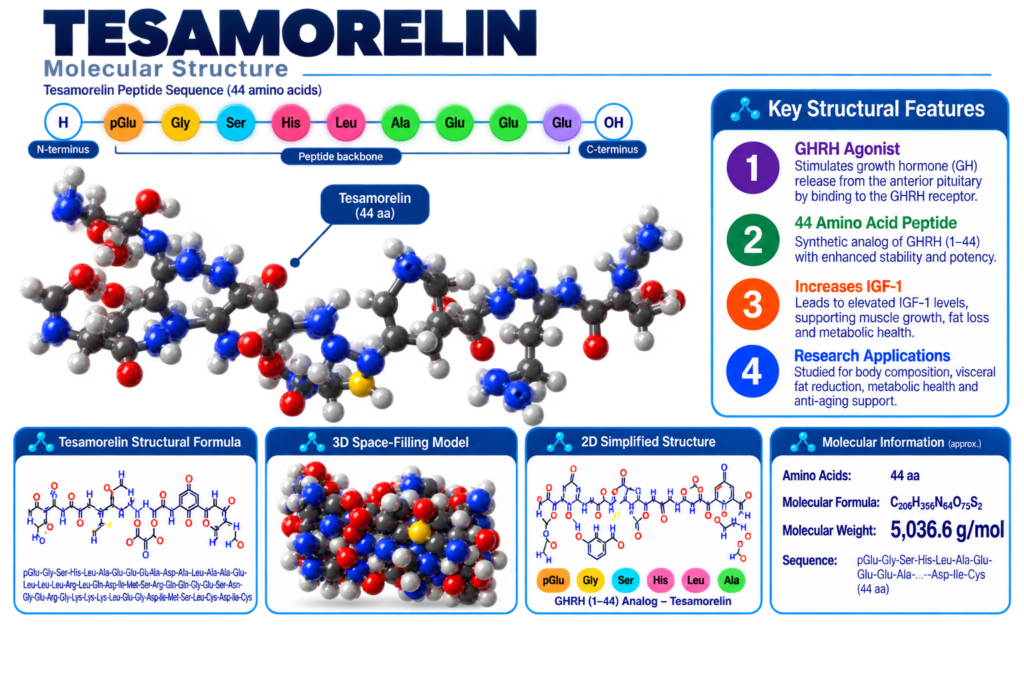
Tesamorelin is a synthetic 44-amino-acid analog of human growth hormone-releasing hormone. It retains the native GHRH peptide sequence while incorporating a trans-3-hexenoic acid modification at the N-terminus, which increases resistance to enzymatic degradation while preserving activity at the GHRH receptor. FDA labeling identifies tesamorelin as a GRF analog that binds and stimulates human GRF receptors.

Chemical Identity

Molecular FormulaC₂₂₁H₃₆₆N₇₂O₆₇S This is the PubChem molecular formula for tesamorelin free base.
Molecular WeightApproximately 5136 g/mol PubChem reports approximately 5136 g/mol for tesamorelin free base.
CAS Number218949-48-5 This CAS number is reported directly on the current OPTMZ COA.

Amino Acid Sequence

Tesamorelin is a 44-amino-acid GHRH analog with an N-terminal trans-3-hexenoyl modification. For the website field, I would use the exact manufacturer-confirmed sequence rather than silently substituting a generic hGHRH(1-44) sequence, because the uploaded COA itself does not list the full primary sequence.

Experimental Research Applications

GHRH receptor signaling studies
Growth hormone secretion research
IGF-1 signaling studies
Pituitary somatotroph research
GH pulsatility analysis
Endocrine pharmacology
Pharmacokinetic/pharmacodynamic studies
Visceral adipose-tissue research
Body-composition research
Metabolic signaling
Liver-fat research

Controlled studies have examined endogenous GH pulsatility, insulin sensitivity, visceral adiposity, and other metabolic outcomes.

Experimental Systems

Published research systems involving Tesamorelin include:

Human GRF receptor systems
Pituitary somatotroph-associated signaling
Healthy adult human endocrine studies
Adults with HIV-associated lipodystrophy
GH pulsatility models
IGF-1 response models
Visceral adipose-tissue imaging studies
Metabolic research systems
Pharmacokinetic/pharmacodynamic models

Tesamorelin has been investigated extensively in randomized controlled human research as well as mechanistic endocrine studies.

Specific Assays

HPLC-UV chromatographic purity analysis
LC-MS identity confirmation
Mass-spectral matching
Serum growth hormone assays
Serum IGF-1 assays
GH pulsatility analysis
Pharmacokinetic analysis
Pharmacodynamic modeling
CT-based visceral adipose-tissue measurement
DEXA body-composition analysis
Metabolic biomarker analysis
USP endotoxin testing

The actual OPTMZ product was characterized by HPLC-UV-MS and USP endotoxin testing.

Clinical tesamorelin trials have also used CT and DEXA to evaluate abdominal and body-fat endpoints.

Measured Endpoints

Chromatographic purity
Tesamorelin identity
Tesamorelin content
Endotoxin concentration
GH concentration
IGF-1 concentration
GH pulse amplitude and frequency
Visceral adipose tissue
Abdominal fat
Body composition
Insulin sensitivity
Metabolic biomarkers

For the actual OPTMZ product, directly measured analytical endpoints were chromatographic purity, identity, tesamorelin content, and endotoxin concentration.

Analytical Characterization

Independent analytical testing of OPTMZ Peptides Tesamorelin 10 mg, batch/lot 2026/02, by Krause Analytical reported:

Chromatographic Purity: >99.9%
Tesamorelin Content: 9.95 mg
Label Claim: 10 mg
Percent of Label: 99.5%
Identity: Mass spectral match confirmed
CAS Number: 218949-48-5
Analysis Method: HPLC-UV-MS
Endotoxins: <0.5 EU/mL Endotoxin Method: USP
Lab Number: 205072
Project: 145211
Date Received: April 28, 2026
Report Issued: May 13, 2026

The laboratory states that analytical values are reported on a per-vial basis unless otherwise noted.

Text us, our dedicated team is here to help.

Reach out and get a response within minutes