For laboratory research use only. Not for human consumption.
Talk to our research support team: 512-998-2437
By Dr. Leonard Haberman, Chief Science Officer, OPTMZ Peptides Published April 18, 2026 · Last updated April 18, 2026
BPC-157 is a synthetic pentadecapeptide derived from a 15-amino-acid sequence of a protective protein identified in human gastric juice. Pre-clinical research has examined its interaction with the nitric oxide (NO) system, the vascular endothelial growth factor receptor-2 (VEGFR2) pathway, and angiogenesis — the formation of new blood vessels from existing vasculature. This summary reviews what the published research record has documented about those interactions and what remains under active investigation.
BPC-157 — “Body Protection Compound 157” — is a 15-residue sequence (Gly-Glu-Pro-Pro-Pro-Gly-Lys-Pro-Ala-Asp-Asp-Ala-Gly-Leu-Val) originally isolated from the protective protein fraction of human gastric juice in the early 1990s. It has been stable under a wide range of conditions in laboratory settings, which has made it a frequent subject of pre-clinical research into tissue-repair signaling, gastrointestinal cytoprotection, and vascular biology.
In research-use contexts, BPC-157 is studied as a synthetic peptide — not as a therapeutic agent. It has no FDA-approved medical indication in the United States, and the World Anti-Doping Agency added it to its prohibited list in 2022. The research literature is overwhelmingly pre-clinical: rodent models, in-vitro cell assays, and a small number of ex-vivo tissue studies. See Vasireddi et al. (2025) for a comprehensive orthopedic-research review of the current evidence base (PMC12313605).
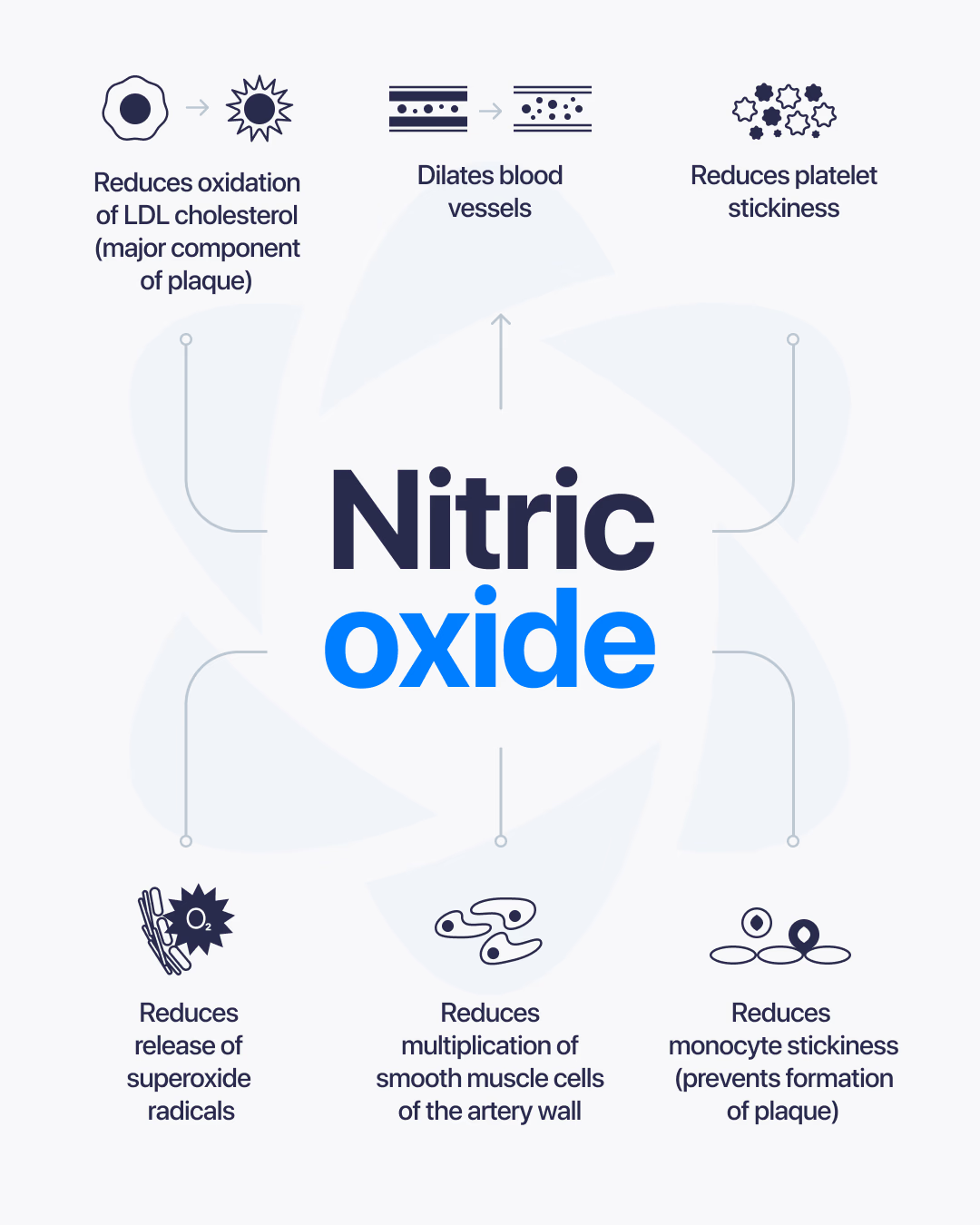
Nitric oxide is a gaseous signaling molecule synthesized endogenously from L-arginine by three isoforms of nitric oxide synthase (NOS): neuronal (nNOS), inducible (iNOS), and endothelial (eNOS). In vascular biology, eNOS-derived NO is the principal regulator of vasomotor tone. Its local release relaxes vascular smooth muscle, producing vasodilation, and it participates in leukocyte adhesion, platelet aggregation, and endothelial integrity.
NO is studied in peptide research because many peptides with documented pre-clinical effects on circulation, tissue perfusion, or repair appear to act — at least partially — through modulation of the L-arginine–NO axis. BPC-157 is one of the most extensively documented examples of such a peptide in the pre-clinical record.
The most systematically studied interaction between BPC-157 and the NO system comes from the work of Sikiric and colleagues, whose research program has spanned nearly three decades. Their 1997 paper — among the earliest mechanistic investigations of BPC-157 — examined how the peptide modified the effects of L-arginine and the NOS inhibitor N(G)-nitro-L-arginine methyl ester (L-NAME) on gastric mucosal integrity and blood pressure in rodent models (Sikirić et al., 1997, European Journal of Pharmacology, ScienceDirect S0014299997010339).
The investigators documented that BPC-157 interfered with the vascular effects of both L-arginine (an NO precursor) and L-NAME (an NOS inhibitor) in a bidirectional manner. The peptide appeared to counteract NO-related disturbances regardless of the direction of the perturbation — a pattern Sikiric’s group has since termed the “NO-system counterbalancing” effect. A 2025 review by the same research group summarized the accumulated pre-clinical evidence for this counterbalancing mechanism across more than two dozen injury models (Sikiric et al., 2025, PMC12567428).
Subsequent research has examined the downstream molecular pathway. Hsieh et al. (2020) documented that BPC-157 exposure in cultured vascular endothelial cells was associated with increased NO production and modulation of vasomotor tone in isolated aortic ring preparations (Hsieh et al., 2020, Scientific Reports, PMC7555539). The study reported that the NO induced by BPC-157 exposure contributed to the promoted migration of vascular endothelial cells in their in-vitro angiogenesis assays.
The pro-angiogenic effect of BPC-157 is among the most reproducibly documented findings in the pre-clinical literature. Hsieh et al. (2017) investigated the mechanism using vascular endothelial cell cultures and reported that BPC-157 exposure was associated with increased expression and receptor internalization of VEGFR2 — the principal receptor mediating vascular endothelial growth factor signaling — and downstream activation of the Akt-eNOS pathway (Hsieh et al., 2017, PubMed 27847966, cited 135 times as of the latest indexation).
The investigators proposed a mechanistic sequence consistent with their observations:
BPC-157 binds to or activates VEGFR2 on the endothelial cell surface
VEGFR2 activation drives the Akt-eNOS phosphorylation cascade
eNOS activation increases local NO production
NO, combined with VEGFR2 downstream signaling, drives endothelial cell migration, proliferation, and new vessel formation
This proposed pathway connects the peptide’s observed effects on both angiogenesis and the NO system within a single molecular framework. A 2025 narrative review confirmed that the VEGFR2–NO pathway remains the most widely cited mechanistic model for BPC-157’s vascular effects in the pre-clinical literature (McGuire et al., 2025, PMC12446177).
In isolated aortic ring preparations, BPC-157 has shown concentration-dependent effects on vasomotor tone that were modifiable by co-treatment with L-NAME. This pharmacological pattern — an effect that is partially attenuated by NOS inhibition — is characteristic of an NO-dependent mechanism (Hsieh et al., 2020, PMC7555539).
The Sikiric 2025 review characterized BPC-157’s interaction with the NO system as “counterbalancing” rather than simply “potentiating” or “inhibiting.” In pre-clinical models of NO over-release induced by L-arginine challenge, BPC-157 co-administration reduced NO-mediated disturbances. In models of NO suppression induced by L-NAME, BPC-157 restored aspects of NO-dependent function. This bidirectional pattern distinguishes BPC-157 from a simple NOS agonist or NO donor.
Three independent 2025 review papers have summarized the current mechanistic understanding of BPC-157:
Józwiak et al. (2025), Pharmaceuticals (MDPI 18/2/185), reviewed the multifunctional biological activities of BPC-157 and noted that the peptide “positively interacts with nitric oxide synthase to increase expression of several antioxidants, including heme oxygenase (HO-1).” The review catalogued pre-clinical effects across gastrointestinal, musculoskeletal, and vascular tissue models.
McGuire et al. (2025), Regeneration or Risk? A Narrative Review of BPC-157 (PMC12446177), explicitly identified angiogenesis via the VEGFR2-NO axis as the most reproducibly documented mechanism and flagged the theoretical oncologic risk of sustained pro-angiogenic signaling — a point also raised in a Columbia University Science Journal commentary on the compound.
Vasireddi et al. (2025), Emerging Use of BPC-157 in Orthopaedic Sports Medicine (PMC12313605), documented that pre-clinical studies have associated BPC-157 exposure with increased growth hormone receptor expression in tendon fibroblasts (Chang et al., 2014, PMC6271067) and with effects on pathways implicated in cell growth and vessel formation.
The convergent interpretation across these reviews is that BPC-157’s pre-clinical vascular effects are most consistently explained by a VEGFR2–Akt–eNOS–NO signaling cascade, with additional contributions from FAK-paxillin, growth hormone receptor, and antioxidant pathway modulation. This is the current state of the evidence, and it is entirely pre-clinical.
The research picture has real gaps that any investigator working with BPC-157 should understand:
No adequately powered human clinical trials exist. The evidence base is almost entirely rodent and in-vitro. The translation from rat gastric mucosa models to other species or tissue contexts has not been established by controlled human studies.
The majority of published research originates from a single research group. Sikiric and colleagues have produced the bulk of the BPC-157 literature since the 1990s, which creates an independent-replication gap compared to compounds studied across dozens of unrelated laboratories.
Theoretical oncologic concern. Pro-angiogenic signaling is a known contributor to tumor vascularization. Multiple reviews (McGuire 2025, Columbia University Science Journal) have flagged the theoretical risk of sustained VEGFR2 activation in the context of existing or latent malignancy.
Purity and identity of the peptide material used in research directly affects reproducibility. The 15-amino-acid sequence is sensitive to truncation, oxidation, and impurity artifacts. Research peptides not verified by HPLC and mass spectrometry may contain degradation products that alter observed effects.
Reproducibility in pre-clinical peptide research depends on the material being exactly what the label claims. For BPC-157 specifically, sequence truncation or oxidation of the N-terminal glycine can shift observed activity in angiogenesis and NO assays. This is why OPTMZ Peptides publishes the full analytical chemistry record for every batch of BPC-157 we supply — not just a current-batch summary.
Every batch of BPC-157 sold by OPTMZ Peptides is independently tested by Krause Analytical, a DEA-registered, ISO/IEC 17025-certified analytical laboratory in Austin, Texas. Each batch is subjected to seven verification methods: HPLC purity analysis, mass spectrometry identity confirmation, endotoxin testing (LAL), heavy metals analysis (ICP-MS), microbial screening, pH stability, and visual inspection. Batches below 98.0% HPLC purity are rejected and never enter inventory.
Current and historical Certificates of Analysis for every batch are published in the OPTMZ Lab Results archive. Researchers can cross-reference batch numbers from vial labels directly to the signed, laboratory-issued COA document, which is how reproducibility in peptide research is supposed to work.
Dr. Leonard Haberman is Chief Science Officer at OPTMZ Peptides, overseeing analytical quality assurance and third-party laboratory partnerships with a focus on HPLC-based purity verification and research-grade peptide compound validation. All research peptides sold by OPTMZ Peptides are intended strictly for laboratory research use only.
Every compound we sell has been independently tested and published — because researchers deserve suppliers they can verify, not just trust.
Pre-clinical studies dating back to Sikirić et al. (1997) have documented that BPC-157 modulates the L-arginine–NO axis in rodent models. The Sikiric research group has characterized this as a “counterbalancing” interaction, meaning BPC-157 reduces NO-related disturbances in both NO-excess and NO-deficient experimental conditions. The effect has been reproduced in aortic ring preparations and vascular endothelial cell cultures (Hsieh et al., 2020). This research is pre-clinical and has not been established in human clinical trials.
The most widely cited mechanistic model is the VEGFR2–Akt–eNOS–NO pathway. Hsieh et al. (2017) documented that BPC-157 exposure in endothelial cell cultures was associated with increased VEGFR2 expression and receptor internalization, followed by activation of the Akt-eNOS cascade and increased nitric oxide production. This proposed sequence is supported by multiple pre-clinical studies but remains a proposed mechanism — not a confirmed human pharmacological mechanism.
Pre-clinical studies have associated BPC-157 exposure with promoted migration and proliferation of vascular endothelial cells, consistent with pro-angiogenic signaling (Hsieh et al., 2017, 2020). A 2025 narrative review (McGuire et al., PMC12446177) identified the VEGFR2-NO axis as the most reproducibly documented mechanism for these effects in the pre-clinical literature.
OPTMZ Peptides maintains a minimum HPLC purity threshold of 98.0% for BPC-157. Batches below this threshold are rejected and never enter inventory. Most batches test in the 98.5–99.9% range. Every batch is independently verified by Krause Analytical, a DEA-registered, ISO/IEC 17025-certified laboratory. The current batch COA and historical batch archive are published in the OPTMZ Lab Results Vault.
The evidence base is almost entirely pre-clinical — rodent models and in-vitro cell assays. No adequately powered human clinical trials have been completed. The majority of the published BPC-157 literature originates from a single research group (Sikiric and collaborators), which creates an independent-replication gap. Theoretical oncologic concerns related to sustained pro-angiogenic signaling have been raised in recent review literature (McGuire et al., 2025).
Every batch of BPC-157 is subjected to seven analytical methods by Krause Analytical: HPLC for purity quantification, mass spectrometry for sequence identity confirmation, LAL for endotoxin, ICP-MS for heavy metals, microbial screening, pH stability, and visual inspection. Each method’s result is documented in a signed Certificate of Analysis referenced to the batch number on the vial label. The full COA archive is published at /coa-vault/.
Restricted Access · Research Use Only
Independently lab tested, every batch
COAs published and searchable by batch number
Policy version 2026-05-14-ruo-v1.0