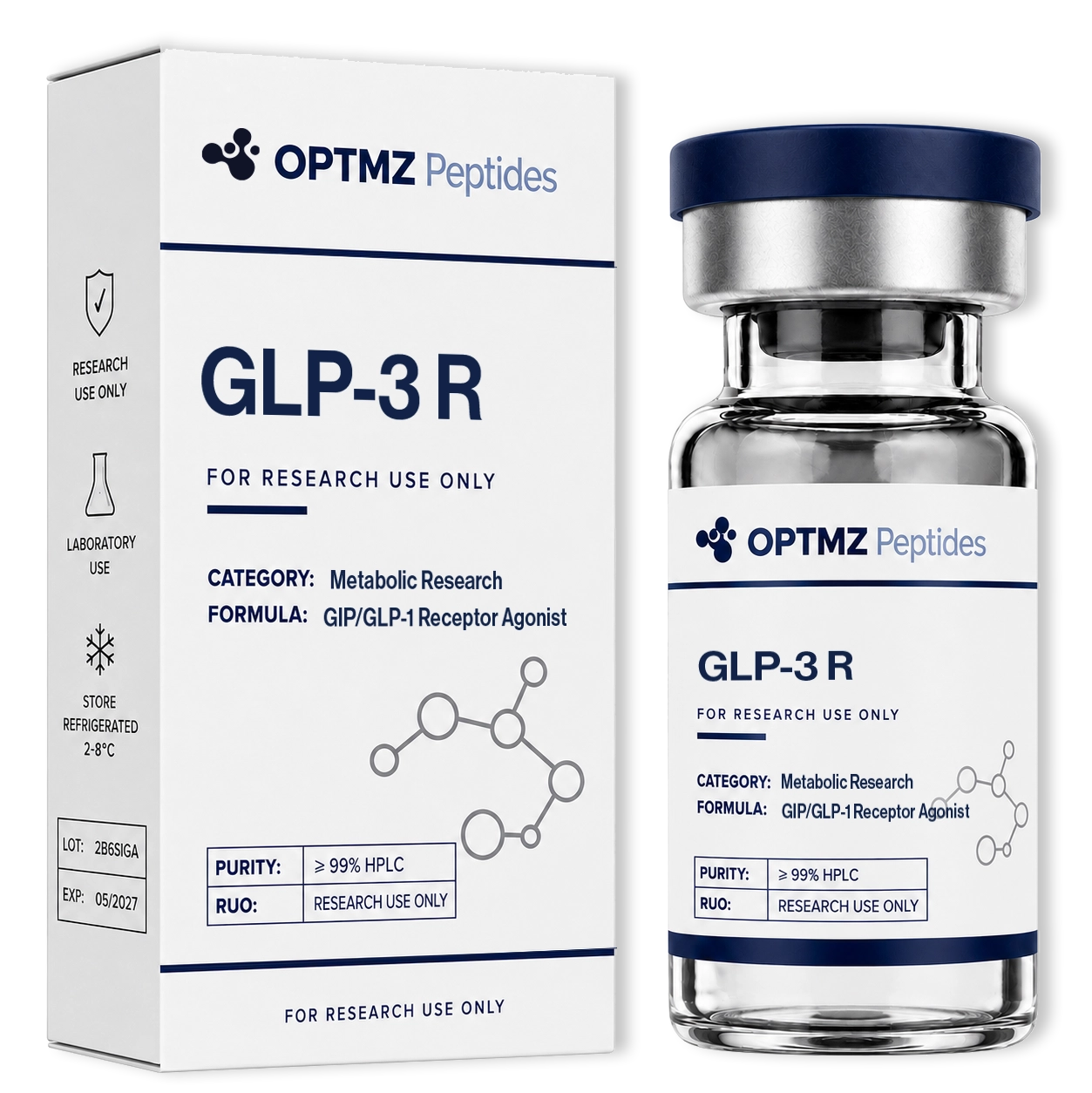
For laboratory research use only. Not for human consumption.
Talk to our research support team: 512-998-2437

By Dr. Leonard Haberman, Chief Science Officer, OPTMZ Peptides Published April 2, 2026 · Updated April 17, 2026
Cagrilintide is a synthetic, long-acting analog of the endogenous peptide hormone amylin, engineered for dual agonism at the amylin receptor (AMYR) and the calcitonin receptor (CTR). Developed by Novo Nordisk and first characterized in the peer-reviewed literature by Kruse and colleagues in 2021 (Kruse et al., 2021, PMID 34288673), cagrilintide is studied in pre-clinical and early clinical research contexts investigating amylin receptor pharmacology. This article reviews what is presently known about its molecular design, receptor binding profile, and the published research literature — written for qualified researchers working with research-grade compounds.
Cagrilintide (development code NN1213) is a 37–amino-acid peptide with a lipidated C16 fatty acid chain attached via a glutamic acid spacer, a structural modification that extends its plasma half-life to a range compatible with once-weekly dosing in research protocols. Its amino acid sequence is derived from human amylin but incorporates substitutions (notably at positions 17, 21, 25, 26, 28, 29, and 37) that reduce aggregation propensity and improve solubility relative to native amylin (Kruse et al., 2021).
Unlike native amylin, which fibrillates rapidly and is unsuitable for long-acting formulation, cagrilintide retains receptor affinity while resisting the self-association that undermines native amylin’s pharmacological utility. It is classified in the research literature as a dual amylin-and-calcitonin receptor agonist (DACRA).
The native amylin peptide has a plasma half-life of approximately 13 minutes, and its propensity to form amyloid fibrils at physiological concentrations has historically limited its use as a research analog. Kruse and colleagues at Novo Nordisk designed cagrilintide by iterating on an earlier amylin analog (pramlintide, which itself addresses the aggregation problem but retains a short half-life) and introducing two key modifications:
Lipidation via albumin binding. Attaching a C16 fatty acid chain to Lys26 enables reversible binding to serum albumin, which substantially extends circulation time. This is the same protraction strategy used in other long-acting peptide analogs including liraglutide and semaglutide.
Sequence stabilization against fibril formation. Substitutions at aggregation-prone residues reduce β-sheet stacking tendency while preserving receptor-binding geometry.
The resulting molecule exhibits a half-life of approximately 159 hours in pre-clinical models — a roughly 700-fold increase over native amylin (Kruse et al., 2021). A detailed characterization of its selectivity profile was later published by Dahl and colleagues in 2024, confirming potent agonism at both amylin and calcitonin receptor subtypes (Dahl et al., 2024, PMC11284788).
The amylin receptor is not a single protein but a heterodimeric complex formed between the calcitonin receptor (CTR) and one of three receptor activity–modifying proteins (RAMPs):
AMY1R = CTR + RAMP1
AMY2R = CTR + RAMP2
AMY3R = CTR + RAMP3
Cagrilintide acts as an agonist at all three amylin receptor subtypes and also at the unmodified calcitonin receptor itself. In receptor binding assays reported by Dahl and colleagues, cagrilintide demonstrated low-nanomolar potency across AMY1R, AMY2R, AMY3R, and CTR, with EC50 values comparable to native amylin at the amylin receptor subtypes (Dahl et al., 2024).
Structural work by Cao and colleagues published in 2025 used cryo-electron microscopy to resolve the binding pose of cagrilintide at the active amylin receptor, showing the peptide adopts an extended helical conformation that engages both the RAMP extracellular domain and the CTR juxtamembrane region — a binding mode consistent with native amylin but with additional stabilizing contacts contributed by the lipidation chain (Cao et al., 2025, PMC11982234).
At the receptor level, cagrilintide binding to amylin receptor heterodimers activates the Gαs signaling pathway, increasing intracellular cAMP production in target cells. This is the canonical amylin signaling cascade characterized across decades of amylin pharmacology research.
In the central nervous system, amylin receptors are densely expressed in the area postrema, the nucleus tractus solitarius, and the hypothalamic arcuate nucleus. Carvas and colleagues (2025) used genetic tools in rodent models to demonstrate that cagrilintide’s pharmacodynamic signal in research animals is mediated primarily through central amylin receptors rather than peripheral calcitonin receptors — establishing that the CNS amylin pathway is the principal locus of pharmacologic activity for this compound (Carvas et al., 2025, PMC12270663).
Because cagrilintide is an amylin-and-calcitonin receptor agonist, research using it as a pharmacological probe can in principle dissect amylin versus calcitonin signaling contributions, though the overlapping receptor affinity means additional selective antagonists are often required for clean attribution in experimental design.
The peer-reviewed literature on cagrilintide has expanded rapidly since the 2021 disclosure. Published research examines:
Pharmacokinetic characterization. Half-life, volume of distribution, and protein-binding behavior in pre-clinical species (Kruse et al., 2021).
Receptor selectivity profiling. Comparative binding at AMY1R, AMY2R, AMY3R, and CTR versus related analogs (Dahl et al., 2024).
Structural biology. Cryo-EM and molecular dynamics characterization of the receptor-bound complex (Cao et al., 2025).
CNS pharmacodynamics. Site-of-action studies using conditional receptor knockout models to localize the active receptor population (Carvas et al., 2025).
Review literature. Integrative analyses of long-acting amylin analogs as a compound class, including pramlintide, cagrilintide, and earlier research tools (Mathiesen et al., 2022, PMID 35066542); (Chung et al., 2026, PMC12884623).
Researchers considering cagrilintide as a pharmacological probe should be aware that much of the published characterization reflects Novo Nordisk’s own development work; independent replication in academic settings is still accumulating, and dose–response ranges reported in early-phase studies should not be generalized outside their original experimental context.
Research-grade peptides vary substantially in purity depending on the manufacturer’s synthesis process, purification protocol, and quality-control procedures. For cagrilintide specifically, the long C16 lipidation chain introduces synthesis challenges that can produce characteristic impurities — including truncated sequences, deletion analogs missing the lipid modification, and oxidation products at methionine residues.
Verified characterization of a research-grade cagrilintide batch requires, at minimum:
Reversed-phase HPLC for purity quantification. High-performance liquid chromatography separates the target peptide from synthesis-related impurities and quantifies the area-normalized purity percentage. Industry practice for research-grade peptides is ≥95%; OPTMZ’s minimum acceptance threshold is ≥98%, with rejection of any batch below that line.
Mass spectrometry for identity confirmation. ESI-MS or MALDI-TOF verifies the observed molecular mass matches the theoretical mass of cagrilintide (5995.4 Da, accounting for the lipidation) and confirms the peptide is what the label claims.
Endotoxin testing (LAL). Required for any peptide handled in sterile research protocols.
Heavy metals and residual solvents. ICP-MS for metal content; GC or HPLC for residual synthesis solvents.
Every lot of cagrilintide sold by OPTMZ Peptides is tested by Krause Analytical, a DEA-registered, ISO/IEC 17025–certified analytical laboratory in Austin, TX. The full Certificate of Analysis — including HPLC chromatogram, mass spectrum, and batch-specific purity value — is published at the OPTMZ COA Vault and searchable by the batch number printed on each vial label. Researchers can cross-reference the batch in hand against the published analytical data before initiating any research protocol.
Honest assessment of the research base:
The published literature is heavily weighted toward the original developer. Most mechanistic and pharmacokinetic characterization has been conducted by Novo Nordisk–affiliated researchers. Independent academic replication of the receptor-binding data is limited but accumulating.
Long-term pharmacodynamic data in non-rodent systems is sparse. Extrapolating findings across species requires care, particularly for a compound that acts via a heterodimeric receptor whose RAMP expression varies between species.
The dual receptor pharmacology complicates interpretation. Because cagrilintide engages both amylin and calcitonin receptors, experimental designs that do not include selective antagonists cannot cleanly attribute effects to one pathway.
Analytical reference standards are not universally available. Research labs performing independent verification of cagrilintide identity may need to rely on in-house synthesized standards or third-party comparative testing.
These limitations are not disqualifying — they simply frame the appropriate level of confidence researchers should attach to findings built on the current evidence base.
Cagrilintide is available from OPTMZ Peptides for research use in lyophilized form, supplied in sealed vials with a published Certificate of Analysis specific to the batch received. Each batch is HPLC-verified to ≥98% purity by Krause Analytical, with full methodology documented on the How We Test page. All historical batch COAs remain accessible in the COA Vault — not only the current lot — which allows longitudinal verification of supply consistency across a research program.
Products are supplied strictly for in-vitro and pre-clinical research conducted by qualified professionals. Research Use Only. Not for human or animal consumption.
Dr. Leonard Haberman is Chief Science Officer at OPTMZ Peptides, overseeing analytical quality assurance and third-party laboratory partnerships with a focus on HPLC-based purity verification and research-grade peptide compound validation. All research peptides sold by OPTMZ Peptides are intended strictly for laboratory research use only.
Every compound we sell has been independently tested and published — because researchers deserve suppliers they can verify, not just trust.
Cagrilintide is a synthetic, long-acting analog of the human peptide hormone amylin. It was engineered by Novo Nordisk by lipidating native amylin with a C16 fatty acid chain, which extends plasma half-life to approximately 159 hours in pre-clinical models. It binds both the amylin receptor heterodimers (AMY1R, AMY2R, AMY3R) and the calcitonin receptor, and is classified in the literature as a dual amylin-and-calcitonin receptor agonist (DACRA).
Native amylin has a plasma half-life of roughly 13 minutes and a strong tendency to form amyloid fibrils at physiological concentrations, which makes it unsuitable as a long-acting research analog. Cagrilintide incorporates sequence substitutions that reduce aggregation and a lipidation modification that enables reversible albumin binding, producing a roughly 700-fold increase in half-life relative to native amylin (Kruse et al., 2021).
Cagrilintide binds all three amylin receptor subtypes — AMY1R (CTR + RAMP1), AMY2R (CTR + RAMP2), and AMY3R (CTR + RAMP3) — as well as the unmodified calcitonin receptor. Published receptor-binding assays (Dahl et al., 2024) show low-nanomolar potency at all four receptor configurations.
Industry practice for research-grade peptides is a minimum purity of 95% by HPLC. OPTMZ Peptides requires a minimum of 98% HPLC purity for every cagrilintide batch, verified by Krause Analytical (DEA-registered, ISO/IEC 17025–certified). Batches below that threshold are rejected and never enter inventory. The batch-specific Certificate of Analysis is published in the COA Vault and includes the HPLC chromatogram and mass spectrometry identity confirmation.
Identity confirmation uses mass spectrometry (ESI-MS or MALDI-TOF) to verify the observed molecular mass matches the theoretical mass of cagrilintide, approximately 5995.4 Da including the C16 lipidation. HPLC confirms purity separately by quantifying the target peak against synthesis-related impurities. Both analyses are documented on the COA.
Most of the foundational pharmacokinetic and receptor-binding characterization of cagrilintide was conducted by Novo Nordisk–affiliated researchers. Independent academic work — including structural biology studies such as Cao et al. (2025) on receptor-bound conformation, and mechanism studies such as Carvas et al. (2025) on the CNS site of action — is accumulating but remains a smaller share of the published literature. Researchers designing experiments should factor this concentration of authorship into how they weight the evidence base.
Restricted Access · Research Use Only
Independently lab tested, every batch
COAs published and searchable by batch number
Policy version 2026-05-14-ruo-v1.0