For laboratory research use only. Not for human consumption.
Talk to our research support team: 512-998-2437
By Dr. Leonard Haberman, Chief Science Officer, OPTMZ Peptides Published: March 2, 2026 | Last Updated: April 15, 2026
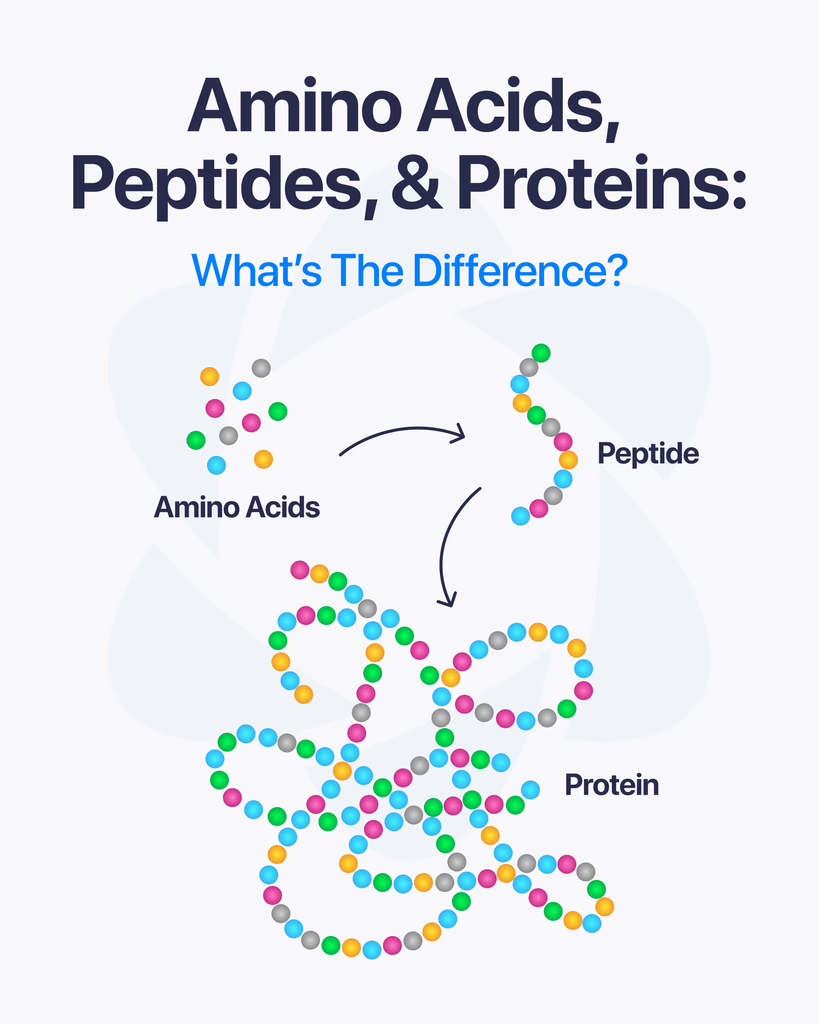
Amino acids, peptides, and proteins share a common structural origin: the amino acid chain. Each level of complexity is defined by how many amino acid residues are joined together, and by the specific bond that links them. In research settings, these distinctions carry practical weight — the chain length of a compound determines how it is synthesized, analyzed, and verified for purity.
This article covers the structural hierarchy from individual amino acids through peptide bonds to full protein architecture, with attention to how these properties inform standard laboratory characterization methods.
An amino acid is an organic compound containing both an amino group (–NH₂) and a carboxyl group (–COOH), joined to a central alpha carbon. The side chain attached to this carbon — designated the R group — is the variable element that distinguishes one amino acid from another. Twenty standard amino acids serve as the primary building blocks for biological peptides and proteins, each with a distinct R group that confers specific chemical properties including charge, polarity, and reactivity (Nelson & Cox, Lehninger Principles of Biochemistry, 7th ed., 2017).
In isolation, amino acids are small, water-soluble molecules. Their biological significance emerges when they form chains.
When two amino acids react, the carboxyl group of one combines with the amino group of the other to release a water molecule — a condensation reaction that produces a peptide bond (–CO–NH–). The resulting covalent linkage is the fundamental structural unit that creates all larger peptide and protein molecules.
Peptide bonds are planar and exhibit partial double-bond character due to resonance, which restricts rotation around the bond axis. This planarity is structurally significant: it constrains backbone geometry and contributes to the secondary structures (alpha helices, beta sheets) that emerge in longer chains.
The atoms on either side of the peptide bond — the carbonyl carbon, oxygen, nitrogen, and the alpha-hydrogen — exist in the same plane. This property, first formally characterized by Linus Pauling and Robert Corey (Pauling & Corey, Proc. Natl. Acad. Sci. USA, 1951), remains central to understanding peptide conformational behavior.
The length of an amino acid chain defines the structural categories used in biochemistry and research chemistry:
The boundary between a “peptide” and a “protein” is not rigidly defined by a single number. In practice, the term peptide is applied to chains short enough that their primary structure — the sequence of residues — largely governs their physical properties, without the elaborate tertiary folding characteristic of proteins.
In research chemistry, the peptide-versus-protein distinction has direct implications for synthesis, analytical characterization, and compound stability.
Synthesis and manufacturing: Research-grade peptides are typically produced via SPPS (solid-phase peptide synthesis), which builds the chain residue-by-residue from a resin support. This method is practical for chains up to approximately 50–70 residues. Longer sequences require recombinant expression systems — the methodology used for protein-scale compounds.
Analytical characterization: The purity of a peptide compound is verified using high-performance liquid chromatography (HPLC), which separates components by their interaction with a stationary phase. HPLC purity analysis is the standard method for research-grade peptide verification — it measures the percentage of the target compound relative to all UV-absorbing species in the sample. Identity confirmation uses mass spectrometry (MS), which measures the molecular mass of the compound to confirm sequence accuracy. These two methods — HPLC for purity, MS for identity — form the analytical core of research-grade peptide characterization.
At OPTMZ Peptides, every batch submitted for verification must meet a minimum 98% purity threshold by HPLC before it is accepted into inventory. Batches are tested by Krause Analytical (DEA-registered, ISO/IEC 17025-certified, Austin TX) using a 7-method panel: HPLC, mass spectrometry, endotoxin (LAL), heavy metals (ICP-MS), microbial, pH stability, and visual inspection. All results are published in the COA Vault and searchable by batch number.
Stability profiles: Shorter peptides typically exhibit distinct stability characteristics compared to folded proteins. Peptide chains can be more susceptible to hydrolysis of the peptide bond under acidic or basic conditions. Lyophilization (freeze-drying) preserves primary structure during storage — which is why research-grade peptide compounds are supplied as lyophilized powders rather than in solution.
The hierarchy from amino acid to protein can be described at four levels of structural organization:
Research peptides operate primarily at the primary structure level. Their behavior is governed by their amino acid sequence and the chemical properties of their side chains — not by folded, three-dimensional architecture.
A certificate of analysis (COA) for a research peptide reports the compound’s measured properties relative to these structural definitions. Key fields include:
When reviewing a COA for any research peptide, the molecular weight field should match the theoretical mass calculated from the amino acid sequence. A discrepancy suggests impurity, truncated synthesis, or mislabeling. For a detailed walkthrough of how OPTMZ’s batch verification process works, see the How We Test page.
Amino acids are the monomeric units. Peptide bonds are the covalent linkages that join them. The resulting amino acid chain — short chains are peptides, long chains that fold are proteins — defines the structural and functional category of the compound. In research chemistry, chain length governs synthesis method, analytical approach, and stability profile. Understanding this hierarchy is the foundation for evaluating any research-grade peptide compound, reading its COA accurately, and interpreting published research data on its structural properties.
Dr. Leonard Haberman is Chief Science Officer at OPTMZ Peptides, overseeing analytical quality assurance and third-party laboratory partnerships with a focus on HPLC-based purity verification and research-grade peptide compound validation. All research peptides sold by OPTMZ Peptides are intended strictly for laboratory research use only.
Every compound we sell has been independently tested and published — because researchers deserve suppliers they can verify, not just trust.
The distinction is primarily structural. A peptide is a short chain of amino acids linked by peptide bonds — typically fewer than 50 residues — where the primary sequence largely governs its properties without significant three-dimensional folding. A protein is a longer polypeptide chain (generally 50 or more residues) that adopts a stable three-dimensional conformation through secondary and tertiary folding. In research chemistry, this distinction determines how the compound is synthesized (solid-phase peptide synthesis vs. recombinant expression) and how it is analytically characterized.
A peptide bond is a covalent linkage formed between the carboxyl group of one amino acid and the amino group of an adjacent amino acid, releasing a water molecule. It is the repeating structural unit of every peptide and protein chain. In analytical research, the integrity of peptide bonds in a compound is verified through mass spectrometry, which confirms that the measured molecular weight matches the theoretical mass expected from the primary sequence.
Research peptides studied in pre-clinical settings range widely in chain length — from tripeptides (3 residues, such as GHK-Cu) to longer sequences such as BPC-157 (15 residues) and TB-500 (43 residues). Solid-phase peptide synthesis can reliably produce chains up to approximately 50–70 residues with acceptable purity. Longer sequences require more complex manufacturing methods and carry higher impurity risk, making third-party HPLC purity verification especially important.
Research-grade peptide purity is measured by HPLC (high-performance liquid chromatography), which separates the target compound from impurities and reports the target as a percentage of all UV-absorbing species in the sample. Identity is confirmed separately using mass spectrometry, which validates the molecular weight against the theoretical value for the primary sequence. At OPTMZ Peptides, all batches are tested through this dual-method panel by Krause Analytical (DEA-registered, ISO/IEC 17025-certified). Published results are available in the COA Vault searchable by batch number.
Both terms describe amino acid chains, but they differ in length. Oligopeptide is an informal classification typically applied to chains of 4–20 residues — short enough that the number of residues is still considered “few.” Polypeptide refers to chains of 20 or more residues joined by peptide bonds, without implying any specific three-dimensional structure. In research literature, both terms appear; the key structural variable in either case is the sequence and length of the amino acid chain.
Peptide bonds are susceptible to hydrolysis — cleavage by water molecules under aqueous conditions, particularly at elevated temperatures or at pH extremes. Storing a peptide in solution accelerates this degradation over time, reducing purity and compromising research reliability. Lyophilization (freeze-drying) removes water from the compound entirely, arresting hydrolytic degradation and stabilizing the primary structure for long-term storage. Research-grade peptides supplied as lyophilized powder should be stored at –20°C unopened and reconstituted only immediately prior to use. Once reconstituted in bacteriostatic water, the solution should be kept at 2–8°C and used within 14–30 days depending on the compound.
Restricted Access · Research Use Only
Independently lab tested, every batch
COAs published and searchable by batch number
Policy version 2026-05-14-ruo-v1.0