By Dr. Leonard Haberman, Chief Science Officer, OPTMZ Peptides Published April 2, 2026 | Last updated April 16, 2026
Research Use Only. All products and information referenced in this article are intended for laboratory research conducted by qualified professionals. AOD-9604 is not approved by the FDA for any clinical use and is not intended for human or animal consumption. Statements in this article have not been evaluated by the FDA and are not intended to diagnose, treat, cure, or prevent any disease.
AOD-9604 is a synthetic 16-amino-acid peptide corresponding to the C-terminal fragment (residues 176–191) of human growth hormone (hGH). It was developed in the late 1990s by Metabolic Pharmaceuticals (Australia) and has been investigated in pre-clinical metabolic research and, more recently, in tissue and cartilage research models. AOD-9604 is sold for laboratory research use only; it is not an FDA-approved therapeutic agent.
What Is AOD-9604?
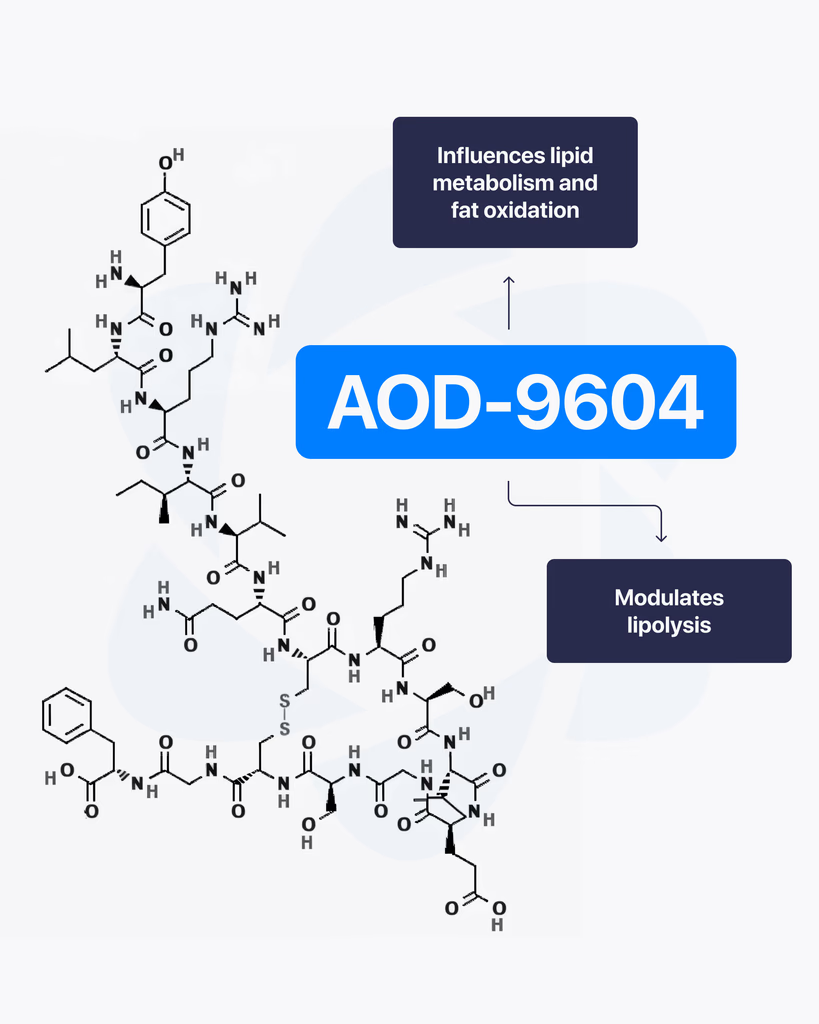
AOD-9604 is a hexadecapeptide engineered to replicate a specific functional segment of hGH — the lipolytic domain — without reproducing the full hormone’s growth-promoting or insulin-modulating activity. Researchers refer to the same molecule by several names: AOD-9604, AOD9604, hGH fragment 176-191, and (less commonly in current literature) hGH 177-191. The compound carries CAS Number 221231-10-3, a molecular formula of C₇₈H₁₂₃N₂₃O₂₃S₂, and a molecular weight of approximately 1,815.1 g/mol. Its PubChem CID is 71300630.
The molecule was synthesized to investigate whether the lipid-pathway-related activity of growth hormone could be isolated from its other endocrine effects. In animal model research conducted at Monash University and by Metabolic Pharmaceuticals, AOD-9604 was reported to induce changes in lipid metabolism without producing the IGF-1 elevation, glucose effects, or growth signaling associated with full-length hGH (Ng et al., 2000) PubMed: 11146367.
AOD-9604 Molecular Structure and Origin: The HGH Fragment 176-191
The full hGH molecule contains 191 amino acids. Early structure-activity research conducted in the 1980s and 1990s identified the C-terminal region — specifically residues 177–191, with a tyrosine added at position 176 to produce a stable hexadecapeptide — as the segment most associated with measurable lipid-pathway effects in vitro and in animal models. Metabolic Pharmaceuticals patented the resulting analogue, designated AOD-9604, in the late 1990s and advanced it through a series of pre-clinical and Phase I/II investigations between 2001 and 2007 (Stier et al., 2013) jofem.org.
A 2010 review of obesity pharmacology characterized AOD-9604 as an orally and parenterally bioavailable analogue of the hGH 177-191 region that demonstrated lipolytic activity in animal trials but produced limited efficacy signals in later-stage human studies (Isidro & Cordido, 2010). The compound’s clinical development as a therapeutic was discontinued in 2007 following Phase 2B trial outcomes that did not support commercial advancement (Valentino et al., 2010) PMC3136748.
For research-grade verification, the molecular structure is commonly confirmed by mass spectrometry (target m/z corresponding to the 1,815.1 g/mol molecular weight) and purity is quantified by reversed-phase HPLC against a reference standard. These methods, along with endotoxin and microbial testing, comprise the standard analytical panel applied to AOD-9604 batches sold for research use.
How Does AOD-9604 Work in Research Models?
The most-studied biochemical activity of AOD-9604 in pre-clinical models involves interaction with lipid-metabolism pathways in adipose tissue. Heffernan and colleagues, working at Monash University, examined chronic AOD-9604 administration in obese mice and in β3-adrenergic receptor knock-out mice. Their 2001 paper in Endocrinology reported that the compound produced effects on lipolytic sensitivity that appeared to depend at least partially on β3-adrenergic receptor signaling — a pathway distinct from the GH receptor — and did not measurably stimulate IGF-1 production (Heffernan et al., 2001) PubMed: 11713213.
A separate study by Ng and colleagues in Hormone Research examined AOD-9604 in obese Zucker rats, a standard rodent model in metabolic research, and reported observations consistent with isolated lipid-pathway activity in the absence of measurable somatogenic effects (Ng et al., 2000) PubMed: 11146367. Together, these foundational papers established the research framework in which AOD-9604 has subsequently been investigated.
It is important to note that the mechanism described in animal models has not translated into clinically meaningful human efficacy. The Phase 2B human trial conducted by Metabolic Pharmaceuticals between 2004 and 2007 did not produce results sufficient to support continued development, and AOD-9604 has not been approved by the FDA, EMA, or TGA for any therapeutic indication.
What Have Published Studies of AOD-9604 Examined?
The published literature on AOD-9604 spans roughly 25 years and includes pre-clinical animal studies, human safety trials, and more recent investigations in tissue research contexts.
Pre-clinical metabolic research
The earliest characterizations of AOD-9604 focused on lipid-pathway interactions in rodent models. Ng et al. (2000) and Heffernan et al. (2001) remain the most-cited references for the foundational pharmacology, and both papers are openly accessible through PubMed.
Human safety and tolerability research
Stier and colleagues published a 2013 review in the Journal of Endocrinology, Metabolism and Diabetes of South Africa summarizing six human clinical trials conducted between 2001 and 2006 involving 893 participants. The review reported that AOD-9604 was generally well-tolerated in short-term administration and did not produce clinically significant changes in IGF-1, glucose, or insulin parameters compared to placebo (Stier et al., 2013) jofem.org. A subsequent 2014 publication by Moré and colleagues reviewed long-term safety and genotoxicology data and reported no evidence of mutagenic or toxicological concerns within the parameters studied (Moré et al., 2014).
Cartilage and tissue research
More recent literature has examined AOD-9604 in the context of cartilage and connective tissue research. A 2026 review of therapeutic peptides in orthopaedic research models discussed AOD-9604 alongside other peptide fragments studied for their potential interactions with chondrocyte signaling and tissue maintenance pathways (Rahman et al., 2026) PMC12753158. This research direction remains preliminary, with most published work confined to in vitro and small-animal models.
Across all three research contexts, the published data is best characterized as exploratory. Sample sizes are limited, the body of human evidence is small, and no large-scale efficacy trials have been completed for any indication.
What Is AOD-9604’s Regulatory Status?
AOD-9604 is not approved by the U.S. Food and Drug Administration for any clinical use. It is not approved by the European Medicines Agency, Australia’s TGA, or any other major regulatory body as a therapeutic agent. Metabolic Pharmaceuticals discontinued its therapeutic development program in 2007.
The compound is listed on the World Anti-Doping Agency’s Prohibited List under category S2 (peptide hormones, growth factors, related substances and mimetics) and is banned for use in competitive athletics. Detection methods for AOD-9604 in anti-doping testing have been published in the analytical chemistry literature.
In the United States, AOD-9604 is supplied exclusively as a research chemical for in-vitro laboratory research conducted by qualified professionals. It is not intended for human or animal consumption, and OPTMZ Peptides supplies the compound under the Research Use Only classification consistent with FDA guidance on RUO labeling. The Stier et al. (2013) review remains the most comprehensive published source on the safety profile observed in completed human studies; researchers interested in the safety literature should consult that paper directly.
How Is AOD-9604 Verified for Research-Grade Purity?
For research conducted using AOD-9604, batch verification is the foundation of reproducibility. Without independently confirmed purity and identity, downstream experimental data cannot be reliably interpreted. OPTMZ Peptides has structured its quality system around this requirement.
Every batch of AOD-9604 supplied by OPTMZ Peptides is independently tested by Krause Analytical — a DEA-registered, ISO/IEC 17025-certified laboratory based in Austin, Texas. The standard analytical panel applied to each batch includes:
Reversed-phase HPLC for purity quantification against a reference standard
Mass spectrometry for identity confirmation against the expected 1,815.1 g/mol molecular weight
LAL endotoxin assay for bacterial endotoxin quantification
ICP-MS heavy metals testing for trace elemental contaminants
Microbial enumeration for bioburden assessment
pH stability assessment of the lyophilized material
Visual inspection for physical conformity
The current AOD-9604 batch in inventory (Batch 2026/02) returned an HPLC purity of 99.81%, exceeding the 98% minimum threshold OPTMZ requires for any batch to enter the catalog. Batches that do not meet the 98% threshold are rejected and never sold. Full Certificates of Analysis for current and prior batches are published in the OPTMZ COA Vault and are searchable by batch number printed on the vial label.
For researchers who want to verify the testing methodology in detail — including sample acquisition protocols, the chromatographic conditions used for HPLC analysis, and how to interpret a research-peptide COA — the OPTMZ How We Test page documents the full analytical workflow. This level of published, batch-level verification is uncommon among research peptide suppliers and is the basis of OPTMZ’s verified-first standard.
AOD-9604 Storage, Stability, and Reconstitution for Laboratory Research
AOD-9604 is supplied as a lyophilized (freeze-dried) white-to-off-white powder. Solid-state lyophilized peptides are generally more stable than reconstituted solutions, and proper handling extends usable shelf life within research applications.
Lyophilized storage: Unopened vials are most commonly stored at -20°C, protected from light and moisture. Under these conditions, lyophilized AOD-9604 is generally stable for the duration of typical research timelines. Repeated freeze-thaw cycles should be avoided.
Reconstitution: For research applications requiring solubilization, AOD-9604 is typically reconstituted in bacteriostatic water or sterile water for laboratory use. The exact concentration depends on the experimental design; researchers should consult relevant published methodology for the specific assay system in use.
Reconstituted storage: Once in solution, peptide stability is reduced. Reconstituted AOD-9604 is commonly stored at 2–8°C and used within a research-defined timeframe (typical handling literature suggests 14–30 days for similar peptide fragments, depending on assay sensitivity to degradation products). For longer-term storage of reconstituted material, aliquoting and freezing at -20°C or -80°C is the standard approach.
Net peptide content: Because purity is quantified as a percentage, the net peptide content of any vial is the labeled mass multiplied by the COA-reported purity. For a 5 mg vial of AOD-9604 at 99.81% purity (current batch), the net peptide content is approximately 4.99 mg. This calculation is relevant for researchers preparing concentration-dependent assays.
Where to Source Research-Grade AOD-9604 with Verified Purity
The research peptide supply market includes vendors of widely varying transparency. For research applications where reproducibility depends on confirmed purity and identity, the relevant evaluation criteria are documented batch testing by an independent laboratory, accessible historical Certificates of Analysis, and clear research-use-only positioning consistent with FDA RUO classification.
OPTMZ Peptides supplies research-grade AOD-9604 with batch-level verification by Krause Analytical and full COA publication for every batch in inventory and in the historical archive. Available formats include 5 mg single vials and 10-vial research packs. All orders ship from Austin, Texas via USPS Priority Mail, with same-day shipping on orders placed before 2:00 PM EST and free shipping on orders over $200.
Researchers who want to verify the purity of AOD-9604 sourced from a different supplier may also be interested in OPTMZ’s third-party peptide testing service, which performs independent HPLC and mass spectrometry analysis on submitted samples through the same Krause Analytical workflow.
Dr. Leonard Haberman is Chief Science Officer at OPTMZ Peptides, overseeing analytical quality assurance and third-party laboratory partnerships with a focus on HPLC-based purity verification and research-grade peptide compound validation. All research peptides sold by OPTMZ Peptides are intended strictly for laboratory research use only.