By Dr. Leonard Haberman, Chief Science Officer, OPTMZ Peptides Published April 2, 2026 · Last Updated April 16, 2026
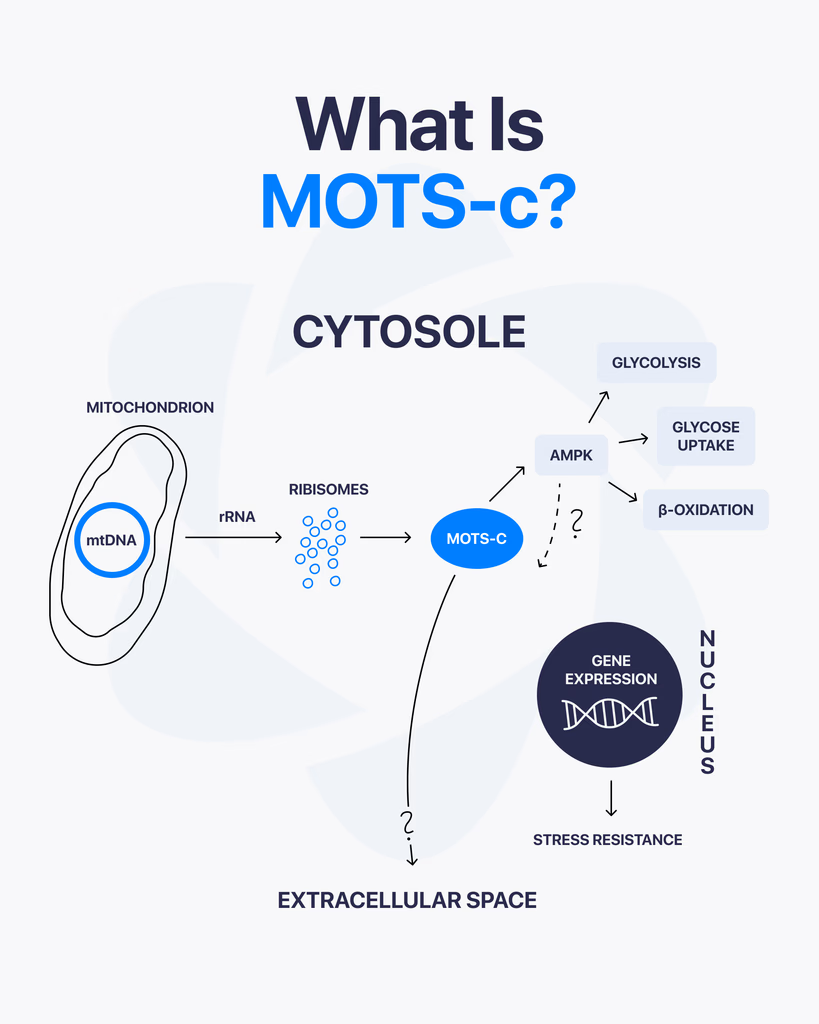
MOTS-c is a 16-amino-acid mitochondrial-derived peptide encoded within the 12S rRNA region of mitochondrial DNA, and it has emerged as a focus of laboratory research into cellular metabolism and mitochondrial signaling. Discovered in 2015 by Lee and colleagues, MOTS-c is one of a small but growing class of peptides that originate inside the mitochondria rather than the cell nucleus, which is why it draws sustained attention in research focused on bioenergetics, exercise physiology models, and aging-related cellular signaling pathways.
This page summarizes the published research literature on MOTS-c, the analytical specifications relevant to research-grade MOTS-c characterization, and the laboratory verification standards that apply to research peptide supply. All batch data referenced is independently verified by Krause Analytical, a DEA-registered, ISO/IEC 17025-certified laboratory in Austin, Texas.
What Is MOTS-c?
MOTS-c — Mitochondrial Open Reading Frame of the Twelve S rRNA-c — is a 16-amino-acid peptide with the sequence MRWQEMGYIFYPRKLR, encoded by a short open reading frame within the mitochondrial 12S rRNA gene. It belongs to a class of small mitochondrial-derived peptides (MDPs) that are translated from the mitochondrial genome rather than the nuclear genome (Lee et al., 2015 PMID: 25738459).
Three structural features make MOTS-c notable in the published literature:
-
Origin inside the mitochondrion. Unlike the majority of cellular peptides, which are encoded in nuclear DNA and trafficked to their site of action, MOTS-c is encoded directly within mitochondrial DNA.
-
Short sequence with documented bioactivity in pre-clinical models. Research has examined MOTS-c interaction with metabolic regulatory pathways, including AMP-activated protein kinase (AMPK) signaling in skeletal muscle cell models (Lee et al., 2015).
-
Detection in human plasma. Studies have measured circulating MOTS-c in human samples and reported its modulation by exercise in pre-clinical and translational research (Reynolds et al., 2021 PMID: 33473109).
How Is MOTS-c Different from Other Research Peptides?
Most research peptides supplied to laboratories — BPC-157, TB-500, GHK-Cu, and others — were either characterized from non-mitochondrial tissue or designed as synthetic analogues of nuclear-encoded signaling molecules. MOTS-c sits in a separate category: it is part of the mitochondrial-derived peptide (MDP) class, alongside humanin and the SHLP series.
The structural distinction matters in research because mitochondrial-derived peptides have been examined as potential signaling molecules between the mitochondrion and other cellular compartments — a process referred to in the literature as mitochondrial-to-nuclear retrograde signaling (Kong et al., 2023). This positions MOTS-c as a research target in two distinct lines of inquiry: classical metabolic signaling research, and the emerging field of mitochondrial communication biology.
What Does the Research Say About MOTS-c?
Published research on MOTS-c is concentrated in pre-clinical and in vitro models. The major research areas covered in peer-reviewed literature include:
Metabolic regulation in skeletal muscle models. The original Lee et al. (2015) paper reported that MOTS-c administration to murine models was associated with changes in glucose homeostasis and skeletal muscle glucose uptake, with a proposed mechanism involving AMPK pathway activation. Subsequent reviews have summarized this body of work and identified skeletal muscle as a primary research target tissue (Zheng et al., 2023 PMC9905433).
Exercise-responsive expression. Reynolds and colleagues (2021) characterized MOTS-c expression patterns in response to exercise in murine and human samples, reporting that MOTS-c is responsive to acute exercise stimuli. The study examined MOTS-c expression in skeletal muscle and serum across multiple experimental conditions.
Aging-related cellular signaling research. Review literature has examined MOTS-c in the context of aging-related cellular pathways, including pre-clinical investigations relevant to neurodegenerative, cardiovascular, and metabolic disease research models (Kong et al., 2023). It is important to note that this research is descriptive of laboratory observations, not therapeutic claims.
Energy homeostasis in metabolic dysfunction models. A 2025 study by Pham and colleagues examined MOTS-c administration in laboratory models of metabolic dysfunction, reporting effects on energy homeostasis markers and muscle function in the experimental system (Pham et al., 2025).
What current research does not establish: clinical efficacy in human populations, validated dosing protocols, long-term safety profiles, or any therapeutic application. Researchers reviewing this literature should treat all published data as descriptive of laboratory experimental systems.
How Is MOTS-c Studied in Laboratory Research?
Research-grade MOTS-c is typically supplied as a lyophilized powder produced by solid-phase peptide synthesis (SPPS), the standard methodology for laboratory peptide production. Laboratory protocols described in published research generally involve:
Reconstitution in bacteriostatic or sterile water for in vitro experimental use
Storage of lyophilized material at -20°C or below to preserve structural integrity
Use within defined stability windows after reconstitution (typically 14–30 days at 2–8°C, depending on protocol and ambient handling conditions)
HPLC and mass spectrometry verification of purity and identity prior to experimental use
For research-grade MOTS-c sourced from suppliers, the most important verification step is review of the batch-specific Certificate of Analysis (COA). A complete COA documents purity by HPLC, identity confirmation by mass spectrometry, endotoxin levels, and the testing laboratory and date.
What Are the Technical Specifications of Research-Grade MOTS-c?
The following analytical specifications apply to research-grade MOTS-c characterization:
|
Specification |
Value |
|
Amino acid sequence |
MRWQEMGYIFYPRKLR (16 residues) |
|
CAS Number |
1627580-64-6 |
|
Molecular formula |
C₁₄₉H₂₆₀N₄₆O₄₆S₂ |
|
Molecular weight |
2171.5 g/mol |
|
PubChem CID |
91808068 |
|
Synthesis method |
Solid-phase peptide synthesis (SPPS) |
|
Form supplied |
Lyophilized powder |
|
Recommended storage (lyophilized) |
-20°C, protected from light |
|
Recommended storage (reconstituted) |
2–8°C, use within 14–30 days |
|
Solubility |
Bacteriostatic water, sterile water |
Researchers requiring batch-specific analytical data — including the actual purity percentage, identity confirmation chromatogram, and endotoxin results for a specific lot — should consult the relevant Certificate of Analysis. OPTMZ publishes COAs for every batch in the Lab Results archive.
How Is MOTS-c Purity Verified for Research Use?
The minimum purity standard applied to research peptide supply varies by vendor. OPTMZ rejects any MOTS-c batch testing below 98% by HPLC; current batches typically test in the 98.5–99.9% range. Verification at the supplier level involves a defined panel of analytical tests:
HPLC (high-performance liquid chromatography) quantifies the percentage of the target peptide relative to total peptide content. This is the primary purity measurement.
Mass spectrometry confirms the molecular weight matches the expected MOTS-c sequence (2171.5 g/mol).
Endotoxin testing (LAL) measures bacterial endotoxin contamination — relevant for any research model where endotoxin is a confounding variable.
Heavy metals testing (ICP-MS) screens for synthesis residues at trace levels.
Microbial testing screens for bacterial and fungal contamination.
OPTMZ’s complete testing protocol — including the seven-method analytical panel and the laboratory partnership with Krause Analytical — is documented separately. Each Certificate of Analysis lists the specific batch number, test date, methods used, and results, and is published at the public COA Vault where it remains accessible by batch number indefinitely.
What Are the Limitations of Current MOTS-c Research?
Researchers reviewing the MOTS-c literature should note several documented limitations of the current evidence base:
Pre-clinical and in vitro dominance. The majority of published MOTS-c research uses cell culture systems, murine models, or limited human sample analyses. Large-scale controlled human research is not present in the published literature.
Heterogeneous experimental designs. Published studies use varying MOTS-c concentrations, exposure durations, and model systems. Direct comparison between studies requires careful attention to experimental conditions.
Mechanism characterization is incomplete. While AMPK pathway involvement has been reported, the full receptor and signaling characterization of MOTS-c is an active research area, not a settled question (Zheng et al., 2023).
Stability and pharmacokinetics in research contexts. The half-life and stability profile of MOTS-c in different experimental systems remains a subject of ongoing investigation.
These limitations do not diminish the research interest in MOTS-c — they define the boundaries within which current observations should be interpreted.
How Should Research-Grade MOTS-c Be Handled and Stored?
Research-grade MOTS-c is handled under standard peptide laboratory protocols. The compound should be received and stored at -20°C in its lyophilized form. Upon reconstitution with bacteriostatic or sterile water, the resulting solution should be stored at 2–8°C and used within the defined stability window (typically 14–30 days, depending on the protocol).
All handling, reconstitution, and experimental use should be conducted by qualified researchers in appropriately equipped laboratory facilities. Bacteriostatic water for reconstitution is supplied separately for laboratory use; researchers should confirm that the reconstitution diluent is appropriate for their specific experimental application.
For batch-level handling notes, the Certificate of Analysis for the specific lot supplied includes any handling considerations identified during analytical testing.
About research-grade supply: OPTMZ Peptides supplies research-grade MOTS-c verified by Krause Analytical, a DEA-registered, ISO/IEC 17025-certified laboratory. Every batch is tested by HPLC, mass spectrometry, endotoxin (LAL), heavy metals (ICP-MS), and microbial assays before release. Certificates of Analysis are published in the public COA Vault, searchable by batch number printed on each vial label. View the MOTS-c product page for current batch specifications and analytical data.
Dr. Leonard Haberman is Chief Science Officer at OPTMZ Peptides, overseeing analytical quality assurance and third-party laboratory partnerships with a focus on HPLC-based purity verification and research-grade peptide compound validation. All research peptides sold by OPTMZ Peptides are intended strictly for laboratory research use only.